10 Major Players in the Private Sector Space Race
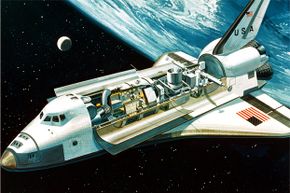
Oh man, it was sad when Atlantis touched down after its final mission. Never fear. We'll be heading back. We'll just be hitching a different ride.
Joe Raedle/Getty Images
10 Major Players in the Private Sector Space Race
Just as globalization transformed the economic landscape for corporations and consumers, the new space race is redefining how people and cargo are lifted aloft. Gone is the (light)saber-rattling between two Cold War superpowers, supplanted by a global horse race in which countries and companies vie to win, place or show in the suborbital track.
The advent of privatized rockets and space stations opens up orbital access to nations, businesses and even people, provided they can afford the fees. Why risk economic and political capital on a costly, chancy and technically challenging space program when, for a relative pittance, you can flag down a space taxi, book lodging in a space station or secure cargo room for your satellite, experiment or instruments on a futuristic cargo van?
It's not a rhetorical question. With more than a dozen Russian launch problems in 2011, with the Obama administration's cancellation of the Ares I rocket, and with its replacement, the Space Launch System, becalmed in uncertain political waters, the former space superpowers have opened up a gap in the market that the commercial space sector is poised to fill.
The next decade may well be for the space race what the late 1990s and early 2000s were for the Internet: a time of uncertainty, ebullient creativity and, ultimately, economic reality -- a game of musical chairs in which contestants struggle to secure their seats before the venture capital runs out.
Dozens of companies are jockeying for position in the new space race. Read on to see our picks for who outclasses the field, who is coming strong in the turn and who has the best track record.
N Marks the Spot
The N-Prize, established by Cambridge biologist Paul H. Dear in 2008, is "a challenge to launch an impossibly small satellite into orbit on a ludicrously small budget, for a pitifully small cash prize."
It's all about the nines: The N-Prize will award 9,999.99 pounds (around $15,000) to the two different teams that can launch a satellite weighing between 9.99 and 19.99 grams (0.35 and 0.71 ounces, the weight of 2-4 quarters) into Earth orbit at an altitude of at least 99 kilometers (about 61.5 miles) for a minimum of nine successful orbits, and pull it off for less than 999.99 pounds (around $1,500), before Sept. 19, 2012 [source: N-Prize].
"Imaginative use of string and chewing gum is encouraged," according to the Web site.
10: The X Prize and Other Awards
Sometimes, inspiring excellence and innovation means setting an audacious goal and backing it up with a pile of cash. The Longitude Act of 1714, which offered 20,000 pounds (roughly $19 million in 2012 dollars) for an accurate means of finding longitude, revolutionized travel by sea; the Orteig Prize spurred Charles Lindbergh's record-setting nonstop flight from New York to Paris in 1927.
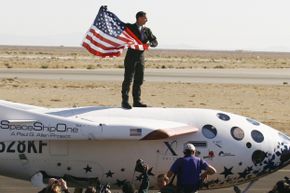
It was in this spirit that the nonprofit X Prize Foundation established the Ansari X Prize for affordable spaceflight, which parlayed an award of $10 million into more than $100 million in commercial space development [source: X Prize Foundation].
Aerospace engineer Burt Rutan and his financial backer, Microsoft co-founder Paul Allen, won the prize in 2004 for being the first private team to "build and launch a spacecraft capable of carrying three people to 100 kilometers above the Earth's surface, twice within two weeks" [source: X Prize Foundation]. Rutan, who earlier in his career designed the first plane to fly around the world without stopping or refueling, has subsequently helped Virgin Galactic develop its passenger space plane system.
Examples of other awards helping to drive the space industry include NASA's Centennial Challenges program, which provides $200,000-$2 million for innovations in areas of agency interest (such as wireless power transmission, nanosatellites and cables with mind-blowing strength-to-weight ratios) and the Heinlein Prize, honoring the eponymous science fiction author, which rewards progress in commercial space activities.
These prizes, small compared to the potential impact they can generate, could provide the grains of sand that agitate these oysters into growing pearls.
Now let's look at a private space company with an inflated sense of self.
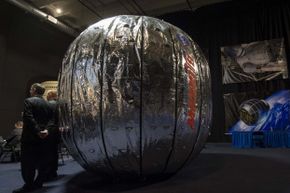
Bigelow's inflatables were inspired by TransHab (illustrated here), a NASA program that's no longer around.
Image courtesy NASA
9: Bigelow Aerospace
While the Henry Fords of the space age compete to build an affordable spaceship, Robert T. Bigelow is planning a place for passengers to hang their helmets: an inflatable, privately owned-and-operated space station.
Lightweight inflatables are a handy way to get around rockets' limited cargo space. NASA floated the idea for years; in fact, the design for Bigelow's billowing bungalows derives from NASA patents for TransHab, a resilient, inflatable habitat engineered for possible applications on Mars, the moon or the International Space Station (ISS).
Bigelow has already placed two unmanned stations in orbit, and plans to construct another in 2014, populate it in 2015, and launch another, larger station in 2016. Individual habitats sport a spacious volume of 6,357 cubic feet (180 cubic meters), and the two stations together will house 36 people -- assuming Bigelow can round up rockets to carry them [source: Chang].
Just under $25 million per person reserves digs for 30 days, transportation included. That's about $34,700 per hour ($10 per second) -- 29 times the rate of the most expensive hotel room in the world, the Bridge Suite at the Bahamas Atlantis resort [source: Valhouli]. Still, it's a steal compared to the more than $50 million NASA pays to secure a single seat on a Soyuz spacecraft headed to the ISS [source: Moskowitz].
Prices should fall as the commercial rocket industry develops and spaceflight become cheaper. In the meantime, in exchange for a four-year commitment, you can reserve a six-person module for an annual lease of $395 million, including free taxi service for a dozen people per year (offer good through 2018) [source: Chang].
If all of that makes you feel like rocket ships are only for Rockefellers, read on.
Commercial Spaceflight Federation
The Commercial Spaceflight Federation is an industry group of more than 40 companies and organizations who pool their resources for the promotion of the private space industry. Commercial spaceflight developers, operators, spaceports and suppliers of mission support services, training, medical services and life-support products make up its roster, and its board is a veritable Who's Who of space entrepreneurs and CEOs, including several moguls mentioned in this list.
8: The Ultrawealthy
Where would outrageous capitalist ventures be without the wealthy?
Rich people don't just provide a market for $50,000 diamond-encrusted Bluetooth headsets; they're also the consumers who, back in 1984, bought the Motorola DynaTAC 8000X cell phone, a 2-pound (0.9-kilogram) brick costing $3,995 ($8,000-$11,000 in 2012 money). In other words, the cycle of development, improvement, marketing and sales that gradually produces smaller, better and cheaper products often begins with affluent early adopters.
For now at least, space tourism is the province of the Midases and market mavens among us. As of January 2012, only seven private citizens have flown to space on their own dime, and each shelled out tens of millions of dollars for his or her golden ticket to the International Space Station aboard a Russian rocket [source: Chang]. Nevertheless, their resolve to use their riches to reach space is an important indicator that a market exists and, perhaps, the start of the market cycle that one day brings us affordable spaceflight.
Meanwhile, who is building these space-based commercial ventures? You guessed it: the superrich, founders and CEOs of such companies as Microsoft, Amazon, PayPal and Virgin Records. So, as you read on, don't be surprised if you run across some familiar faces.
Speaking of which ...
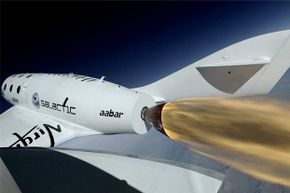
Are you going to sign up for a ride on SpaceShipTwo?
Photo courtesy Virgin Galactic
7: Virgin Galactic
When you think of space tourism, chances are good that Virgin Galactic springs to mind; after all, Virgin's owner, Richard Branson, is hardly a shrinking violet when it comes to self-promotion.
Here's a sneak peek at what to expect once the company starts taking passengers: After 2-3 days of preparation, travelers will board SpaceShipTwo, a 60-foot (18-meter), six-person rocket glider slung below VirginMothership Eve. This dual-fuselage aircraft, which stretches 140 feet (43 meters) from wingtip to wingtip, will climb to 50,000 feet (15,240 meters), from which SpaceShipTwo will rocket them past the edge of space (around 62 miles, or 100 kilometers) on a parabolic flight. After five minutes of weightlessness, the space plane will "feather," using drag to slow its re-entry to 70,000 feet (21,336 meters); from there it will glide to Earth and land airplane-style [sources: Chang].
Billionaire Branson's company has also inked cooperative agreements with Sierra Nevada Space Systems and Orbital Sciences Corp., possibly to act as a broker for spaceflights aboard their respective planned passenger craft, Dream Chaser and Prometheus [sources: Chang].
Travel agents are standing by to take your reservation. A mere $20,000 deposit secures your place alongside the 430 who have booked as of January 2012, but paying the full $200,000 bumps you into Boarding Group A [source: Chang]. Don't delay!
Being a billionaire is all well and good, but sometimes money is in short supply for startup companies. In this next section, we'll see how governments and space agencies can play a role in getting the private space sector off the ground.
Playing Capture the Flag
When the space shuttle Atlantis flew its final trip to the International Space Station, its crew left behind a prize -- and a goad for the U.S. space sector: an American flag that flew into space aboard Columbia during STS-1, the very first shuttle flight. The first American-made-and-launched spacecraft that flies Americans to the ISS will claim the flag.
6: Governments and Space Agencies
As we discussed in the X Prize section, splashing a little stake money around can generate remarkable ripples, inspiring companies to dedicate time, money and brainpower far beyond initial investments.
Few of the countries eyeing the space sector have the kind of deep pockets or political will needed to fund a national space program, so their governments are leveraging what they do have: namely, the ability to provide monetary incentives, the clout to gather key actors around the negotiating table and the savvy to combine brainpower and resources to good effect.
The European Space Agency, for example, leverages intellectual capital and research facilities from across Europe and encourages prominent, specialized companies and research groups to establish space clusters -- collaborations on space-related R&D projects.
NASA, too, helps bootstrap private enterprises, both through its Centennial Challenges and its collaborations with commercial space companies. Its Commercial Crew Initiative incentivizes space enterprises to design and build cheap space taxi services for astronauts and cargo.
The space agency already entered into billion-dollar contracts in 2008 with SpaceX and Orbital Sciences Corp. to ferry cargo to and from the International Space Station: eight flights from Orbital (valued at about $1.9 billion) and 12 flights from SpaceX (valued at about $1.6 billion) [source: NASA]. Given an economic crunch, and looming political and budgetary battles, will the funding continue, or will private companies have to leg it on their own?
Read on to find out about one NASA-funded company that's taking things one quiet step at a time.
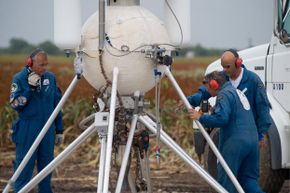
The Goddard test vehicle sits on a launch pad awaiting a test launch. Blue Origin built and tested Goddard as part of its New Shepard program.
Photo courtesy Blue Origin
5: Blue Origin
Ad astra per aspera (Latin for "To the stars, with difficulties") may be the Kansas state motto, but it might as well be NASA's for as often, and appropriately, the two are associated. How fitting, then, that a private spacecraft developer has done the phrase a more aggressive turn, choosing the motto gradatim ferociter, which (very roughly) deciphers as "step-by-step, fiercely."
That's the approach of Blue Origin, developer of the New Shepard vertical-takeoff-and-landing spacecraft: step by step, fiercely -- and secretly. The company, established by Amazon.com founder Jeff Bezos, has remained one of the most tight-lipped in the biz, raising the curtain (slightly) only when it was ready to test its nine-engined rocket pod prototype. Inspired by the old DC-X craft developed by McDonnell Douglass for NASA and the Defense Department, the ship is designed to carry a handful of astronauts on a suborbital ride into space.
Quiet as the company might be, its whispers been sufficient to make NASA sit up and take notice. The space agency has ponied up $22 million in second-round Commercial Crew Development funding for the strut-legged craft, on top of the $3.7 million in first-round funding it awarded Blue Origin earlier to support development of a Launch Escape System (LES) and a composite crew module pressure vessel for structural testing.
Now let's see if another group of companies is living up to one their mottos, "Forever New Frontiers."
Just Like Heathrow But With Space Planes
For commercial space really to get off the ground, all of those rocket pods and space planes will need places to take off and land, but substantial legal ramifications regarding launching humans and cargo into space await resolution before a private version of Kennedy Space Center, Baikonur Cosmodrome or Jiuquan Launch Center can proceed.
For now, companies like Boeing and SpaceX are turning to NASA's two Space Coast facilities to handle their traffic, while Virgin Galactic and UP Aerospace enter into leases with New Mexico's Spaceport America which, like an airport, is owned by the state.
4: Lockheed Martin, Boeing and United Launch Alliance
Much of the attention in the new space race has been focused on old hands like Lockheed Martin and Boeing, both of whom boast five-decade-long track records building airplanes and spacecraft with NASA [sources: Chang; NASA]. Not surprisingly, the two legacies remain major players.
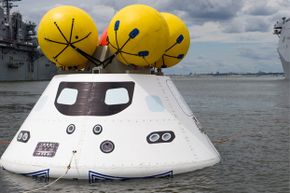
Lockheed Martin -- which has built every aeroshell flown by NASA to Mars, from Viking to the Curiosity rover -- was responsible for two spacecraft inserted into lunar orbit in January 2012, and is developing the Orion crew capsule for NASA's Space Launch System [source: Lockheed Martin].
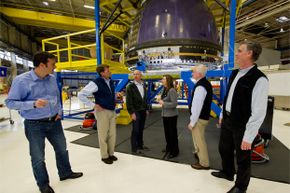
In October 2011, Boeing signed a 15-year lease to use a space shuttle hangar at Kennedy Space Center to build and oversee its Crew Space Transportation-100 (CST-100) spacecraft. NASA has funded the ship via its Commercial Crew Development program to the tune of $110 million.
Meanwhile, United Launch Alliance, a joint venture of Boeing and Lockheed Martin, continues to build Atlas V rockets, the platform on which several commercial ventures plan to launch their space planes or crew capsules. The mainstay rocket all but guarantees United Launch Alliance a future place at the table.
The question is, will such strong ties to the old guard -- and the old school -- help carry the companies to the stars, or strap them to a sinking ship?
To help answer that, let's look at how another old government sector workhorse has changed with the times: by spawning a yearling space company.
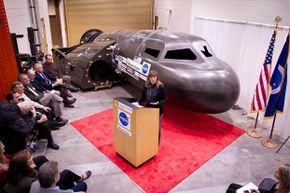
The Dream Chaser under development in February 2011
Bill Ingalls/NASA via Getty Images
3: Sierra Nevada Space Systems
Consult your racing forms, ladies and gentlemen, because here comes the dark horse, gaining ground at the outside turn. Its bloodline is strong. Its sire, the thoroughbred Sierra Nevada Corp., has manufactured defense electronics since 1963 and, as of 2011, remained the American pack leader in fabricating small satellites [source: Chang].
Sierra Nevada's main brainchild is the Dream Chaser, a commercial crew vehicle for ferrying up to seven astronauts and cargo to and from the International Space Station. The company hopes that the reusable mini-shuttle, which will launch via rocket and land like an airplane, will stake out a sizable plot of the space tourism and commerce real estate.
To negotiate the jump from small satellites to crewed spacecraft, Sierra Nevada has assembled a dream team: Draper Laboratory, an Apollo legacy organization with extensive experience in spacecraft guidance systems; NASA's Langley Research Center, whose inquiry into the Bor-4 Soviet design provided the basis for Dream Chaser; Boeing, with its long aeronautical and astronautical design legacy; and United Launch Alliance, maker of the Atlas V rocket that will carry Dream Chaser aloft [source: Chang].
Sierra Nevada must be doing something right: In 2010, the company netted $20 million out of an available $50 million in NASA funding for preliminary development; in 2011, NASA added another $80 million in second-round funding.
A good pedigree is well and good, but our next contestant has made bona fide space history -- and is aiming to do so again in 2012.
Fancy a ride in the Dragon spacecraft? The capsule and trunk are pictured here, with the solar panels deployed.
Image courtesy Space Exploration Technologies Corporation
2: Space Exploration Technologies Corp. (SpaceX)
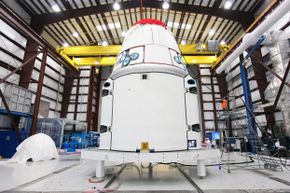
On Dec. 8, 2010, Space Exploration Technologies Corporation, or SpaceX, launched the first privately owned ship ever to return safely from Earth orbit. The Dragon capsule, propelled to space atop a two-stage SpaceX Falcon 9 rocket, had just made history, but its brash, young founder, PayPal entrepreneur and Tesla motors CEO Elon Musk, didn't rest on his laurels: Not long after, he made the surprising claim that, within three years, the company could send astronauts to space at $20 million a pop.
Can Musk make good on his assurances that SpaceX can easily convert the Dragon cargo container into a seven-seat space minivan? Experts are skeptical. After all, transitioning a pod from cargo hauler to crew cab requires more than bolting in some bucket seats and wiring up a climate control system.
SpaceX's late disclosure of engine overheating issues experienced during the December 2010 test flight has fueled further criticism [source: Kramer].
Whether Musk makes his deadline or not, SpaceX's successes thus far, added to its $1.6 billion contract with NASA to haul cargo to the International Space Station (ISS), equate to a major player in the commercial space race. In fulfilling the contract, the company hopes to set another record, by becoming the first private space company to send an uncrewed spacecraft to the ISS in late March 2012 [source: MSNBC].
SpaceX isn't the only company planning its first trip to the ISS in 2012, however.
That's one of Orbital Sciences' rockets, the Taurus XL, getting prepped before carrying NASA's Glory satellite into low-Earth orbit.
Photo courtesy NASA/Randy Beaudoin
1: Orbital Sciences Corp.
The Virginia-based Orbital Sciences Corp. does it all, from launch vehicles, to satellites and space systems, to advanced space programs. Its clientele encompasses the commercial, military and civil government sectors, including NASA, with whom it has secured a $1.9-billion contract to fly eight cargo missions to the International Space Station (ISS).
Open Orbital's catalog of space products and you'll find small- and medium-class rockets, along with launch services covering orbiting satellites, deep space probes and payload deliveries to high altitudes. The company plans to send its first rocket delivery van to the ISS late in 2012 [source: MSNBC].
Like others embarked on the rough road to space, the company has suffered its share of setbacks: In June 2011, an engine caught fire during a ground test and, in April of that year, NASA's Commercial Crew Development program bypassed funding its Prometheus space plane, which could force the company to back away from the project [source: Kramer and Chang].
Still, as the contenders in the new space race round the first turn, Orbital remains strong in the pack. By maintaining a stake in NASA's Orion crew capsule, for which it is developing a launch abort system, it has not only positioned itself well for future dealings with the space agency, it has also hedged its bets across public and private space sectors.
Orbital, a survivor of fickle space budgets since 1982, knows when to hold 'em and when to fold 'em. It's a lesson worth learning for any challenger who wants to survive and thrive in the new space age.
Lots More Information
Related Articles
- Behind the X Prize
- How Astronauts Work
- How could a hotel orbit the Earth?
- How the Google Lunar X Prize Works
- How Rocket Engines Work
- How Space Shuttles Work
- How Virgin Galactic Works
- How will Blue Origin work?
- Our Top 10 Stops for a Space Program Road Trip
- Will humans be living in space in the next 50 years?
More Great Links
- Blue Origin
- Heinlein Prize Trust
- NASA Centennial Challenges
- Northrop Grumman Lunar Lander X Challenge
- Open Source Aerospace Project
Sources
- Associated Press. "First Cell Phone a True 'Brick.'" MSNBC. April 11, 2005. (Jan. 17, 2012) http://www.msnbc.msn.com/id/7432915/ns/technology_and_science-wireless/t/first-cell-phone-true-brick/#.Tx2baW9SSP0
- Blakeslee, Sandra. "Plane Reaches Pacific Coast as it Aims for World Record." The New York Times. Dec. 23, 1986. (Jan. 18, 2012) http://www.nytimes.com/1986/12/23/us/plane-reaches-pacific-coast-as-it-aims-for-world-record.html?ref=burtrutan
- Chang, Kenneth. "Adding Rocket Man to His Résumé." The New York Times. Feb. 15, 2010. (Jan. 16, 2012) http://www.nytimes.com/2010/02/16/science/16elon.html?pagewanted=all
- Chang, Kenneth. "Businesses Take Flight, with Help from NASA." The New York Times. Jan. 31, 2011. (Jan. 16, 2012) http://www.nytimes.com/2011/02/01/science/space/01private.html?ref=orbitalsciencescorporation
- Chang, Kenneth. "Booking a Flight to Space, With Travel Insurance." The New York Times. Jan. 3, 2012. (Jan. 16, 2012) http://www.nytimes.com/2012/01/04/science/space/spaceflights-prepare-to-expand-customer-base.html?scp=1&sq=virgin%20galactic&st=cse
- Chang, Kenneth. "House Panel's NASA Bill Cuts Back Obama Plan." The New York Times. July 20, 2010. (Jan. 17, 2012) http://www.nytimes.com/2010/07/21/science/space/21nasa.html?scp=1&sq=House%20Panel's%20NASA%20Bill%20Cuts%20Back%20Obama%20Plan&st=cse
- Chang, Kenneth. "In New Space Race, Enter the Entrepreneurs." June 7, 2010. (Jan. 16, 2012) http://www.nytimes.com/2010/06/08/science/space/08space.html?pagewanted=all
- Dean, James. "NASA Awards $270 Million for Commercial Crew Efforts." Florida Today. April 18, 2011. (Jan. 17, 2012) http://space.flatoday.net/2011/04/nasa-awards-270-million-for-commercial.html
- Dear, Paul H. "N-Prize: There's Plenty of Room at the Bottom at the Top." Halfbakery. Feb. 13, 2008. (Jan. 18, 2012) http://www.halfbakery.com/idea/N-Prize#1203710516
- Dunn, Marcia. "Space Shuttle Makes Final Departure From Space Station." Associated Press. July 19, 2011. (Jan. 19, 2012) http://www.msnbc.msn.com/id/43803573/ns/technology_and_science-space/t/space-shuttle-makes-final-departure-space-station/#.Tx3bOm9SSP0
- Fought, Bonnie E. "Legal Aspects of the Commercialization of Space Transportation Systems." Berkeley Technology Law Journal. Vol. 3, No. 1. Spring 1988. (Jan. 19, 2012) http://btlj.org/data/articles/vol3/fought.pdf
- Kramer, Andrew E. and Kenneth Chang. "A Setback Could Force NASA to Bid for a Plan B." Sept. 13, 2011. (Jan. 18, 2012) http://www.nytimes.com/2011/09/14/world/europe/fears-over-soyuz-again-delay-space-launch.html
- Lockheed Martin Space Systems. "Lockheed Martin and NASA Place Two GRAIL Spacecraft Into Orbit Around the Moon." Jan. 1, 2012. (Jan. 18, 2012) http://www.prnewswire.com/news-releases/lockheed-martin-and-nasa-place-two-grail-spacecraft-into-orbit-around-the-moon-136511093.html
- Lockheed Martin Space Systems. "NASA'S Mars Science Laboratory Lifts Off, Protected by Lockheed Martin-Built Aeroshell." Nov. 26, 2011. (Jan. 18, 2012) http://www.lockheedmartin.com/us/news/press-releases/2011/november/NASASMarsScienceLaborator.html
- McDougal, Myres S. and Leon S. Lipson. "Perspectives for a Law of Outer Space." Faculty Scholarship Series. Paper 2618. 1958. (Jan. 19, 2012) http://digitalcommons.law.yale.edu/fss_papers/2618
- Miles, Stuart. "$50,000 Plantronics Bluetooth Headset Announced." Pocket Lint. Feb. 16, 2009. (Jan. 16, 2012) http://www.bornrich.com/entry/diamond-encrusted-bluetooth-headset-from-plantronics-worth-50000/
- Moskowitz, Clara. "NASA Signs New $335 Million Deal to Fly Astronauts on Russian Spaceships." Space.com. April 6, 2010. (Feb. 1, 2012) http://www.space.com/8158-nasa-signs-335-million-deal-fly-astronauts-russian-spaceships.html
- Moskowitz, Clara. "Virgin Galactic Picks Air Force Pilot to Fly Private Spaceship." Nov. 2, 2011. (Jan. 17, 2012) http://www.msnbc.msn.com/id/45133123/ns/technology_and_science-space/t/virgin-galactic-picks-air-force-pilot-fly-private-spaceship/#.TyA30G9SSP0
- MSNBC. "SpaceX Plans to Mark 'Year Of The Dragon' with a Big Blast." Jan. 23, 2012. (Jan. 24, 2012) http://www.msnbc.msn.com/id/46107436/ns/technology_and_science-space/#.TyB5qm9SSP0
- NASA. "Boeing to Build Commercial Spacecraft at Kennedy, Create 550 Jobs." Oct. 31, 2011. (Jan. 16, 2012) http://www.nasa.gov/exploration/commercial/OPF_Boeing.html
- NASA. "Centennial Challenges Summary." Nov. 1, 2011. (Jan. 17, 2012) http://www.nasa.gov/offices/oct/early_stage_innovation/centennial_challenges/history/index.html
- NASA. "NASA and Lockheed Martin: Partners in C-130 Technology." November 1998. (Jan. 18, 2012) http://www.nasa.gov/centers/langley/news/factsheets/C130.html
- NASA. "NASA Announces Commercial Crew Initiative Forum." Aug. 13, 2010. (Jan. 17, 2012) http://www.nasa.gov/home/hqnews/2010/aug/HQ_M10-115_Commercial_Crew_Forum.html
- NASA. "NASA Awards Second Round of Development Awards." April 20, 2011. (Jan. 17, 2012) http://www.nasa.gov/offices/c3po/home/ccdev2award.html
- NASA. "NASA Awards Space Station Commercial Resupply Services Contracts." Dec. 23, 2008. (Jan. 16, 2012) http://www.nasa.gov/home/hqnews/2008/dec/HQ_C08-069_ISS_Resupply.html
- NASA. "NASA's Centennial Challenges Collaborates With Foundation." Oct. 11, 2005. (Jan. 17, 2012) http://www.nasa.gov/home/hqnews/2005/oct/HQ_05341_Centennial_Challenges.html
- Orbital Sciences Corp. "Orbital Announces the Closing of its Acquisition of General Dynamics' Satellite Development and Manufacturing Business." April 2, 2010. (Jan. 18, 2012) http://www.orbital.com/NewsInfo/release.asp?prid=725
- Orbital Sciences Corp. "Orbital Selected by NASA for $1.9 Billion Space Station Cargo Delivery Contract." Dec. 23, 2008. (Jan. 17, 2012) http://www.orbital.com/NewsInfo/release.asp?prid=680
- Potter, Ned. "SpaceX Falcon 9 Rocket Flies Safely." ABC News. Dec. 8, 2010. (Jan. 16, 2012) http://abcnews.go.com/Technology/spacex-falcon-launch-successful-privately-owned-spacecraft-return/story?id=12345299#.TxnIwG9SSP1
- Royal Naval Museum Library. "John Harrison and the Finding of Longitude." 2004. (Jan. 18, 2012) http://www.royalnavalmuseum.org/info_sheets_john_harrison.htm
- Schrader, Ann. "NASA Chief Inspects Orion Crew Vehicle at Lockheed Martin Facility in Littleton, Colo." The Denver Post. Jan. 11, 2012. (Jan. 17, 2012) http://www.denverpost.com/business/ci_19716485
- Schwartz, John. "A Secretive Aerospace Company Sheds a Bit of Light on its Rocket Program." The New York Times. Jan. 9, 2007. (Jan. 17, 2012) http://www.nytimes.com/2007/01/09/science/space/09rock.html?scp=1&sq=Blue%20Origin&st=cse
- Shostak, Seth. "Where Does 'Outer Space' Begin?" MSNBC. June 25, 2004. (Jan. 16, 2012) http://www.msnbc.msn.com/id/5287945/ns/technology_and_science-space/t/where-does-outer-space-begin/#.Tx2iY29SSP0
- Sierra Nevada Corp. "Space Systems. Space Exploration Systems: Dream Chaser (brochure)." (Jan. 17, 2012) http://sncspace.com/uploads/brochures/Dream_Chaser.pdf
- Sobel, Dava. "Longitude: The True Story of a Lone Genius Who Solved the Greatest Scientific Problem of His Time." Walker & Company. Oct. 30, 2007.
- Valhouli, Christina. "The World's Most Expensive Hotel Rooms." Forbes. 2002. (Jan. 26, 2012) http://www.forbes.com/2002/03/07/0307feat.html
- X Prize Foundation. "Ansari X Prize." 2011. (Jan. 18, 2012) http://space.xprize.org/ansari-x-prize