There was no problem with the choice of a timing element. The quartz crystal is possibly thousands of times better for timing than the tuning fork, and quartz crystals had been around for many years. Only the type and the frequency of the crystal needed to be chosen. The difficulty was in the selection of the integrated circuit technology that would function at sufficiently low power.
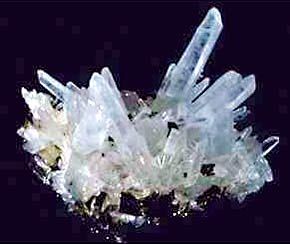
Quartz crystals have been in regular use for many years to give an accurate frequency for all radio transmitters, radio receivers and computers. Their accuracy comes from an amazing set of coincidences: Quartz — which is silicon dioxide like most sand — is unaffected by most solvents and remains crystalline to hundreds of degrees Fahrenheit.
The property that makes it an electronic miracle is the fact that, when compressed or bent, it generates a charge or voltage on its surface. This is a fairly common phenomenon called the Piezoelectric effect. In the same way, if a voltage is applied, quartz will bend or change its shape very slightly.
If a bell were shaped by grinding a single crystal of quartz, it would ring for minutes after being tapped. Almost no energy is lost in the material. A quartz bell — if shaped in the right direction to the crystalline axis — will have an oscillating voltage on its surface, and the rate of oscillation is unaffected by temperature. If the surface voltage on the crystal is picked off with plated electrodes and amplified by a transistor or integrated circuit, it can be re-applied to the bell to keep it ringing.
A quartz bell could be made, but it is not the best shape because too much energy is coupled to the air. The best shapes are a straight bar or a disk. A bar has the advantage of keeping the same frequency provided the ratio of length to width remains the same.
A quartz bar can be tiny and oscillate at a relatively low frequency — 32 kilohertz (KHz) is usually chosen for watches not only for size, but also because the circuits that divide down from the crystal frequency to the few pulses per second for the display need more power for higher frequencies. Power was a big problem for early watches, and the Swiss spent millions trying to bring forward integrated-circuit technology to divide down from the 1 to 2 MHz the more stable disk crystals generate.
Modern quartz timepieces now use a low-frequency bar or tuning-fork-shaped crystal. Often, these crystals are made from thin sheets of quartz plated like an integrated circuit and etched chemically to shape.
The major difference between good and indifferent time keeping is the initial frequency accuracy and the precision of the angle of cut of the quartz sheet with respect to the crystalline axis. The amount of contamination that is allowed to get through the encapsulation to the crystal surface inside the watch can also affect the accuracy.
The electronics of the quartz movement initially amplifies noise at the crystal frequency. This builds or regenerates into oscillation — it starts the crystal ringing. The output of the watch crystal oscillator is then converted to pulses suitable for the digital circuits.
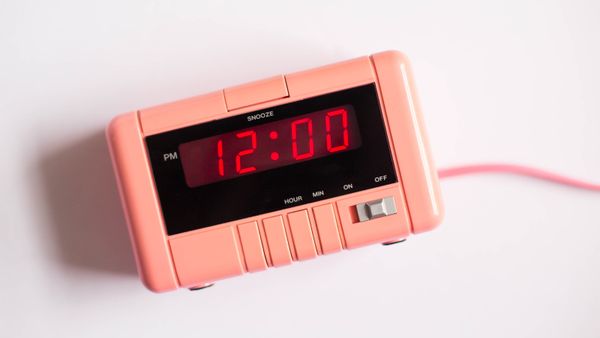
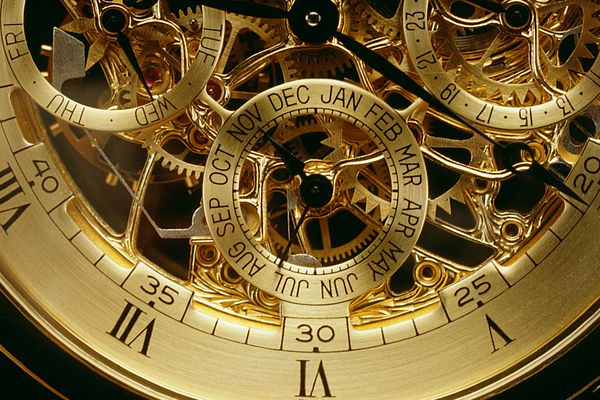
These divide the crystal's frequency down and then translate it into the proper format for the display. (See How Digital Clocks Work for a detailed discussion of dividers and display drivers.) Or, in a quartz watch with hands, the dividers create one-second pulses that drive a tiny electric motor, and this motor is connected to standard gears to drive the hands.