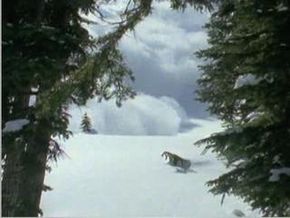
Introduction to How Avalanches Work
|
Avalanches can be surprising, sublimely beautiful and deadly. They can sweep trains off their tracks, crush buildings, uproot trees and bury people. Some avalanches have even covered entire houses with people still inside them. Even though movies and news reports say that they "strike without warning," most deadly avalanches start when victims trigger them.
So what do you do if you're caught in an avalanche? How can you stay alive, and what does it take to rescue people who've been buried in the snow? In this article, you'll learn how avalanches form and what triggers them. You'll also learn how to survive and how to rescue others.
The Properties of Snow
To understand how avalanches form, you need to understand the properties of snow crystals. Depending on the temperature, humidity and other atmospheric conditions, snow crystals can have a variety of shapes, but all are generally hexagonal or six-pointed.
![]() Photo courtesy Beltsville USDA Agricultural Research Center A six-pointed snow crystal, viewed through a scanning electron microscope. |
In areas that get a lot of snow, the snow on the ground forms a snowpack. The layers within the snowpack have different qualities due to the shapes of the crystals in the layer. For example, six-pointed crystals can interlock more easily than needle-shaped crystals, so they create a steadier layer. On the other hand, when super-cooled water comes into contact with snow crystals in the air, it creates rime. Heavy rime deposits can cause pellet-like snow called graupel, which creates a very unstable layer.
Snowpack layers also have different qualities because of changes that take place once the snow is on the ground. Changes in the weather lead to changes on the snowpack's surface.
- If the top of the snowpack melts and re-freezes, it can form a layer of slick ice.
- If air just above the snowpack reaches the dew point, the snowpack can develop hoar, which is a light, feathery crystal that does not bond well to snow.
- If the top of the snowpack freezes and thaws repeatedly, it can develop clusters of frozen particles with space in between, which creates an unstable surface for the next layer of snow.
![]() Photo courtesy Beltsville USDA Agricultural Research Center A hexagonal snow crystal with rime along its edge. |
Changes within the snow pack take place due to the temperature gradient -- the difference in temperature between the upper and lower layers. The snow near the bottom is relatively warm (close to 0° Celsius/32° Fahrenheit) because of residual heat from the ground. The temperature in the upper layers depends on the temperature of the air. Snowflakes within the snowpack undergo different types of metamorphosis depending on the size of the temperature gradient.
In snowpacks with a high temperature gradient -- a large difference in temperature -- crystals tend to develop facets. The flat surface of a facet cannot bond well to other surfaces. Heavily faceted crystals located deep in the snowpack are called depth hoar and create dangerous instability.
![]() Photo courtesy Beltsville USDA Agricultural Research Center Depth hoar crystal. These crystals cannot bond well to one another and create instability in the snowpack. |
On the other hand, low temperature gradients and consistent sub-freezing temperatures cause rounding, which allows crystals to compress more tightly. The exchange of water vapor during rounding also creates bridges between crystals and parts of crystals, creating a firm, stable snowpack.
![]() Photo courtesy Beltsville USDA Agricultural Research Center A rounded snow crystal that has spent several days in the snowpack. |
Regardless of whether they are the result of temperature gradients, atmospheric conditions during snowfall or melting and refreezing, strong and weak layers of snow make avalanches possible. Next, we'll look at how avalanches form and what can trigger them.
| |
Avalanche Formation
Avalanche Victim back country sports. |
If the weak layer is deeper in the snowpack, it can cause a slab avalanche, which is far more dangerous. In a slab avalanche, a strong, cohesive layer of the snowpack slides down over a bed layer of snow, like thawing snow sliding down a car's windshield. Sometimes, the entire snowpack breaks free from the mountain and slides over the ground.
The strength of a slab avalanche depends on the properties of the slab and the depth of the weak layer, also called the failure layer. Hard, cohesive slabs create very large chunks of solid slow, while softer slabs create smaller blocks. Slabs of wet snow cause generally slower avalanches than dry slabs, but they typically hit obstacles with more force.
Avalanches usually start on mountain slopes that are at a 25 to 60 degree angle to the ground. Slopes less than 25° generally aren't steep enough to produce avalanches, and slopes steeper than 60 degrees usually sluff their snow constantly, giving slabs little chance to develop. Most avalanches begin on 35 to 45 degree slopes.
![]() Photo courtesy MorgueFile Debris from a slab avalanche |
- A starting zone, often above the tree line and near the ridge, where the slab breaks away from the rest of the snow.
- A track, or the course the avalanche follows down the mountain. You can often see avalanche tracks even in the summer because of missing trees.
- A runout, where the sliding snow and debris eventually comes to a stop.
When the snow stops, it compacts and sets up like concrete. This is what makes avalanches so dangerous to skiers, hikers and snowmobilers -- they generally cannot dig themselves out and must wait for rescue.
| |
Avalanche Prevention and Control
Avalanche fatalities are most common in the winter months, but since early-season snowfalls and spring thaws are also dangerous, they can occur in every month of the year. In addition to the threat to human life, avalanches can cause tremendous damage to buildings and property. They can also close roads, cover train tracks and disrupt local economies. So, ski patrols and other organizations usually take steps to prevent major avalanches.
![]() Photo courtesy National Park Service A bulldozer clears avalanche debris from a road in Glacier National Park. |
One technique is to deliberately trigger small, controlled avalanches when no one is on the slope. Staff and researchers first study the snowpack either by digging pits and analyzing each layer or by using radar technology. They then start an avalanche with explosives or artillery fire. On small test slopes, they may also perform ski checking by deliberately skiing along fracture lines high on the slope. People performing ski checking always work with at least one partner, who remains in a safe location in the event that the skier gets caught in the avalanche.
![]() Photo courtesy National Park Service A rescue volunteer in Olympic National Park investigates an avalanche surface. |
Other techniques involve preventing the conditions that lead to avalanches or interrupting the flow of snow. In some locations, fences, posts, nets, anchors and windbreaks change the way snow collects, reduce the size of the slab or provide physical obstacles in the event of an avalanche. Authorities in parts of the United States and Canada have also reforested areas that underwent heavy logging (clear-cutting in avalanche-prone areas is illegal in most of Europe).
But avalanches can happen in spite of all preventive measures, especially in the first 24 hours after fast, heavy snowfall. Next, we'll look at how people can avoid triggering avalanches.
| |
Avoiding an Avalanche
Avalanches are most common on smooth, steep slopes, without a lot of obstacles or tree cover. Unfortunately, these are the sorts of areas backcountry enthusiasts like to use for skiing, hiking and snowboarding. Also, some popular activities, like high marking (driving a snowmobile as high as possible up a steep incline and making an arc back down the slope) are exactly the kind of actions that will likely start an avalanche. This makes avalanches in areas where people are likely to be inevitable.
![]() Photo courtesy NOAA A clear fracture in a snow slab |
Preventing an avalanche is far easier than surviving one. The most important step is to be aware of your surroundings and to monitor weather conditions closely. Most countries use a warning system to tell people how likely avalanches are. Lots of parks and resorts have hotlines and web pages with up-to-date information about the area avalanche forecast. In addition to keeping up with this information, you should:
- Take an approved avalanche safety course before going into the backcountry.
- Take a partner with you.
- Carry a shovel, a rescue beacon and an avalanche probe. Make sure your rescue beacon is under your outer layer of clothing, has fresh batteries and is set to "transmit."
- Measure the angle of the slope. Most outdoor supply stores sell small, inexpensive inclinometers for this purpose.
- Look out for shady areas and places where snow collects.
- Be alert for fracture lines, hollow sounds, and "whumphing" noises, which can all signal an impending avalanche.
- Dig a quick pit -- a deep pit with smooth sides in which all the layers are visible -- to examine the snowpack.
- Test the stability of the snowpack. The U.S. Forest Service has tutorials on three basic tests -- shovel shear, compression and rutschblock. Another common test is called the stuffblock test. You can also test use a belay system and kick or cut down cornices to test whether the terrain below is stable.
- Avoid obvious avalanche tracks and areas with previous avalanche activity.
- Travel above avalanche-prone areas instead of through the center. If you must cross a hazardous slope, do so one at a time to minimize risks.
- Never travel above your partner.
- Do not assume that existing tracks from other people mean that an area is safe.
![]() Photo courtesy Image After Most areas provide avalanche forecasts, but survival in the backcountry still requires constant vigilance. |
But even if you follow all of these steps, you could still be caught in a naturally-occurring avalanche or one started by someone else. Next, you'll learn the steps you can take to survive an avalanche.
| |
Surviving an Avalanche: If You're the Victim

Most victims are buried in the debris in the avalanche runout.
Virtually all avalanche safety courses will advise you to try to get away from the avalanche as soon as you realize what is happening. The Forest Service National Avalanche Center advises skiers to ski off the slab and snowmobile drivers to try to outpace the avalanche. Call for help one time so your party knows you are in danger. Then, close your mouth so snow doesn't block your airway. If you can't get away from the avalanche:
- Abandon ski equipment. It can drag you down and provide more torque on your extremities, leading to broken bones. If your pack is light and has emergency equipment inside, keep it with you.
- If you are thrown from your snowmobile, try to get away from the machine.
- Use swimming motions to fight your way to the surface of the avalanche.
- Try to grab nearby trees to get away from the snow.
- As the snow slows, cup your hand or arm over your mouth so you will have an air pocket. Thrust any part of your body through the snow as it comes to a stop so rescuers can see you.
- Wait for rescue. Stay calm. Conserve oxygen. Do not try to call for help unless you hear rescuers above you.
Next, we'll look at the steps to take if you witness an avalanche.
In any system of moving particles, large particles tend to stay on top while smaller particles filter to the bottom. Inflatable airbags and vests increase a person's size relative to the particles of snow and debris around them, so they tend to stay closer to the top of the flowing avalanche. The airbags also provide additional buoyancy and may protect against physical trauma from the moving debris. Two airbag systems currently available are the ABS avalanche airbag and the Avagear avalanche life jacket.
In addition to probes, transceivers and shovels, some people use high-tech safety gear to improve their chances in an avalanche. One device, called the AvaLung, lowers the likelihood of suffocation. It pulls air from the snowpack through a mouthpiece. When you exhale, it diverts the carbon dioxide-rich air to the snow behind you so you don't re-inhale it. 
Photo courtesy HowStuffWorks Shopper
The AvaLung
Surviving an Avalanche: If You're a Witness
If you see an avalanche overtake someone, you should:
- Watch him closely without looking away.
- Keep your eyes fixed on the last point at which you saw him if he becomes completely buried.
- Wait a minute or so after the avalanche stops for the snow to settle. Evaluate the risk of another avalanche. If one seems likely, have someone keep watch while you search for the victim.
- Conduct an efficient search.
![]() Photo courtesy HowStuffWorks Shopper |
Everyone who goes into the backcountry should have an avalanche rescue beacon, an avalanche probe and a shovel. These three items are central to any search and rescue operation.
- An avalanche beacon is a small transceiver. When an avalanche occurs, survivors switch their beacon from "transmit" to "receive" and use the signal to locate the victim. New beacons display the direction of the signal as well as its strength, but educators recommend that people practice locating buried beacons before going into avalanche territory.
- Avalanche probes are 10'-12' poles that collapse into segments that are about 2' long. They allow you to find solid objects buried in the snow. Some ski poles have removable grips and baskets and can also function as probes.
- Shovels are a basic necessity for digging out buried survivors. Avalanche snow is very solid, and digging with a shovel takes far less time than digging with your hands.
The closer you get to the victim, the stronger the signal will be. When you find the victim, dig him out quickly. Clear his airway and perform CPR or artificial respiration if necessary. Treat for hypothermia and shock, and get help as quickly as possible.
For lots more information about snow and avalanches, check out the links on the next page.
Lots More Information
Related HowStuffWorks Articles- Harrowing Survival Stories
- How Snowmakers Work
- How Hurricanes Work
- How Tornadoes Work
- How Four-Wheel Drive Works
- How Tsunamis Work
- How Emergency Rooms Work
- How Your Lungs Work
- If the temperature is 30 degrees F, why do we sometimes get snow and other times get freezing rain?
- Why is snow white?
More Great Links
- Forest Service National Avalanche Center
- Canadian Avalanche Association
- National Snow and Ice Data Center
- Colorado Avalanche Information Center
- SnowCrystals.com
Sources
- "Avalanche!" NOVA Online, 1997.
http://www.pbs.org/wgbh/nova/avalanche/ - "Avalanche Awareness." National Snow and Ice Data Center.
http://nsidc.org/snow/avalanche/ - Avalanche Library Project. WestWide Avalanche Network, 2005.
http://www.avalanche.org/~moonstone/ - Avalanche Research Publications. Applied Snow and Avalanche Research, University of Calgary, October 2005.
http://www.eng.ucalgary.ca/Civil/Avalanche/papers.htm - Birkeland, K., et al. "Near-Surface Faceted Crystals: Conditions Necessary for Growth and Contribution to Avalanche Formation, Southwest Montana, U.S.A." Gallatin National Forest Avalanche Center, 1996.
http://www.mtavalanche.com/articles/art2.htm - Brugger, H. and M. Falk. "Analysis of Avalanche Safety Equipment for Backcountry Skiers." Austrian Association for Alpine and High Altitude Medicine, 2002.
http://www.abssystem.com/abs-Dateien/main-Dateien/downloads/brugger_falk_report_2002%20_%20e.pdf - Clayton, Mary. "Faceting." Canadian Avalanche Centre, January 26, 2005.
http://avalancheinfo.net/Newsletters%20and%20Articles/Articles/Faceting.pdf - Cyberspace Snow and Avalanche Center
http://www.csac.org/ - Falk, M., et al. "Avalanche Survival Chances." WestWide Avalanche Network, 2001.
http://www.avalanche.org/~moonstone/rescue/avalanche%20survival%20chances.htm - Frequently Asked Questions. Friends of Utah Avalanche Center.
http://www.avalanche.org/~uac/ed-faq.htm - Gallatin National Forest Avalanche Center
http://www.mtavalanche.com/ - Glossary: Snow and Avalanches. European Avalanche Forecasting Services.
http://wa.slf.ch/index.php?id=278 - Hoffman, Nick. "Avalanches and Avalanche Deposits." University of Melbourne, 2002.
http://www.earthsci.unimelb.edu.au/mars/Avalanche.html - Johnson, R. and K. Birkeland. "The Stuffblock: A Simple and Effective Snowpack Stability Test." Gallatin National Forest Avalanche Center, 1996.
http://www.mtavalanche.com/articles/art1.htm - "Ready, Aim, Fire!" Linde Gas, January 11, 2004.
http://www.linde-gas.it/International/Web/LG/IT/likelgit.nsf/docbyalias/kh_2004_01_11 - Snow and Avalanche Glossary. Cyberspace Snow and Avalanche Center.
http://www.csac.org/Education/glossary/ - Snowgripper
http://www.snowgripper.at/index_en.php?site=snowgripper.htm - Terdiman, Daniel. "Taming the Wild Side." Wired News, January 24, 2005.
http://www.wired.com/news/planet/0,2782,66360,00.html - USDA Forest Service Northwest Weather and Avalanche Center
http://www.nwac.noaa.gov/ - Williams, Knox. "Eight Steps to Reducing your Avalanche Risk." Colorado Mountain Club, March 1996.
http://www.cmc.org/cmc/eightstp.html


