
World War II Timeline: December 1, 1934-September 15, 1935
Nazi Germany's anti-Semitic views during World War II began to emerge when Nazi Germany adopted the swastika for its national flag and the Nuremberg Laws in 1935. The World War II timeline below summarizes these events and other important events that occurred from December 1, 1934, to September 15, 1935.
World War II Timeline: December 1, 1934-September 15, 1935
December 1, 1934: Soviet Union official Serge Kirov, an associate of Soviet premier Joseph Stalin, is assassinated. Joseph Stalin will use Serge Kirov's death as a pretext to purge Leningrad of 2,000 party officials.
Advertisement
January 7, 1935: France undercuts international efforts to censure Italy for its actions in Abyssinia when it enters into a treaty with Rome. France thinks it is buffering itself against Adolf Hitler's aggression, but it is actually giving also-dangerous Benito Mussolini carte blanche in Northeast Africa.
March 1935: Adolf Hitler publicly repudiates the Treaty of Versailles, announcing that he will not adhere to the limits on the German military imposed by the treaty.
May 2, 1935: Berlin is incensed by a mutual assistance treaty signed between Russia and France that would serve to force Nazi Germany into a two-front war. Russia will enter into a similar agreement with Czechoslovakia within the month.
July 28, 1935: Boeing's B-17 Flying Fortress, a heavy bomber that will become the workhorse of the war's signature European bombing raids, makes its maiden voyage.
August 31, 1935: President Franklin Delano Roosevelt signs the U.S. Neutrality Act, prohibiting material support for any side in a European war. FDR famously predicts that the act "might drag us into war instead of keeping us out."
September 1935: Nazi Germany adopts the swastika, an ancient symbol representing life, power, and luck, for its national flag. The Nazi Party had already co-opted the swastika in the 1920s, radically altering its symbolism.
September 15, 1935: The Nuremberg Laws, which impose strict limits on citizenship and civil rights for German Jews, are adopted.
World War II Headlines
Below are more highlights and images that outline the events of World War II and show the details of increasing anti-Semitic propaganda by the Nazis, as well as information about the Dollfuss assassination in the early 1930s.
Anti-Semitic propaganda begins in newspapers and on radio broadcasts: At a 1934 Nuremberg rally, Joseph Goebbels advocated mass-media propaganda to influence the public to follow "superior leadership." With the Nazis in power, many newspapers and radio broadcasts turned anti-Semitic. The political newspaper Der Stürmer (The Attacker) repeated the slogan "The Jews are Our Misfortune." Edited by Nazi politician Julius Streicher, the popular sheet featured cartoons by Fips (Philip Rupprecht) that portrayed Jews as swindling, money-hoarding sexual perverts. This 1934 special edition accused Jews of ritual murders of Christian children.
Nazi Brownshirts help bring Adolf Hitler to power: Adolf Hitler leads senior officers of the Sturmabteilung (SA; Storm Troopers), who were also known as the "Brownshirts." This often-brutal force of roughly two million men, headed by Ernst Röhm, helped bring Adolf Hitler to power. When his position became more secure, Adolf Hitler looked to weed out potential threats within the SA. Röhm's homosexuality -- long overlooked by Adolf Hitler in spite of strict Nazi bans against gays -- suddenly became an issue. During the June 30-July 1, 1934, purge that Adolf Hitler called the "Night of the Long Knives," hundreds of SA officers were arrested. Many, including Ernst Röhm, were executed.
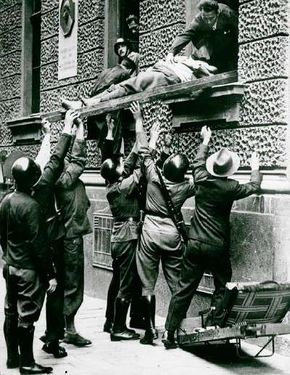
Adolf Hitler orders Austrian Nazis to assassinate Chancellor Engelbert Dollfuss: A wounded Nazi is removed from the Vienna Broadcasting Station on July 27, 1934. In February, in a bid to prevent a German takeover of Austria, Chancellor Engelbert Dollfuss abandoned parliamentary government and established a dictatorship. Engelbert Dollfuss used Austrian troops and Fascist militias to suppress the Social Democrats, which resulted in more than 1,000 deaths. Austrian Nazis supported by Berlin launched a sabotage and terror campaign across Austria. At Adolf Hitler's orders, on July 25, eight Austrian Nazis attacked the Federal Chancellery and murdered Chancellor Engelbert Dollfuss. Alarmed by these events, the Italians mobilized four divisions at the Brenner Pass, prompting the postponement of Adolf Hitler's planned Anschluss until 1938.
Triumph of the Will is German director Leni Riefenstahl's most famous work: "It is a documentary, not propaganda," German director Leni Riefenstahl declared after the war in defense of her most famous work, Triumph of the Will. Adolf Hitler had personally chosen Riefenstahl to film the German Nationalist Socialist Party conferences in Nuremberg in 1933 and 1934. She won numerous awards for Triumph, but had to defend her work to those who claimed it was the most insidious propaganda film ever made. Heavily choreographed, it opened with a sequence portraying Adolf Hitler as a god emerging from the clouds to address his followers.
The Thousand-Year Reich through a German Communist's perspective: The Thousand-Year Reich (1938), depicting the fundamental flaws in the Nazi state, was Hans Grundig's greatest masterpiece. The native German and his wife, Lea, were ardent Communists and critics of the Nazi regime. Lea Grundig escaped to Palestine in 1939, but in 1940 Hans Grundig was committed to the Sachsenhausen concentration camp. After the war, they returned to Dresden. There they were officially recognized for their art and as acclaimed political campaigners against fascism and repression.
Tensions build as German troops entered Rhineland, and Italy renounced its membership in the League of Nations. The World War II timeline on the following page details these and other important events from October 1935 to July 17, 1936.
For additional information about World War II, see: