How LifeStraw Works

Many of us take clean water for granted. We twist the cap off a plastic bottle or head to the kitchen faucet for a cool drink without a second thought. However, obtaining water that's fit to drink is a daily struggle for about one-sixth of the world's population [source: World Water Day 2001]. According to the 2006 United Nations Human Development Report, more than a billion people on this planet don't have ready access to clean water. To make matters worse, purifying water to make it drinkable can be a time-consuming and expensive process.

Contaminated water can cause disease and death. About half of the world's poor suffer from diseases caused by the water they drink and use for cooking, and approximately 6,000 people die each day from illnesses that access to clean water could have prevented [source: United Nations]. Cholera, typhoid and enteric fever are all deadly illnesses caused by the consumption of contaminated water. Bacterial or viral contaminants in the water can cause diarrhea and vomiting in humans by releasing toxins into the intestines. As a result, a person becomes dehydrated -- and could die, especially if that person loses more than 10 percent of the body's fluids [source: Rehydration Project]. Contaminated water causes more than 4 billion cases of diarrhea each year; 1.8 million people die from it, according to the World Health Organization (WHO). Diarrhea can be especially severe in young children and persons who are malnourished or have weakened immune systems: Children with HIV get diarrhea at a rate four times that of their non-infected peers, while adults with HIV are seven times more likely to contract diarrhea than adults who don't have HIV. Adding to this problem is the fact that more than 95 percent of the world's people with HIV live in developing countries without consistently safe water sources [source: WHO].

Ensuring the safety of the world's drinking water has become a top priority of welfare organizations around the world. Studies show that filtering impurities from the water is the best way to make it drinkable, and at least one company's already on the case. LifeStraw is a water filtration device developed in 2005 by Swiss corporation Vestergaard Frandsen. Inexpensive and easy to use, LifeStraw has become a major weapon in the battle against waterborne illness. In this article, we'll learn about LifeStraw and discover why Forbes magazine named it "one of the 10 things that will change the way we live" and why Time named LifeStraw "the best invention of 2005."

Lifestraw can help make the water in this polluted river drinkable again.

Mauricio Simonetti/Getty Images

LifeStraw Technology


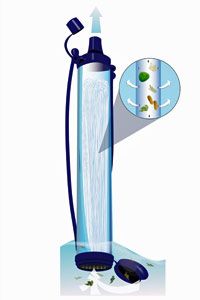
LifeStraw Personal is a tube about 10 inches (25 centimeters) long and about an inch (2.5 cm) around. The outer shell of LifeStraw Personal is made of a durable plastic. LifeStraw has a string attached so users can wear it around their necks. To use it, a person simply sticks the LifeStraw directly into the water source and drinks as he or she would from a straw. When the user finishes, he or she blows air out to clear the filter. It takes about eight minutes to drink a quart of water with LifeStraw Personal, and anyone who can use a straw can use it.

Here's what happens when you take a drink using LifeStraw:

  • Water passes through a mesh filter that removes the larger sediment and dirt. The holes in the filter are about 100 microns in diameter.
  • A polyester filter with a much smaller mesh of about 15 microns -- about a tenth of the diameter of a human hair -- catches bacteria.
  • The next step sends the water through iodine-coated resin beads. Iodine is a halogen (reactive nonmetal) that kills parasites, viruses and bacteria. These halogenated resin beads lie in a specially designed chamber that maximizes the exposure of pathogens to the iodine.
  • The water passes through an empty chamber.
  • The water is pulled through an active carbon filter to remove any taste left from the iodine and block any remaining pathogens. Carbon is the porous result of burned organic material and is activated by a special chemical process that makes it even more porous and more able to absorb impurities.

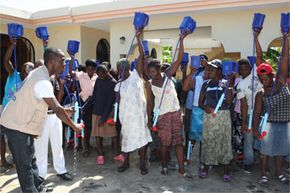
LifeStraw Family is a larger unit that can clean enough water for several people at once. LifeStraw Family consists of a blue bucket with a pre-filter insert, a long plastic tube and a filter cartridge with a tap attached to draw out the water. No electricity or battery power is required. Gravity guides water through a series of filters. The user pours water into the pre-filter and bucket at the top of the unit. The water then moves down the tube to run through a chlorine-saturated purification filter riddled with tiny pores that acts as a sieve for bacteria. The user can then pour the newly purified water from the tap. The user can clean the filter by closing the tap and pressing a squeeze bulb to release the collected residue and can use a rag to wipe the pre-filter bucket. LifeStraw Family can filter about 10 quarts (9.5 liters) of water per hour.

In just a few years, LifeStraw has become a leader in the struggle to give everyone clean water. On the next page, we'll look at what LifeStraw can and can't do. We'll also explore some water purification alternatives.

Other Ways to Purify Water

While LifeStraw is one of the easiest ways to ensure a clean water supply, methods to purify water are as varied as the societies that use them. The most basic methods include boiling, adding chlorine bleach or distilling the water. As common as these methods are, they're not practical for large volumes of water. They also require fuel, which can be hard to find in areas where pure water is scarce. Fuel-free alternatives are available, though: Solar purification, for example, uses the sun's energy to distill water and allows the sun's heat and ultraviolet rays to kill bacteria.

LifeStraw in Action

Both the family and personal models of LifeStraw eliminate sediment, bacteria and viruses from drinking water. The filter can stop particles measuring 15 microns or larger, which is about the size of a droplet of fog. Both models have filters that kill 99.9 percent of the bacteria and viruses present in the water. Some of the bacteria killed include salmonella, shigella, enterococcus and staphylococcus.

While LifeStraw Family filters out and kills parasites such as cryptosporidium and giardia lamblia, LifeStraw Personal does not. In fact, giardia lamblia is resistant to iodine. In addition, at 15 microns, LifeStraw Personal's filter screen is large enough to allow both parasites to pass through [source: WorldChanging]. LifeStraw Personal can't filter out heavy metals such as arsenic or fluoride either, which decreases LifeStraw Personal's effectiveness in industrialized communities with polluted water supplies [source: Vestergaard Frandsen].

Vestergaard Frandsen says a LifeStraw Personal unit should be able to purify about 700 quarts (662 liters) of water -- about two quarts (1.9 liters) a day -- meaning that it will last a year before it needs to be replaced. There are no replacement parts; users must buy a new unit each year. A LifeStraw Family unit can filter about 18,000 quarts (17,029 liters) of water, which should fill a typical family's needs for about three years before the apparatus wears out.

While some people hail LifeStraw and other personal water filters as the answer to the developing world's water woes, others say they're only a temporary fix. Paul Hetherington, spokesperson for the British charity WaterAid, feels the real problem is the distance that some people in remote areas have to travel to a water source, which can be as far as 20 kilometers (12.4 miles) round-trip. He also says LifeStraw is too expensive for the average person in these countries. He believes that education on good hygiene and the establishment of a reliable source of clean water in the village is a more viable solution [source: BBC News].

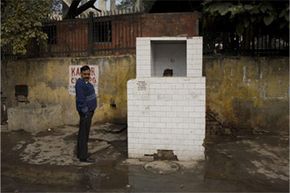
A man waits to use a public restroom in New Delhi, India. Twenty five percent of New Delhi's 16 million residents have no access to running water.

Robert Nickelsberg/Getty Images

LifeStraw Distribution

The United Nations (U.N.) wants to reduce the number of people without access to sustainable water by half by 2015. While digging new wells and putting in water treatment plants are viable solutions, some experts feel that personal filtration systems will work even better. For example, studies have shown that filtration is the most effective way to prevent diarrhea. Treating water at the household level has been proven to be more than twice as effective in preventing diarrhea as treating water at the source [source: HBNS]. In light of this information, many humanitarian and disaster relief organizations have started in earnest to distribute LifeStraw Personal and LifeStraw Family to people in need. These groups can purchase LifeStraw Personal units for around $3 each, while LifeStraw Family costs $25.

Rotary Clubs around the world are assuming the mission of getting LifeStraw out to those who need it. In addition, Project H Design, a charitable group in the U.S. that supports design solutions to humanitarian problems, is distributing LifeStraw Family in Mumbai, India. Project H Design is working with the health organization Haath Mein Sehat to give out the units and teach families how to use them. The World Bible Society sponsors a Web site designed to accept donations to purchase and distribute LifeStraws. The apparatus also plays an important role in disaster relief efforts worldwide. For example, many relief organizations have distributed LifeStraw Personal to victims of natural disasters like the 2008 earthquake in Pakistan.

LifeStraw has earned many honors in recognition of its role in the fight for clean water access. As we mentioned before, in 2005, Time magazine named LifeStraw as the year's best invention. Reader's Digest has named it "Europe's best invention," and Forbes magazine actually dubbed it "one of the 10 things that will change the way we live."

Who's responsible for this invention, anyway? Let's learn about the people behind LifeStraw on the next page.

One Life at a Time

Swiss company Vestergaard Frandsen has developed and currently manufactures several relief-aid textile products:

  • PermaNet bed and window curtains are made of yarn and treated with an insecticide. The insecticide coating lasts even after years of washing and reuse. It helps prevent a slew of illnesses, including malaria, dengue and Chagas disease. With the help of various humanitarian organizations, the company has distributed more than 170 million PermaNet products throughout the world to prevent the spread of malaria [source: Vestergaard Frandsen].
  • ZeroFly sheets and tents are made of plastic and coated with insecticide. They're designed primarily for use in refugee camps. According to Vestergaard Frandsen, ZeroFly products helped to nearly eliminate malaria casualties in these camps, which, in turn, reduced the death rate at these sites by half. CarePacks are packages designed to help HIV-positive people and their families. CarePacks include a PermaNet and a LifeStraw Family unit, as well as antibiotics, condoms and health information.

Vestergaard Frandsen: The Company Behind LifeStraw

Vestergaard Frandsen manufactures LifeStraw. The Lausanne-based company originally produced material for work clothes, but in 1992, the company started a line of relief products like blankets and tents. By 1997, the company had phased out its line of conventional textiles to concentrate on relief aid products [source: Vestergaard Frandsen].

Torben Vestergaard Frandsen, the firm's development director, developed LifeStraw while he was searching for a way to stop Guinea worm disease, a drug-resistant illness caused by a waterborne parasite found in Africa. For such a relatively little-known malady, Guinea worm disease packs a big punch: An organism called Dracunculus medinensis causes it by infecting people who drink water infested with worm larvae. They pierce the intestines of their victims, mate and grow up to 3 feet long as they make their way through the human body. After about a year, victims start feeling symptoms like fever, as well as swelling and pain at the worm's location. Then, they will develop painful blisters that will burst into open wounds that the worms will use finally to exit the body [source: Directors of Health Promotion and Education].

At first, Vestergaard Frandsen tried to use textile filters, but he soon discovered that cloth alone couldn't properly remove smaller particles. With the help of a designer from Israel, another designer from the Netherlands and support from The Carter Center in the U.S., he came up with a workable solution. Vestergaard Frandsen's plastic pipe filter, which has a stainless steel mesh, became an effective weapon in the battle against Guinea worm disease. What's more, the breakthroughs that Vestergaard Frandsen made as he worked on his initial textile filter led to the development of LifeStraw Personal, which hit the market in 2005. LifeStraw Family followed in 2008. Today, Guinea worm disease is on the brink of being the first parasitic disease - - and only the second disease overall - - to be declared eradicated by the World Health Organization (WHO).

Lots More Information

Related HowStuffWorks Articles

Sources

  • BBC News. "New Straw To Kill Disease As You Drink." 5/4/2006. (12/20/2008). http://news.bbc.co.uk/2/hi/africa/4967452.stm
  • Directors of Health Promotion and Education. "Guinea Worm Disease." (7/10/2009)
  • Dunn, Collin. "Sponsor a LifeStraw Family Water Filter With Project H Design." TreeHugger.com, 4/25/08. (12/22/08)http://www.treehugger.com/files/2008/04/lifestraw-family-water-filter-sponsor-project-h.php
  • Inderscience Publishers. "Cheap, Clean Drinking Water Purified Through Nanotechnology." ScienceDaily, 2/26/ 2008. (12/22/2008)http://www.sciencedaily.com­ /releases/2008/02/080220094656.htm
  • Lakehaven Utility District. "Three Ways to Purify Water." (12/20/2008) http://www.lakehaven.org/Emergency/disinfect.htm
  • Medgadget: Internet Journal of Emerging Medical Technologies. "LifeStraw." 5/23/2005. (12/22/2008)http://medgadget.com/archives/2005/05/lifestraw.html
  • Time. "Best Inventions 2005: Healthy Options. Clear Water Revival." 11/13/2005. (12/22/2008) http://www.time.com/time/business/article/0,8599,1129522-2,00.html
  • The Carter Center. "Guinea Worm Eradication Program." (12/22/2008) http://www.cartercenter.org/health/guinea_worm/index.html
  • United Nations Educational, Scientific and Cultural Organization. "World Water Assessment Program."(12/20/2008). http://www.unesco.org/water/wwap/wwdr/index.shtml
  • Vestergaard Frandsen. "LifeStraw." (12/16/2008)http://www.vestergaard-frandsen.com/lifestraw.htm