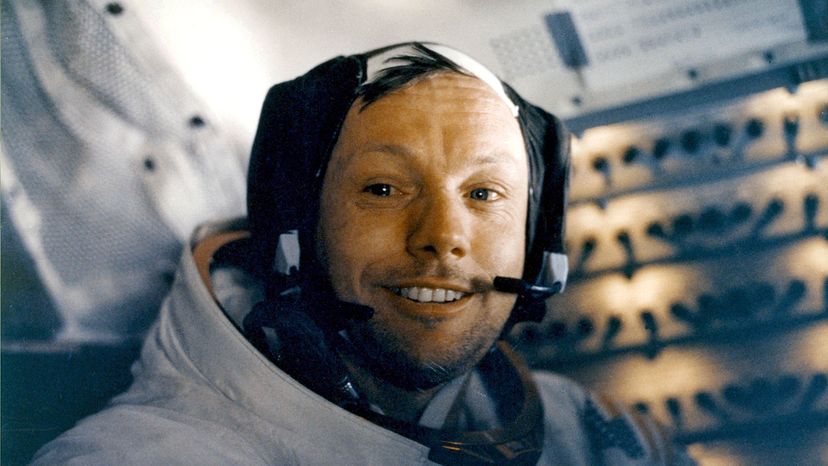
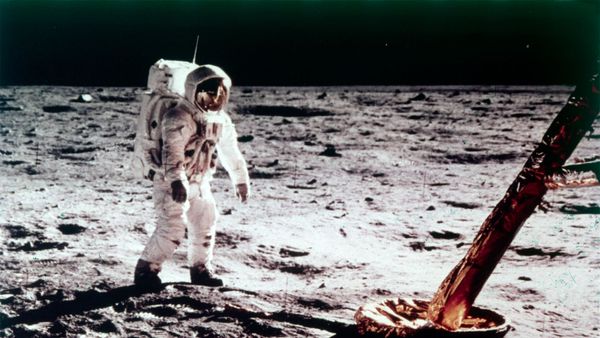
Portrait of Neil Armstrong in the Apollo 11 lunar module on the way back to Earth in July 1969. Pool NASA/REFLEX/Gamma-Rapho via Getty Images
Neil Armstrong was uniquely suited to be an Apollo astronaut. The self-described "white socks, pocket protector, nerdy engineer" was also a fearless test pilot who dutifully put his life on the line in the name of scientific progress. But Armstrong, a plainspoken kid from Ohio, was far less suited for the celebrity and fame that greeted him when he returned to Earth in 1969 as the first human being to walk on the moon.
"Neil Armstrong really was, right until the end of his life, an incredibly humble man awed by what he had done, but not terribly impressed by it," says space historian Rod Pyle, author most recently of "First on the Moon: The Apollo 11 50th Anniversary Experience." "Armstrong was impressed by the engineering. But in terms of making a mark in history, he really felt like he was a just a guest there."
Advertisement
Armstrong said as much himself in a rare 2005 interview on "60 Minutes" when the late Ed Bradley asked if he was uncomfortable with his celebrity. "No, I just don't deserve it," replied Armstrong with his signature toothy grin. "Circumstance put me into that particular role. That wasn't planned by anyone."
But looking back at Armstrong's early life, it feels like destiny chose this gifted young man from Wapakoneta, Ohio, to become an astronaut. Armstrong was fascinated by planes and flying from a young age. At 16, he received his pilot's license before he got his driver's license.
He went to college at Purdue University on a U.S. Navy scholarship, but his aeronautical engineering studies were interrupted by the Korean War, in which served for three years as a combat pilot.
Advertisement
Armstrong flew 78 missions over Korea, bombing supply routes behind enemy lines and escorting spy planes. He even had to eject into a rice paddy when his low-flying plane was snagged on an improvised North Korean booby trap.
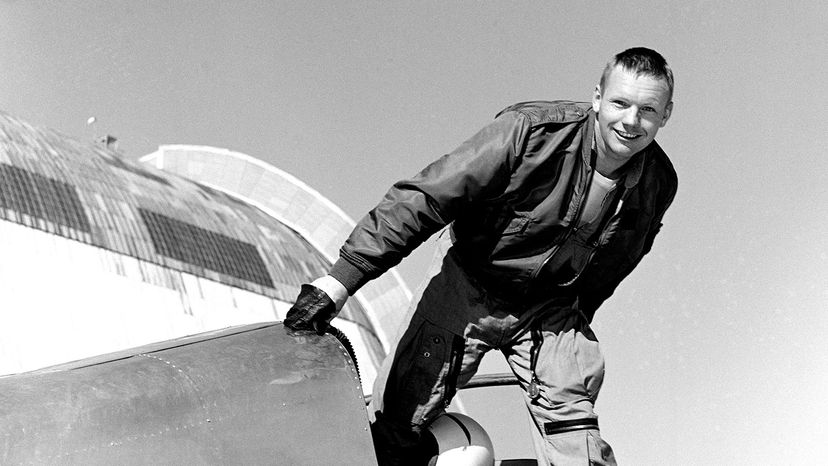
Neil Armstrong in the cockpit of the Ames Bell X-14 airplane at NASA's Ames Research Center, Moffett Field, California, 1955.
NASA/Smith Collection/Gado/Getty Images
He returned to Purdue to finish his degree and was hired by the fledgling National Advisory Committee for Aeronautics (NACA), the precursor to NASA, in 1955. A year later, Armstrong married Janet Shearon and they welcomed their first son, Eric, in 1957.
Armstrong began his space career at the NACA Lewis Research Center (now NASA Glenn) in Cleveland, Ohio, but made his name as a daring test pilot at NASA's Flight Research Center (now the Armstrong Flight Research Center) in Edwards, California.
Armstrong flew the famed X-15, one of a line of experimental rocket-powered planes that claimed the lives of several brave NASA test pilots. The X-15 reached a top speed of 4,000 mph (6,437 kph) and could climb right to the edge of space. But to fully break the bonds of Earth's atmosphere, Armstrong would have to become an astronaut.
The long-awaited call to join NASA's astronaut training program came in 1962, the very same year that Neil and Janet suffered a gut-wrenching tragedy. Their second child, a daughter named Karen, died from an inoperable brain tumor. Armstrong threw himself into his new job at NASA headquarters in Houston, Texas.
"I thought the best thing for me to do in that situation was to continue with my work, to keep things as normal as I could and try as hard as I could to not let it affect my ability to do useful things," Armstrong told "60 Minutes." (A third child, Mark, was born in 1963.)
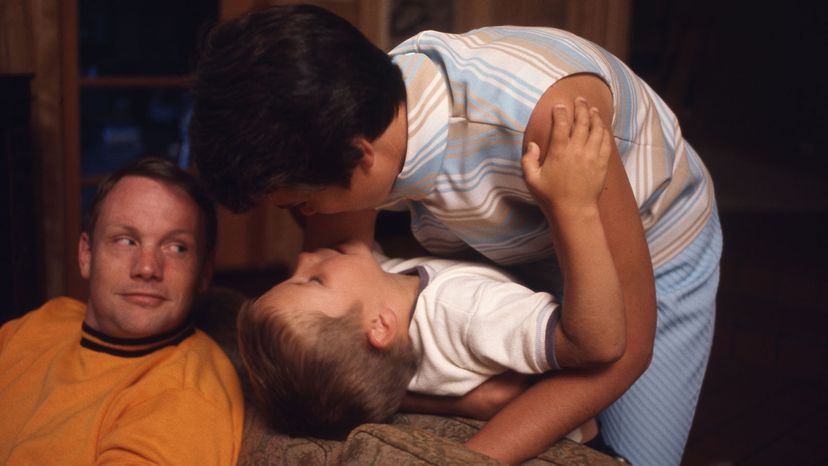
Neil Armstrong watches as his wife Jan plays with the couple's son Mark in the living room of their home, Houston, Texas, March 1969.
Ralph Morse/The LIFE Picture Collection via Getty Images
Armstrong's hard work paid off. In 1966, he was chosen as the command pilot for the Gemini 8 mission. The mission required someone with Armstrong's steady hand to attempt the first-ever docking of two vehicles in orbit, a critical maneuver for the future moon landing.
Advertisement
Coolness Under Pressure
Armstrong and his co-pilot, David Scott, pulled off the docking without a hitch, but then a malfunctioning thruster caused their space capsule and the attached Gemini Agena target vehicle began to veer off course. Reacting quickly, Armstrong undocked from the Agena, but the release of the other vehicle's weight caused the astronaut's capsule to enter a wild spin.
"We have serious problems here," Scott told mission control in Houston. "We're tumbling end over end. We're disengaged from the Agena."
Advertisement
As the rate of the uncontrolled spin approached one revolution per second, the G-forces reached critical levels.
"If Armstrong and Scott would have blacked out, their oxygen and life support would have eventually run out and they would have died up there," says Pyle.
Exhibiting his trademark coolness under pressure, Armstrong switched to a second control system that gave him access to different thrusters, which he fired to pull out of the spin, saving their lives and possibly the fate of the entire Apollo mission. Pyle says that losing a crew in 1966, when the War in Vietnam was eroding support for NASA, might have deep-sixed the moon mission.
But of course it didn't, and Armstrong would return to space July 16, 1969, as commander of Apollo 11. There was controversy over who would get the honor of being the first man to walk on the moon, and Armstrong's crewmate Edwin "Buzz" Aldrin was lobbying NASA hard. But flight director Chris Kraft passed over the brash Aldrin for Armstrong's soft-spoken hero.
"Neil was Neil," Kraft explained in a 2005 New Yorker article. "Calm, quiet and absolute confidence. We all knew that he was the Lindbergh type. He had no ego."
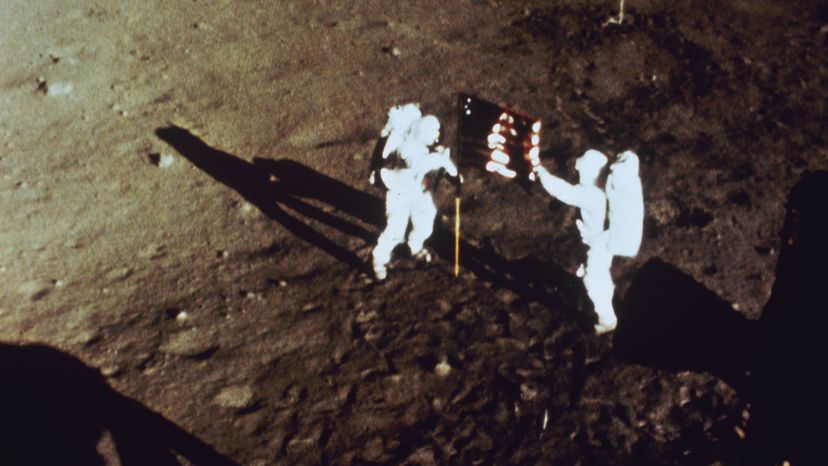
Neil Armstrong and "Buzz" Aldrin set up an American flag on the surface of the moon during NASA's Apollo 11 lunar mission, July 16, 1969.
NASA/The LIFE Picture Collection via Getty Images
On July 20, 1969, as millions watched on live television, Armstrong piloted the Lunar Module (L.M.) toward the moon's surface. In a last-second decision, he switched off the computer guidance system, which was aiming Armstrong and Aldrin for a large boulder-strewn crater as big as a football stadium. With fuel supplies 30 seconds from empty, Armstrong coolly set down the L.M. on the thickly dusted lunar surface. The Eagle, the code name for the L.M., had landed.
"You got a bunch of guys about to turn blue," said Charlie Duke, the spacecraft communicator on behalf of the white-knuckled NASA crew in Houston. "We're breathing again. Thanks a lot."
Advertisement
The Story Behind that Famous Quote
When Armstrong descended the stairs of the L.M. minutes later, he uttered the words that will be forever tied to his legacy: "That's one small step for man, one giant leap for mankind." At least that's what everybody heard. Armstrong swears he meant to say, "That's one small step for a man..." but either the audio was bad or he misspoke in the moment.
"[C]ertainly the 'a' was intended, because that's the only way the statement makes any sense," Armstrong told his biographer, James R. Hansen. "So, I would hope that history would grant me leeway for dropping the syllable and understand that it was certainly intended, even if it wasn't said — although it actually might have been." He also said there was no big story behind this famous line: "What can you say when you step off of something? Well, something about a step. It just sort of evolved during the period that I was doing the procedures of the practice takeoff and the EVA [extravehicular activity] prep and all the other activities that were on our flight schedule at that time."
Advertisement
In the 2018 film "First Man," based on Hansen's 2005 biography of the same name, Armstrong (played by blue-eyed Ryan Gosling) is brought to tears during the moonwalk as he remembers his beautiful daughter Karen and deposits her bracelet in a small crater. While it's a touching scene, it's not what happened in real life, says Pyle.
"Armstrong was literally like a 5-year-old boy in a candy store," says Pyle. "He was running from place to place really geeking out on the science and having a fantastic time."
Advertisement
Life After the Moon
Returning to Earth, Armstrong and his Apollo 11 crewmates were greeted as conquering heroes with a ticker-tape parade in New York City attended by 4 million people. NASA then sent them on a 45-day world tour to meet adoring fans and dignitaries, including the Queen.
Armstrong left NASA in 1971 and re-entered civilian life as an engineering professor at the University of Cincinnati.
Advertisement
"You can imagine a college student walking into a freshman aeronautical engineering class and there's Neil Armstrong with chalk dust all over the sleeves of his black jacket," laughs Pyle. "'Isn't that the dude who walked on the moon?'"
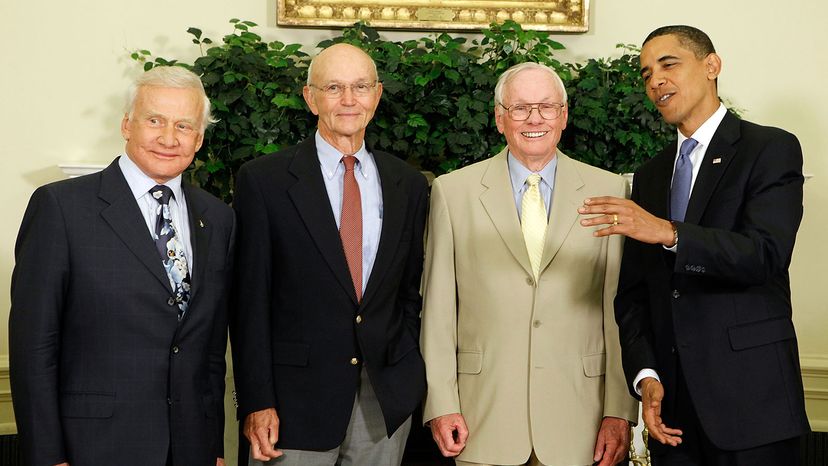
President Barack Obama (R) hosts Apollo 11 astronauts (L-R) Edwin "Buzz" Aldrin, Michael Collins and Neil Armstrong in the Oval Office at the White House July 20, 2009 in Washington, D.C.
Chip Somodevilla/Getty Images
When a reporter tracked Armstrong down for an interview, he expressed frustration at his unwelcomed notoriety. "How long must it take before I cease to be known as a spaceman?" he asked.
Armstrong left teaching after eight years and made a comfortable living serving on the boards of various aerospace companies. After the devastating Challenger explosion in 1986, he served on the NASA commission to investigate the cause of the crash. In rare interviews and public appearances, he aired disappointment with lack of funding for NASA and the kind of ambitious missions that had captured his scientific imagination in the 1950s and 1960s.
Armstrong died Aug. 25, 2012, from complications of a heart bypass procedure. He was 82 years old. His family sued the hospital for malpractice and settled for $6 million.
The man who never asked for recognition was eulogized as a true American hero whose "one small step" remains one of the proudest collective moments in human history.
Now That's Too Bad
After 33 years of marriage, Armstrong's wife Janet asked for a divorce in 1989 with a note left on the kitchen table citing "years of emotional distance." Armstrong remarried in 1994.
Advertisement
Cite This!
Please copy/paste the following text to properly cite this HowStuffWorks.com article: