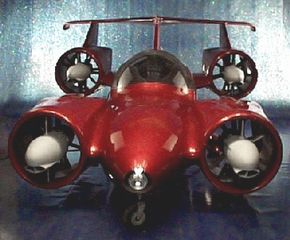
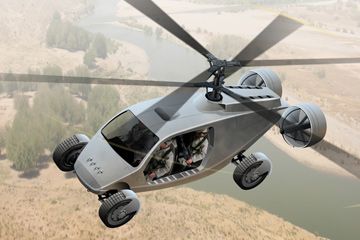
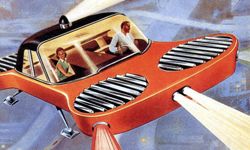
You're bound to turn some heads in a Moller M400. See more concept car pictures.
Photo courtesy Moller International
Sitting amidst a sea of cars in bumper-to-bumper traffic on an endless expressway, have you ever daydreamed about your car taking off and flying over the road? Imagine if you could just flip a switch and unshackle yourself from the asphalt!
Traffic jams are the bane of any commuter. Many of us spend an hour or so stuck in traffic every week. One solution is to create a new type of transportation that doesn't rely on roads — one that could one day make traffic jams a relic of the past. To do this, we must look to the sky.
Advertisement
You've probably heard promises about flying cars before, and the technology to make them safe and easy to fly may finally be here. In this article, we will take a look back at some of the attempts to build a flying car, and examine some of the flying vehicles that you may someday be able to park in your garage!
Just a decade and a half after the Wright Brothers took off in their airplane over Kitty Hawk, N.C., in 1903, other people began chasing the dream of a flying car. There are nearly 80 patents on file at the United States Patent and Trademark Office for various kinds of flying cars. Some of these have actually flown. Most have not. And all have come up short of reaching the goal of the mass-produced flying car. Here's a look back at a few of the flying cars that distinguished themselves from the pack:
Curtiss Autoplane - In 1917 Glenn Curtiss designed his aluminum Autoplane that sported three wings that spanned 40 feet (12.2 meters). The car's motor drove a four-bladed propeller at the rear of the car. The Autoplane never truly flew, but it did manage a few short hops.
Arrowbile - Developed by Waldo Waterman in 1937, the Arrowbile was a hybrid Studebaker aircraft. Like the Autoplane, it too had a propeller attached to the rear of the vehicle. The three-wheeled car was powered by a typical 100-horsepower Studebaker engine. The wings detached for storage. A lack of funding killed the project.
Airphibian - Robert Fulton, who was a distant relative of the steam engine inventor, developed the Airphibian in 1946. Instead of adapting a car for flying, Fulton adapted a plane for the road. The wings and tail section of the plane could be removed to accommodate road travel, and the propeller could be stored inside the plane's fuselage. It took only five minutes to convert the plane into a car. The Airphibian was the first flying car to be certified by the Civil Aeronautics Administration, the predecessor of the the Federal Aviation Administration (FAA). It had a 150-horsepower, six-cylinder engine and could fly 120 miles per hour and drive at 50 miles per hour. Despite his success, Fulton couldn't find a reliable financial backer for the Airphibian.
ConvAirCar - In the 1940s, Consolidated Vultee Aircraft (eventually renamed Convair) developed a two-door sedan equipped with a detachable airplane unit. The ConvAirCar debuted in 1946 and offered one hour of flight and a gas mileage of 45 miles (72 kilometers) per gallon. Plans to market the car ended when it crashed on its third flight.
Avrocar - The first flying car designed for military use was the Avrocar, developed by John Frost, a product designer for Avro Canada, in the 1950s. The flying-saucer-like vehicle was supposed to be a supersonic fighter-bomber aircraft capable of vertical takeoff and landing (VTOL). In 1957, the United States Air Force agreed to fund further development, but the Avrocar never functioned as intended.
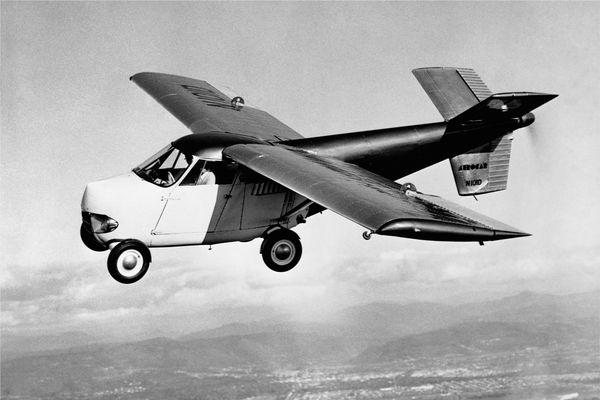
Aerocar - Inspired by the Airphibian and Robert Fulton, whom he had met years before, Moulton "Molt" Taylor created perhaps the most well-known and most successful flying car to date. The Aerocar was designed to drive, fly and then drive again without interruption. Taylor covered his car with a fiberglass shell. A 10-foot-long (3-meter) drive shaft connected the engine to a pusher propeller. It cruised at 120 mph (193 kph) in the air and was the second and last roadable aircraft to receive FAA approval. In 1970, Ford Motor Co. even considered marketing the vehicle, but the decade's oil crisis dashed those plans.
These pioneers never managed to develop a viable flying car, and some even died testing their inventions. However, they proved that a car could be built to fly, and inspired a new group of roadable aircraft enthusiasts. With advances in lightweight material, computer modeling and computer-controlled aircraft, the dream is closer than ever to becoming reality. In the next section, we will look at more recent attempts to develop flying cars.
Advertisement
Modern Flying Cars
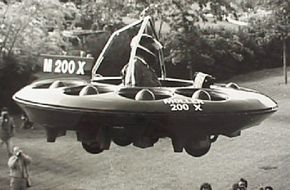
The M200X, the predecessor of the Skycar, flew for the first time in 1989 to a height of 50 feet.
Photo courtesy Moller International
When George Jetson first flew across American TV screens in his flying car-like vehicle in 1962, many of us began wondering when we could buy our own Supersonic Suburbanite or Spacion Wagon. Amazingly, that day may be around the corner. After a century of unfulfilled promises, flying cars may fill the skies in the next few decades. There are still some obstacles to overcome, including receiving approval from the FAA, but the cars are close to being finished.
There is no lack of engineers taking on the challenge to design a new breed of flying cars. While sleeker, more advanced cars have been developed in the last decade, no one has come close to opening up a flying car dealership. Here are a few of the individuals attempting to deliver a flying car:
Advertisement
Paul Moller has spent 40 years and millions of dollars developing his Skycar. He is now very close to developing the first mass-marketed flying car. In 1965, he demonstrated his first attempt, the XM-2, which hovered off the ground but didn't go anywhere. In 1989, Moller unveiled the M200X, which has now flown 200 flights and can go as high as 50 feet (15.24 meters).
MACRO Industries in Huntsville, Ala., is developing a flying car that it's calling the SkyRider X2R. This aero car will be able to take off and land vertically. SkyRider incorporates the interior design of a 2-seat sports car with the mobility of a helicopter or airplane. The company said it is also developing 5 and 7-seat models of the SkyRider, and it should fit in most two-car garages. The navigation system will be controlled almost entirely by GPS satellites and cellular services.
In Israel, Dr. Rafi Yoeli of Urban Aeronautics is testing the CityHawk, a prototype of a fly-by-wire car. He's also working on a project centered around the X-Hawk, a rotorless Verticle-Take-Off and Landing vehicle (VTOL). Visit this Web site for more information.
In 1990, Kenneth Wernicke formed Sky Technologies to develop a small-winged flying car. His Aircar has flown at 200 to 400 mph (322 to 644 kph) and driven at 65 mph (105 kph). It's also small enough to fit into an average parking space.
Recently, Branko Sarh, a senior engineer at McDonnell Douglas Aerospace, has attempted to develop a flying car, called the Sokol A400, or Advanced Flying Automobile. Sarh designed a 4-passenger vehicle that would pop out telescoping wings at the push of a button.
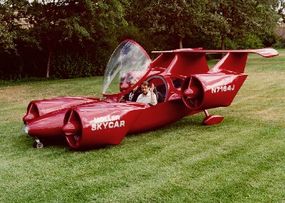
The Skycar will be operated completely by computer and guided by GPS satellites.
Photo courtesy Moller International
Moller's latest design, the Skycar M400, is designed to take off and land vertically, like a Harrier Jet, in small spaces. It can reach speeds of 400 mph (644 kph), but will cruise at around 350 mph (563 kph), and it has a range of 900 miles (1449 km). Gasoline, diesel, alcohol, kerosene and propane can be used to fuel the Skycar, and its fuel mileage will be comparable to that of a medium-sized car, getting 20 miles (32.2 km) to the gallon. The initial cost of a Skycar will be about $1 million, but once it begins to be mass produced that price could come down to as low as $60,000.
The four-seat Skycar is powered by eight rotary engines that are housed inside four metal housings, called nacelles, on the side of the vehicle. There are two engines in each nacelle so that if one of the engines in one of the nacelle fails, the other engine can sustain flight. The engines lift the craft with 720 horsepower, and then thrust the craft forward. The Wankel engine replaces pistons of a conventional engine with a single triangular rotor spinning inside an oval-shaped chamber, which creates compression and expansion as the rotor turns. There are three combustion chambers in the Wankel, with a crankshaft between them.
To make the Skycar safe and available to the general public, it will be completely controlled by computers using Global Positioning System (GPS) satellites, which Moller calls a fly-by-wire system. In case of an accident, the vehicle will release a parachute and airbags, internally and externally, to cushion the impact of the crash.
MACRO Industries' SkyRider X2R will also use this fly-by-wire system to safely transport passengers to their desired destinations. Drivers will simply get in, turn on the power and enter the address or phone number of their destination. SkyRider will do the rest. MACRO said that the system will be almost fully automatic, but may allow some manual control. Commands will be entered just by telling the car what you want it to do.
According to their Web site, MACRO is shooting to have a working vehicle produced sometime in 2006. The company is planning to power the vehicle with an enhanced automobile engine to drive four-ducted fans. The unique feature of the SkyRider will be the company's patented rotary cartridge valve, which is expected to increase fuel efficiency and reduce emissions.
The CityHawk is similar to the Skycar and SkyRider in that it also takes off and lands vertically. However, there are some key differences. The CityHawk will be powered by fans that are driven by four internal combustion engines. Much like in the Skycar, this redundancy of engines will allow the vehicle to land even if one of the engines is lost. The CityHawk is about the size of a Chevy Surburban, and will have cruising speeds of 90 to 100 miles per hour (145 to 161 kph). CityHawk developers say that it could be used as an air taxi, for news gathering and for traffic control.
The mass availability of flying cars could be very exciting or very scary, depending on how you look at it. If proper safeguards are put in place, they could be the answer to our ever-worsening traffic jams. Flying cars that can travel at hundreds of miles per hour would not only cut that rush hour commute to a few minutes, but it would allow us to live hundreds of miles farther from work and still make it to the office faster than by road-bound cars today.
Personal Air Vehicle
Wouldn't it be great to be able to pack a few bags, grab your friends and fly anywhere in the world in your own personal jet anytime you want? The folks behind start-up "Terrafugia" hope to make your dreams come true by 2009 or 2010. Well, sort of. Change the dream to 'friend' and imagine the flight plan being somewhat limited.
The Terrafugia team is currently working on a personal air vehicle (known as the "Transition") that pretty much looks like an SUV with retractable wings. The Transition won't be able to whisk you off on a non-stop flight to any destination, but you will be able to get as far as 500 miles in one "jump." And, amazingly, the designers hope it will do it on a single tank of premium unleaded gas. Oh, and don't worry about having to rent a car once you reach your getaway -- as hinted at in its name, the Transition gets decent mileage on the road, too! (Planned vehicle specs: In flight, the Transition will fly up to 120 miles per hour and get 30 mpg. On the highway, it will get 40 mpg and around town, it will get 30 mpg.)
A full-size prototype is planned, but for now the designers are working with a one-fifth scale model in the wind tunnel and relying on computer simulations for development.