History of Navies

For many centuries there was little tactical difference between warfare on land and warfare at sea. The principal warship of the ancient world was the galley, a long, single-deck vessel propelled by oars and sails.

Lacking long-range weapons, galleys could only attempt to drive into and sink each other with rams that were built into their hulls. As the ships came together armed men fought across their decks as they would have fought on land.

Galley Warfare

The first important naval battle was fought between Greek and Persian fleets at Salamis, Greece, in 480 B.C. It involved hundreds of galleys; accounts vary as to their exact number. Themistocles, the Athenian leader, ably placed his ships—and in the ensuing battle the Persian fleet of Xerxes was destroyed, ending the Persian threat to Greece.

The Romans developed huge galleys carrying large numbers of well-trained soldiers and dominated the Mediterranean Sea. In the Second Punic War (218-201 B.C.), Carthage, under Hannibal, invaded Italy from the north and won nearly every battle it fought; Rome won the war, however, because Carthage lacked the sea power to maintain its armies.

The Battle of Lepanto, 1571 A.D., was the last important clash of fleets of galleys. An allied force, mainly Spanish and Venetian under Don John of Austria, defeated a larger Turkish fleet threatening Cyprus.

Sailing Ships

Only a few years later, 1588, a large fleet of heavily armed sailing ships, called the Spanish Armada, was assembled for the conquest of England. The Armada was outfought and repulsed by the smaller, more maneuverable ships of the English fleet, but most of its losses were caused by storms on the voyage home.

In the early days of sailing ships, all merchant ships were armed for defense; they could be converted to use as privateers or part of the fleet by simply adding more guns. When Oliver Cromwell reorganized the English navy in 1652 for wars with the Dutch, it was made up of all sorts of ships, commanded for the most part by soldiers, called “generals-at-sea.” Two of them, Robert Blake and George Monk, became outstanding sea fighters. Ships were armed with guns of similar size arranged in rows along both sides of a deck, with two or more larger guns pointed forward and aft. The most effective fire was by broadside, all the guns on one side of a ship firing in unison.

To give some form to naval tactics, England's “Fighting Instructions” of 1653 provided that “All ships of every squadron shall endeavour to keep in line with the chief.” This established the column as the normal formation for naval battles. As smaller ships would be overwhelmed by heavier broadsides, they were eliminated from the line of battle. Ships of the navy became specialized.

During the latter half of the 17th century, the Dutch were a formidable naval power, their great admirals Maarten H. Tromp and Michel A. de Ruyter challenging and defeating England's navy in several wars.

By the mid-18th century, types of naval ships became standardized. A ship of the line carried 74 to more than 100 guns (the most was about 140) on three decks. Frigates, used as cruisers, became standardized at 36 and 44 guns.

In the wars between Great Britain and France, further advances were made in naval tactics. Especially significant were departures commanders occasionally made from strict adherence to the column formation, which had become formalized in naval doctrine. Two such departures occurred during the Succession Wars in 1747, when British admirals George Anson and Edward Hawke, in the two battles of Finisterre, off the coast of Spain, ordered their ships to break away from the column while in pursuit of the enemy ships and succeeded in destroying the French fleets. As a result of their success, the British navy issued new “Fighting Instructions” allowing more tactical flexibility.

During the American Revolution, France fought Great Britain on the seas in support of the colonies. A fleet led by Comte de Grasse skirmished with and outmaneuvered a British fleet at the Virginia Capes in 1781. The French thus won temporary control of Chesapeake Bay, which led to the surrender of Lord Cornwallis to George Washington at Yorktown. Off the coast of India, French admiral Pierre Andre de Suffrn with a poorly supplied fleet outfought British admiral Sir Edward Hughes in five major battles and repeatedly kept the British fleet on the defensive.

The one great French setback during the American Revolution was de Grasse's defeat by Sir George B. Rodney in the Battle of the Saints, off the les des Saintes in the West Indies. The British use of improved gunnery techniques, which gave them a more rapid rate of fire than the French, was a critical factor in the victory.

In the wars of the French Revolution notable fleet actions were the British victories of Lord Howe in the Battle of the First of June, 1794; Sir John Jervis at Cape St. Vincent, February 14, 1797; and Lord Duncan at Camperdown, October 1, 1797. Admiral Horatio Nelson at the Battle of the Nile, 1798, ended Napoleon's hope of Near East conquests; and Nelson's great victory of Trafalgar in 1805 ended Napoleon's threat to invade England.

Steam and Armor

Early in the 19th century steam power began to replace sails in warships, although most ships carried masts and sails for auxiliary use until the 20th century. Armored floating batteries were used in the Crimean War, 1853-56, but it was the fight of the ironclads Monitor and Merrimack (Virginia), 1862, in the American Civil War that ended forever the days of wooden ships. The Monitor, with its revolving turret, revolutionized warship design and led directly to the development of the battleship. By the mid-1870's, iron-and-steel warships were the norm.

As larger and more powerful guns were built, battleships were built with heavier and thicker armor, but at the cost of speed. Navies therefore developed the cruiser, which carried big guns but was lightly armored so that it would not sacrifice speed.

Navies also had to find defenses against new, more lethal mines, torpedo boats, and submarines. To protect their battleships, navies devised an escort vessel called a torpedo-boat destroyer, or later simply destroyer after the submarine replaced the torpedo boat in navies. By the end of the 19th century, all the basic warship types of a modern navy, except for the aircraft carrier, had been developed.

Great Britain was by far the greatest naval power throughout the 19th century. During the early part of the 20th century, two new naval powers—the United States and Japan—emerged, and Germany became a threat to British supremacy on the seas. The United States victories over Spain's fleets in the Spanish-American War in 1898 signaled United States ascendancy as a sea power. In the Russo-Japanese War, 1904-05, Japan established itself as a sea power when it destroyed a Russian fleet at the Battle of Tsushima, the most one-sided naval engagement since the Battle of Trafalgar. The Japanese admiral, Togo Heihachiro, used the classic naval maneuver of “crossing the T.” He had his fleet sail across the head of the Russian column so that gunfire could be concentrated on each Russian ship as it came up.

The German challenge to Great Britain began in 1900, when Admiral Alfred von Tirpitz announced a program to double the number of German capital (major) ships. In later programs, obsolescent warships were retired and replaced with modern fighting ships.

Great Britain countered in 1906 with the Dreadnought, the first all-big-gun battleship. It had ten 12-inch (30-cm) guns in five turrets. Previous battleships commonly had four big guns and as many as six different calibers of small guns.

Growing German naval might forced the British navy to concentrate its strength in home waters. When World War I started, the British fleet was in position to keep the German High Seas Fleet bottled up in the North Sea. The Battle of Jutland, the only attempt by the German fleet to challenge the British fleet, was the only major naval battle of the war, and it was indecisive. Both the Germans and the British held to the idea that the threat of the “fleet in being”—that is, of having an intact fleet, ready to fight— was so important that their main fleets could not be risked in an attempt to destroy the enemy fleets.

Germany's principal naval operations were conducted by its submarines and raider cruisers against Allied shipping. In the first years of the war, Germany almost succeeded in cutting off vital supplies to the Allies, but beginning in 1917 the convoying of merchant ships effectively neutralized German attacks. Convoys at first were not considered practical, but after the United States entered the war and provided additional naval strength convoying was adopted. A mine barrage (a heavy concentration of mines) in the English Channel and the North Sea also helped to overcome the submarine menace.

World War II

In World War II, the Germans again were very nearly successful in their submarine campaign, bringing Great Britain to the brink of defeat. The key to Allied victory over the submarines was again the use of convoys. The Allies at first did not have sufficient numbers of destroyers and other escort vessels to protect all its shipping convoys, and German strategy was to search out and destroy unprotected vessels and to overcome convoy defense with groups of submarines forming what were called “wolf packs.” As the Allies were able to provide protection for more and more ships, the German submarine ceased to be a major threat. The Allied campaign against submarines was greatly aided by the use of airplanes, sonar, and radar.

The German surface navy helped in the conquest of Norway in 1940, but through the rest of the war it did not risk battle in major operations. The Germans used lone cruisers and battleships as commerce raiders, but Allied surface ships, often supported by warplanes, eliminated these vessels by 1943.

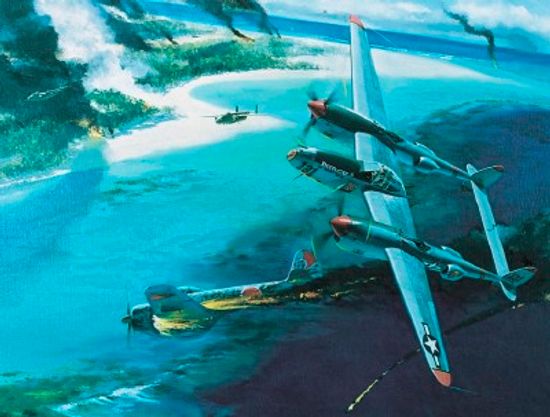
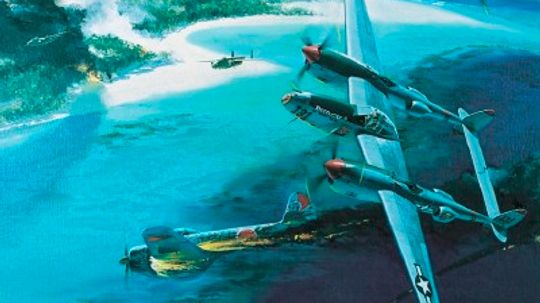
The major naval development of the war was the dominant role assumed by the airplane, both land-based and carrier-based. From the opening contests at sea, it became evident that the navy that had superiority in the air could achieve superiority with its surface fleet. The German battleship Bismarck, the most powerful warship afloat, was sunk in 1940 by surface vessels with the help of carrier-based aircraft. Japanese carrier planes at Pearl Harbor in 1941 severely crippled the United States fleet and opened the way for Japanese conquest of the eastern Pacific and Southeast Asia. Two British vessels, the battleship Prince of Wales and battle cruiser Repulse, were sunk in 1941 by land-based Japanese planes.

In the Battle of Midway, 1942, the ships of the Japanese surface fleet greatly outnumbered those of the United States fleet, but in the number of carrier planes each side was about equal. United States planes won the battle, and the Japanese fleet was forced to withdraw.

It became evident to naval strategists that carrier-based aircraft were the primary element in naval strikes and that the aircraft carrier had replaced the battleship as the most important vessel of surface fleets.

Amphibious warfare became crucial to winning the war for the Allies. The D-Day landing in Normandy (1944), which involved the largest flotilla of vessels of any naval operation during the war, opened a Western front that was crucial for the ultimate defeat of Germany. The United States conflict against Japan was primarily a sequence of amphibious campaigns.

After World War II

With the introduction of the atomic bomb during the war and its subsequent spread among world powers, new naval policies were adopted by those nations armed with such weapons. The major Western navies had to be prepared for nuclear conflict, but they had to be flexible enough to still be able to use conventional forces in limited wars, such as in the Korean War, 1950-53.

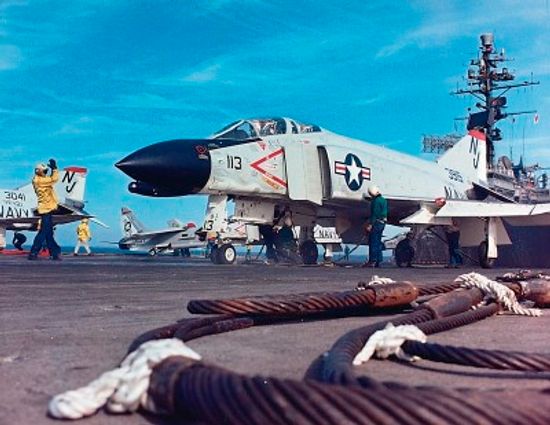
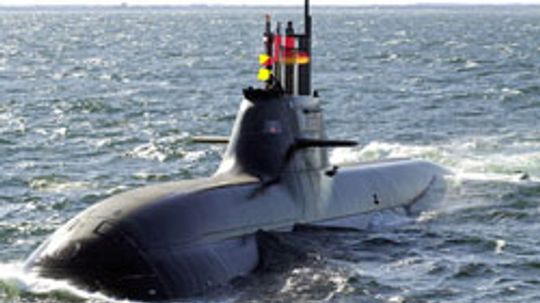
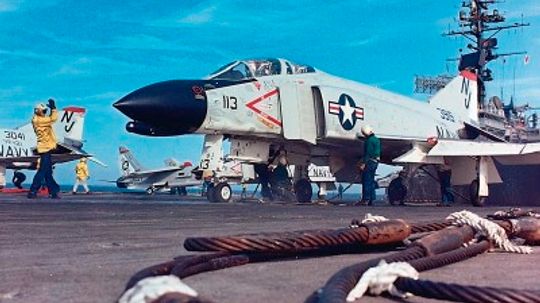
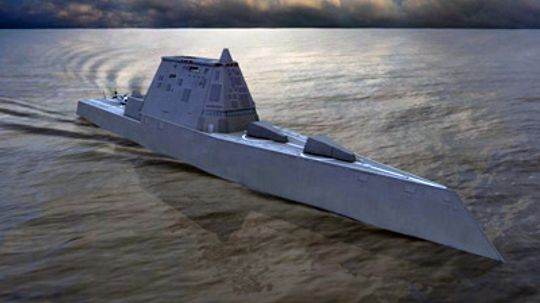
The Western powers put emphasis on aircraft carriers, both for their conventional utility and for their ability to supplement other nuclear strike forces with nuclear-armed carrier planes. Beginning in the 1960's, submarines were built equipped with long-range ballistic missiles, adding greatly to their navies' offensive capabilities. The Western powers, the United States in particular, also built many destroyers.

The Soviet Union was also developing a navy with both conventional warfare and nuclear warfare capabilities. Its navy, which had been small before World War II, by the 1970's was equal in strength to the U.S. Navy. The Soviets concentrated on building a large number of attack submarines and missile-armed vessels for destruction of enemy warships, and ballistic-missile submarines for strategic nuclear warfare.

The Falkland Islands War in 1982, between Great Britain and Argentina, provided one of the few tests since World War II of naval doctrine, weapons, and tactics. The British carrier strike force was built around a VTOL aircraft carrier rather than a fixed-wing aircraft carrier. The VTOL warplanes provided effective air cover for the successful amphibious assault on the islands and were able to defend against enemy aircraft near the strike force. The relatively short range of the VTOL planes, however, left the strike force vulnerable to long-range cruise missiles launched from Argentine planes, and the British lost several ships. The British established the continued viability of carrier strike forces, but the Argentines demonstrated the effectiveness of missiles against such forces.