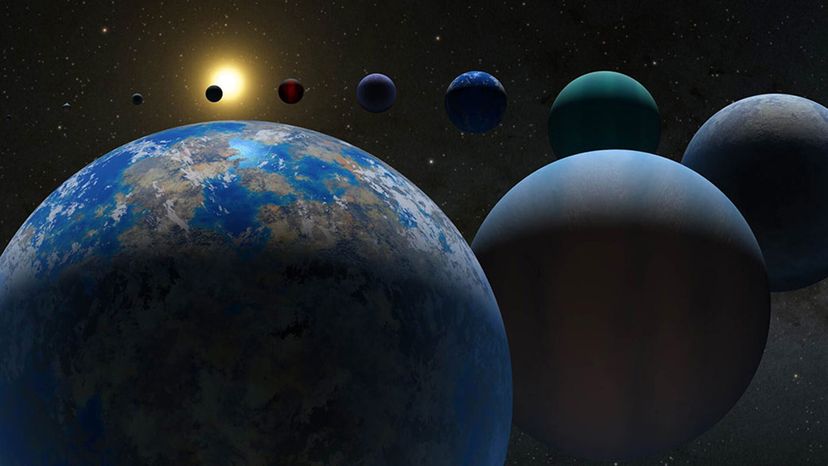
What do exoplanets, or planets outside our solar system, look like? A variety of possibilities are shown in this illustration. Scientists discovered the first exoplanets in the 1990s. NASA/JPL-Caltech
Picture the planets we're all familiar with: Mercury, Venus, Earth, and so on. They're comfortably nestled in their orbits around our sun, part of our solar system's family. But our family isn't the only one out there. Just like we have cousins living in different cities or even different countries, our planets have cousins too — they're called exoplanets.
An exoplanet or extrasolar planet is a planet just like ours, but it revolves around another star. The term "extrasolar" means outside our solar system. For most of human history, astronomers could only observe the planets in our solar system, though they believed there were other planets out there based on calculations involving our sun. The first of these far-flung worlds was discovered in the 1990s. Since then, our cosmic family tree has expanded enormously.
So how do we locate these cosmic relatives? Through the use of special telescopes and methods. One method used is the transit technique. Picture a kid running in front of a lit window at night — when he does so, the light dims slightly. That's kind of how the transit method works. When an exoplanet passes in front of its host star, it causes a tiny, momentary dip in the star's brightness.
Another technique we use is called radial velocity, where we watch for small "wobbles" in a star's position caused by the gravitational pull of an orbiting planet.
Advertisement
Finally, there is the technique of microlensing. This is often used to detect planets that don't orbit around host stars or exoplanets that are very far from Earth. A massive object (like a star) can bend and magnify the light of a star located behind it from our point of view, a phenomenon known as a gravitational lens. When a planet is orbiting the foreground star, it distorts the magnified light in a specific way that can be detected and used to infer the presence of the planet.
Telescopes like the now-defunct Kepler space telescope and the current TESS (Transiting Exoplanet Survey Satellite) have been instrumental in finding exoplanets orbiting beyond our solar system. In fact, a planet discovered via Kepler is referred to as a Kepler planet. More than 2,600 Kepler planets were discovered during Kepler's nine-year mission, from 2009-2018. Thanks to Kepler and other telescopes, we've already found over 5,000 exoplanets as of 2023. These include GJ-1214b and Gliese-581c.
Advertisement
What Are the Main Types of Exoplanets?
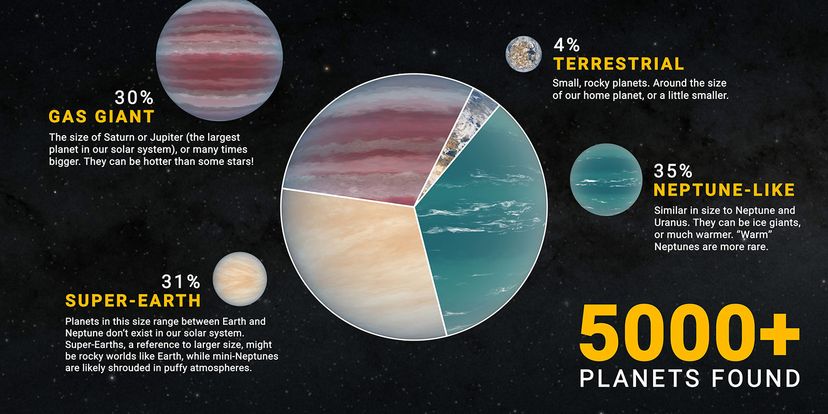
The more-than-5,000 exoplanets confirmed in our galaxy so far include four main types listed above. NASA/JPL-Caltech
While exoplanets share some similarities with their cousins in our solar system, they come in an amazing array of types. Here are the main ones:
Gas giants: Huge planets as big or bigger than Jupiter. Some are called "Hot Jupiters" because they revolve near their star and are extremely hot.
Super-Earths: Rocky planets bigger than Earth but smaller than Neptune. They may or may not have atmospheres. The name "Super-Earth" refers to their size, not that they are Earth-like.
Neptunian Planets: Planets around the size of Neptune but with hydrogen or helium-filled atmospheres. This type is very common outside our solar system but doesn't exist inside it (as far as know).
Terrestrials: Earth-size planets, mostly made of rock and metal, possessing water or atmospheres that could be habitable.
Some of the most intriguing exoplanet observation has centered around finding planets that could be habitable. In order for planets to be considered possibly habitable, they have to reside in habitable zones. These are areas in space where the planet is not too far nor not too close to its star, meaning its surface temperature is not too hot nor too cold. That gives the possibility of liquid water. Habitable planets would also need to be rocky planets, so that trees and animals would have a surface to live on. A 2020 study suggests there could be as many as 300 million potentially habitable planets in our galaxy alone. We don't know how many of them have atmospheres or oceans.
Advertisement
Another interesting planet type is rogue planets. These are planets that orbit no stars. These were once thought to be rare but a 2021 study put the number at between 70 and 170 in the Milky Way alone. Some of these might be gas giants while others might Earth-sized.
Advertisement
The Future of Exoplanet Exploration
Exoplanets are like pieces of a cosmic puzzle. By studying them, we get to understand what they're made of and what conditions prevail on these distant worlds. We use powerful tools like the Hubble Space Telescope and the newly launched James Webb Space Telescope (JWST) to analyze light passing through an exoplanet's atmosphere — a process known as spectroscopy. This gives us precious clues about the planet's atmospheric composition and temperature. JWST is specialized to observe infrared wavelengths and can penetrate the hazy atmospheres of many planets to see what lies beneath.
There are also future missions like the European Space Agency's spacecraft PLATO (PLAnetary Transits and Oscillations of stars) telescope and ARIEL (Atmospheric Remote-sensing Infrared Exoplanet Large-survey). PLATO, expected to launch in 2024, is structured to learn how planets form and which conditions might be favorable for life. ARIEL, expected to launch in 2029, will specifically target and study exoplanets.
Advertisement
These alien worlds also help us answer bigger questions about the universe. How do planetary systems form? What types of stars have planets? Are the characteristics of our solar system typical, or are we living in some kind of galactic oddball? The next few decades of exoplanet exploration promise to be an exciting era of discovery.
Major Exoplanets Found
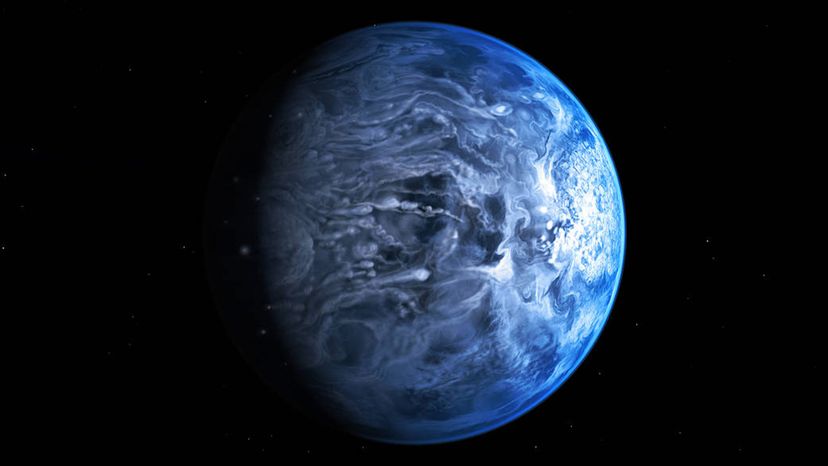
The cobalt blue color of HD 189733b comes not from the reflection of a tropical ocean, but rather from a hazy, blow-torched atmosphere containing high clouds laced with silicate particles. Its winds blow up to seven times the speed of sound. Getting caught in the rain on this planet means death by a thousand cuts. This scorching alien world possibly rains glass — sideways — in its howling winds. ESO/M. Kornmesser
While all exoplanets hold a certain allure, some are particularly notable due to their unique characteristics, potential habitability or the circumstances of their discovery. Here are a few of these fascinating celestial bodies.
51 Pegasi b
This was the first exoplanet discovered around a sun-like star. 51 Pegasi b, also known as Dimidium, was discovered in 1995 and opened a new era in the search for exoplanets. It's a Hot Jupiter, meaning it's a gas giant that orbits extremely close to its star (every four Earth days), which results in blistering surface temperatures. This exoplanet is about 50 light-years away from Earth.
Advertisement
Kepler-22b
Discovered by NASA's Kepler Space Telescope in 2011, Kepler-22b was the first planet discovered within its star's habitable zone — the region where conditions might be just right for liquid water, as opposed to water vapor. We don't know for sure if it's a water world, but it's a tantalizing possibility. This super-Earth is over 600 light-years away and seems to have a moderate surface temperature of 72 degrees F (22 C). Its orbit is 290 Earth days.
Proxima Centauri b
Meet our nearest exoplanet neighbor: Proxima Centauri b. Located just over four light-years away, this Earth-sized planet orbits in the habitable zone of its red dwarf star, Proxima Centauri, the closest star to the sun. Its orbit takes around 11 Earth days.
Kepler-186f
This was the first Earth-size planet found orbiting within its star's habitable zone. Finding this planet in 2014 confirmed that planets the size of Earth could exist in the habitable zone of stars beyond our sun (previous discoveries showed much-bigger planets). Kepler-186f orbits its red dwarf star every 130 days and receives one-third of the energy from its star that Earth gets from the sun, so it's on the outer edge of the habitable zone.
Kepler-452b
Discovered in 2015, Kepler-452b was the first near-Earth-sized planet to be in the habitable zone of a sun-like star. The time it takes to orbit its star (385 Earth days) is also very close to that of Earth's. This makes it one of the most Earth-like planets we've found in terms of size, temperature and the type of star it orbits.
HD-189733b
This gas giant has a beautiful blue look from afar, but appearances sure can be deceiving. HD 189733b rains molten glass and experiences winds of around 5,600 miles (9,000 kilometers) per hour. This incredible speed causes the glass to blow sideways rather than fall to the ground. With an orbit of just two days, this exoplanet has temperatures of 1,700 degrees F (930 degrees C).
WASP-12b
Lastly, let's visit the pitch-black WASP-12b. This Hot Jupiter absorbs at least 94 percent of the light that hits it, making it one of the darkest-known exoplanets. Its discovery in 2008 challenged our understanding of what planets could look like. With an orbit of just one Earth day around its star, the planet's temperature is 4,000 degrees Fahrenheit (2,210 degrees Celsius); this heat is slowly tearing the planet apart. Its star will devour the planet in a mere 10 million years.
This article was created in conjunction with AI technology, then fact-checked and edited by a HowStuffWorks editor.
What's With the Weird Names?
Exoplanets are named after the stars they orbit, with lowercase letters tacked on in the order the planets are discovered. But if the system's so simple, why are the names so complicated? That's because, in order to have an idea of where a star is located, they sometimes include the galactic equivalent of latitude and longitude in the name, making their monikers pretty unwieldy in the process.
Advertisement
Cite This!
Please copy/paste the following text to properly cite this HowStuffWorks.com article: