Introduction to How Poison Ivy Works
![]() Photo courtesy National Park Service |
In this article, you'll discover how poison ivy causes that rash, learn where it grows, how to get rid of it and how to spot it before you get too close.
Poison Ivy Basics
![]() Photo courtesy Jon Sachs, poison-ivy.org A blistered poison ivy rash |
The culprit behind the rash is a chemical in the sap of poison ivy plants called urushiol (oo-roo-shee-ohl). Its name comes from the Japanese word "urushi," meaning lacquer. Urushiol is the same substance that triggers an allergic reaction when people touch poison oak and poison sumac plants. Poison ivy (Toxicodendron radican), Eastern poison oak (Toxicodendron quercifolium), Western poison oak (Toxicodendron diversilobum), and poison sumac (Toxicodendron vernix) are all members of the same family -- Anacardiaceae.
![]() Photo courtesy Jon Sachs, poison-ivy.org Poison ivy plants creeping along the ground. |
About 85 percent of people are allergic to the urushiol in poison ivy, according to the American Academy of Dermatology [ref]. Only a tiny amount of this chemical -- 1 billionth of a gram -- is enough to cause a rash in many people. Some people may boast that they've been exposed to poison ivy many times and have never gotten the rash, but that doesn't necessarily mean they're not allergic. Sometimes the allergy doesn't emerge until you've been exposed several times, and some people develop a rash after their very first exposure. It may take up to ten days for the rash to emerge the first time.
We'll take a closer looks at some of the different types of poison plants on the next page.
Poison Plants
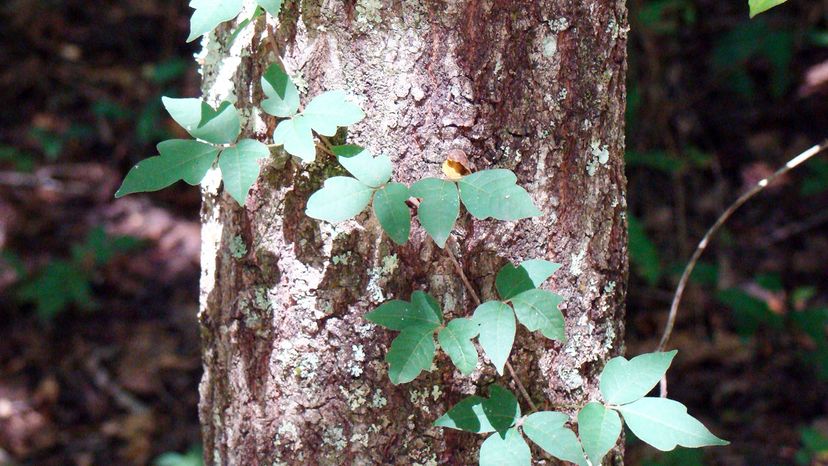
Because urushiol is found in all parts of the poison ivy plant -- the leaves, stems, and roots -- it's best to avoid the plant entirely to prevent a rash. The trouble is, poison ivy grows almost everywhere in the United States (with the exception of the Southwest, Alaska, and Hawaii), so geography won't help you. The general rule to identify poison ivy, "leaflets three, let it be," doesn't always apply. Poison ivy usually does grow in groups of three leaves, with a longer middle leaf -- but it can also grow with up to nine leaves in a group.
![]() Photo courtesy Jon Sachs, poison-ivy.org The leaves of the poison ivy plant turn red and yellow for fall. |
Here are some other ways to identify the poison ivy plant:
- It generally grows in a cluster of low, weed-like plants or a woody vine which can climb trees or fences.
- It is most often found in moist areas, such as riverbanks, woods, and pastures.
- The edges of the leaves are generally smooth or have tiny "teeth." Their color changes based on the season -- reddish in the spring; green in the summer; and yellow, orange, or red in the fall.
- Its berries are typically white.
Poison ivy's cousins, poison oak and poison sumac, each have their own unique appearance.
![]() Photo courtesy Jon Sachs, poison-ivy.org Poison sumac |
Poison sumac mainly grows in moist, swampy areas in the Northeast, Midwest, and along the Mississippi River. It is a woody shrub made up of stems with rows of seven to thirteen smooth-edged leaflets.
|
|
Poison Ivy and the Immune System
![]() Photo courtesy Jon Sachs, poison-ivy.org Climbing poison ivy |
Here's how the poison ivy response occurs. Urushiol makes its way down through the skin, where it is metabolized, or broken down. Immune cells called T lymphocytes (or T-cells) recognize the urushiol derivatives as a foreign substance, or antigen. They send out inflammatory signals called cytokines, which bring in white blood cells. Under orders from the cytokines, these white blood cells turn into macrophages. The macrophages eat foreign substances, but in doing so they also damage normal tissue, resulting in the skin inflammation that occurs with poison ivy.
The allergic reaction to poison ivy is known as delayed hypersensitivity. Unlike immediate hypersensitivity, which causes an allergic reaction within minutes of exposure to an antigen, delayed hypersensitivity reactions don't emerge for several hours or even days after the exposure.
Most people don't have a reaction the first time they touch poison ivy, but develop an allergic reaction after repeated exposure. Everyone has a different sensitivity, and therefore a slightly different reaction, to poison ivy. Sensitivity usually decreases with age and with repeat exposures to the plant.
Poison Ivy Symptoms and Treatment
In the places where your skin has come into contact with poison ivy leaves or urushiol, within one to two days you'll develop a rash, which will usually itch, redden, burn, swell, and form blisters. The rash should go away within a week, but it can last longer. The severity of the reaction often has to do with how much urushiol you've touched. The rash may appear sooner in some parts of the body than in others, but it doesn't spread -- the urushiol simply absorbs into the skin at different rates in different parts of the body. Thicker skin such as the skin on the on soles of your feet, is harder to penetrate than thinner skin on your arms and legs.
![]() Photo courtesy Theresa L. Ford A crusty poison ivy leg rash |
Call your doctor if you experience these more serious reactions:
- Pus around the rash (which could indicate an infection)
- A rash around your mouth, eyes, or genital area
- A fever above 100 degrees
- A rash that does not heal after a week
Any of the following symptoms require immediate emergency medical assistance:
- Swelling of the throat, tongue, or lips and/or difficulty swallowing
- Difficulty breathing
- Weakness
- Dizziness
- Bluish lips
The quicker you treat poison ivy, the greater the odds that you can remove at least some of the urushiol before it gets into your skin, and you may be able to ward off a reaction. As soon as you notice that you've touched poison ivy (or poison oak or sumac):
![]() Photo courtesy HowStuffWorks Shopper Over-the-counter corticosteroid creams can relieve itching. |
- Rinse off your skin immediately with water. Rinsing within the first five minutes of contact is most effective.
- Remove all clothes that have come in contact with the plant and wash them with soap and water.
- Wash your skin with soap and cool water.
- Using a cotton ball, cleanse the affected areas of your skin with isopropyl (rubbing) alcohol.
Once the rash appears, you'll most likely be very itchy, but try not to scratch. Although breaking the blisters by scratching can't spread the rash, the bacteria under your skin can cause an infection and leave scars.
The rash should go away on its own within two weeks. If you're in a lot of discomfort, you can use wet compresses or soak the affected areas in water. You can also apply a topical corticosteroid (over-the-counter brands such as Cortaid and Lanacort), or take an over-the-counter antihistamine (such as Benadryl) to relieve the itching. Prescription cortisone can stop the reaction, but only if it is taken soon after exposure. Other topical products that can soothe itching are calamine lotion, zinc oxide ointment, baking soda paste (3 teaspoons baking soda and 1 teaspoon water), or an oatmeal bath (Aveeno).
Avoiding Poison Ivy
Poison ivy is often difficult to avoid. Even if you don't directly brush up against the plant, you can get poison ivy from touching a garden tool, ball, or even a pet (animals don't have the same sensitivity) that has urushiol on it. Some creams containing the ingredient bentoquatum can block urushiol and offer some protection before poison ivy exposure. Still, your best defense is to stay away from poison ivy and to get rid of it in your yard.
![]() Photo courtesy HowStuffWorks Shopper This product claims to protect you against poison ivy. | ![]() Photo courtesy HowStuffWorks Shopper Try spraying the plant with a weed killer. |
But the plant is not an easy foe to defeat. If you spray it with a weed killer (products such as Roundup and Kleenup, which contain the ingredient glyphosate), you may kill the poison ivy, but you must be careful not to kill any other plants around it. The other option is to remove the poison ivy by hand, but you must wear a long-sleeved shirt, long pants, gloves, and boots to avoid any contact with your skin. Clean your clothes as soon as you're finished with water and soap or isopropyl alcohol. Be sure to pull the plants out from the roots, because any trace of a plant you leave behind can regrow. Never burn the plant, because the urushiol vaporizes when heated. When it gets into the smoke, it can severely irritate the lungs.
To find out more about poison ivy and related topics, check out the links on the following page.
| Reality: You can't spread poison ivy by coming into contact with a person who has it, unless that person has urushiol on their skin. You can, however, pick it up by touching a dog that has gotten poison ivy on its fur, or by touching the blade of a weed whacker that you just used to cut down the plants. Myth: You can spread poison ivy to other parts of your body by picking at the blisters on your skin. Myth: If I eat poison ivy, I'll become immune to it in the future. Myth: Some people are so sensitive to poison ivy that they can catch it just by being near the plant. Myth: You can't get poison ivy from a dead plant. |
Lots More Information
Related HowStuffWorks Articles
- How Allergies Work
- How Cells Work
- How Your Immune System Works
- How Sunburns and Sun Tans Work
- When you have an itch, what is happening under your skin?
More Great Links
- What Poison Ivy Looks Like
- Poison Ivy, Oak & Sumac Information Center
- American Academy of Dermatology: Poison Ivy, Oak & Sumac
- Department of the Interior Poison Ivy Fact Sheet -- PDF
Sources
http://www.fda.gov/fdac/features/796_ivy.html
http://www.bio.umass.edu/micro/immunology/poisoniv.htm#pi-acd
http://medical.smis.doi.gov/POISON%20IVY%20FACT%20SHEET.pdf
http://www.conservation.state.mo.us/nathis/plantpage/flora/poivy/
http://www.aad.org/public/Publications/pamphlets/Poison_IvyOakSumac.htm
http://www.goaskalice.columbia.edu/1354.html


