Introduction to How Spud Guns Work
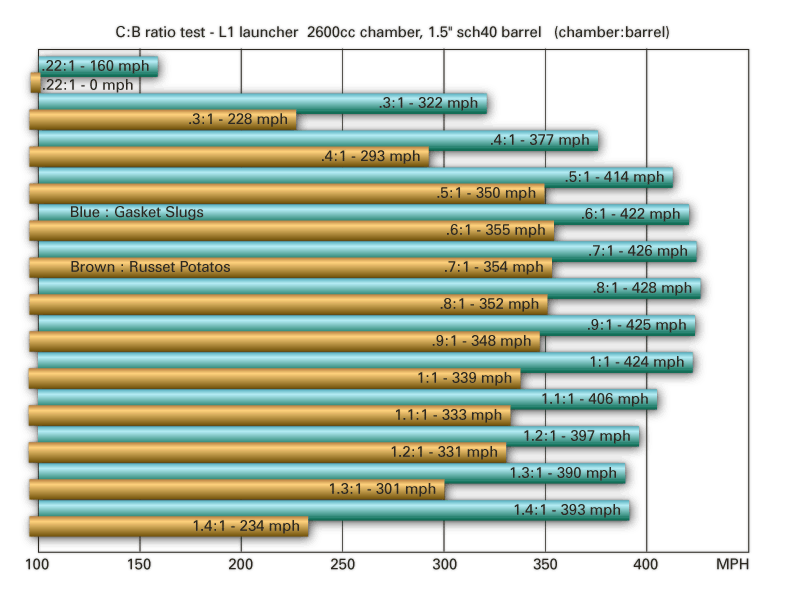
At the touch of a button, an explosion hurls a projectile hundreds of feet at close to 400 miles (643.7 km) per hour, obliterating a target [source: Burnt Latke]. But the explosion isn't from a cannon or a rocket launcher. It's from a spud gun.
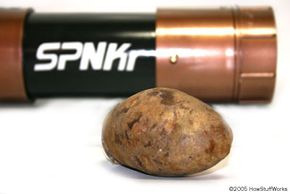
![]() The HowStuffWorks spud gun, with spud. See more spud gun pictures. |
Spud guns come in a variety of shapes, sizes and configurations. Depending on the size of the barrel, they can fire a number of common objects, including potatoes, tennis balls and polyvinyl chloride (PVC) rockets. The only requirement is that the size of the projectile fits the size of the barrel. "The projectiles," says Joel Suprise, owner of The Spudgun Technology Center, "are pretty much limited to one's imagination."
We interviewed Suprise to get a better look at how spud guns work and what they can do. In this article, we will examine the science behind spud guns' ability to fire potatoes over long distances. We will also discuss other uses for spud guns as well as safety and legal issues.
|
|
Spud Gun Theory
The two basic types of spud gun -- combustive and pneumatic -- each use a rapidly expanding volume of gas to move a potato. Both types of guns are typically made of PVC pipe, although some people use acrylonitrile butadiene styrene (ABS), aluminum or other piping materials.
|
|
All spud guns have the same basic components:
- A chamber in which gas reaches a high pressure
- A barrel for the projectile
- Some type of firing mechanism
Typically, the sharpened end of the barrel acts as a barrel knife, which shaves off the excess potato during loading.
![]() Photo courtesy The Spudgun Technology Center Combustion spud guns with various features and levels of complexity |
The method for creating high-pressure gas is what differentiates combustive and pneumatic spud guns. "A combustion-based spud gun," says Suprise, "uses a flammable vapor...you have a fuel-air mix in a chamber, and then you have an ignition source, typically an electric barbecue sparker, something of that nature, which will ignite that flammable mix." When the vapor ignites, the resulting explosion creates a large volume of hot gas, which forces the potato down the length of the barrel and out.
A pneumatic spud gun uses compressed air rather than flammable gas. Suprise explains:
You have a large-volume chamber that you pressurize with an air compressor or a regulated CO2 tank or something of that nature, and then a fast-acting dump valve, and then your barrel…when you fire that valve, that dumps that entire amount of air…just in the blink of an eye, sending your projectile down the barrel at great velocities.
In the next section, we'll examine the differences between combustive and pneumatic guns and how each generates the pressure needed to fire the potato.
|
|
Anatomy of a Spud Gun: Combustive
|
|
![]() The HowStuffWorks combustion spud gun |
An actual igniter placed inside the chamber would be prone to damage from heat, fire and fuel. That's why many spud guns use two metal points within the chamber to create the spark. Current from the ignition device -- often a grill starter or stun gun -- travels into the chamber, and a spark jumps from one point to the other, just like a spark plug in a car.
|
|
Now, let's look at how pneumatic spud guns create the pressure necessary to fire a potato.
Anatomy of a Spud Gun: Pneumatic
A pneumatic spud gun uses the same principles of force as a combustive gun. However, instead of using an explosion to generate force, it uses compressed air.
A pneumatic spud gun generally has a larger chamber than a combustive model. The user fills the chamber with air from a pump, an air compressor or a CO2 tank. "With a pneumatic launcher, you have a large volume of relatively high pressure, say 80-100 PSI, that is being dumped instantly…so a good rule of thumb is that a pneumatic launcher will be more powerful than a combustion-based launcher," says Suprise.
![]() Photo courtesy The Spudgun Technology Center A pneumatic spud gun |
A valve, typically a sprinkler, ball or piston valve, lies between the pneumatic gun's chamber and the barrel. This valve keeps all the air inside the chamber while the pressure builds. The operator uses a gauge to keep an eye on the pressure. When it reaches a suitable level, the operator disconnects the tank and presses the button or pulls the lever that opens the valve. The air rushes into the barrel, forcing the potato out.
|
|
Next we'll look at some other ways that spud guns can be used -- aside from firing spuds.
Other Uses for Spud Guns
Spud guns can be used for a variety of purposes other than recreationally firing potatoes at targets. The basic pneumatic spud gun design also powers t-shirt and confetti launchers often used at sporting events.
![]() Photo courtesy The Spudgun Technology Center A custom air cannon built for use as a tornado simulator for the U.S. Department of Agriculture. |
Suprise has designed a special effects air cannon, which creates fireballs, debris explosions and water effects for films. He has also created a tornado simulator for the United States Department of Agriculture: "It's a massive air cannon...its primary purpose is to fire a 12-foot-long, 15-pound chunk of 2 x 4 at a wall at 100 miles an hour, and that is to simulate the effect of flying debris during a tornado for the purpose of developing new building materials, building techniques, so on and so forth."
![]() Photo courtesy World Championship Punkin Chunkin |
For some, a small device that fires a potato is not enough of a challenge. They instead use larger, heavier projectiles -- like pumpkins. There is even an annual World Championship Punkin Chunkin competition.
|
|
Next, we'll look at laws and safety precautions aimed at spud gun use.
Spud Gun Safety & Legal Issues
![]() A harmless little spud, sans gun |
People use spud guns for fun and recreation, but they are not toys. "You know, they can be extremely, extremely dangerous...if used unsafely or inappropriately," says Suprise. "You never look down the barrel of a loaded spud gun, no matter what type it is."
Igniting a flammable gas is, naturally, a hazardous process. But using the correct fuel minimizes the risk. Acetylene, gasoline, gunpowder and oxygen are dangerous, and spud guns should never use these fuels.
Stray projectiles can cause property damage, serious injuries and death. An ideal spud gun firing range is a large, open area, far from people or buildings. In addition, several basic rules are vital to the safe use of spud guns. The Spud Gun Technology Center has a comprehensive list of safety guidelines.
The United States Bureau of Alcohol, Tobacco and Firearms does not classify spud guns as firearms when they are used appropriately -- that is recreationally, and without intent to harm people or damage property. However, firing a spud gun is illegal in most cities, and some states have outlawed them. Other countries have their own regulations regarding spud gun ownership and use.
For more information about spud guns and related topics, check out the links on the next page.
Lots More Information
Related HowStuffWorks Articles
More Great Links
Sources
http://www2.ljworld.com/news/2003/oct/29/airpowered_cannon_chucks