Antisubmarine Warfare

Antisubmarine warfare (ASW) is the branch of naval warfare devoted to denying the enemy effective use of his submarines. It includes not only the seeking out and destroying of enemy submarines, but also passive defensive measures (such as sailing in a zigzag course) and the destruction of the enemy's submarine bases. ASW was of major importance in both World Wars and, with the development of nuclear-powered submarines carrying nuclear-armed missiles, has become even more important since.

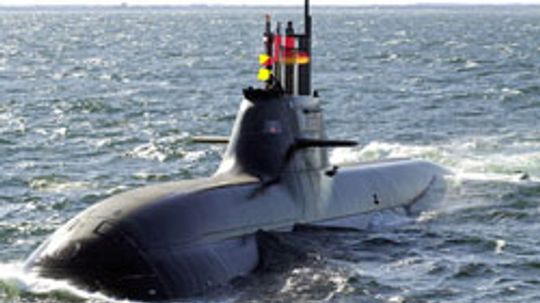
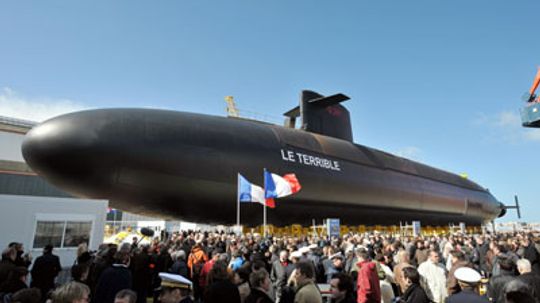
Many types of naval vessels and aircraft carry instruments that can detect and weapons that can sink submarines. The most effective weapon against a submarine, however, is another submarine. Attack, or hunter-killer, submarines, developed after World War II, are designed for the specific purpose of finding and destroying enemy submarines. They carry a variety of detection devices and antisubmarine weapons, and can operate either independently or in close coordination with surface ships and aircraft.

In both World Wars I and II, the convoy system, in which Allied merchant ships traveled in large groups protected by escort vessels (mainly destroyers and cruisers), was the most effective measure used to prevent German submarines from dealing a death blow to Allied shipping. In World War II, air cover (airplanes or blimps) was also used to protect convoys. Aircraft from escort carriers (CVE's) were especially effective.

Detection of Submarines

Sonar was widely used in World War II and is the most important instrument for detecting enemy submarines. An important consideration in submarine design is the reduction of selfnoise (the noise made by the submarine itself) to the lowest possible level—both as a defense against enemy vessels' passive sonar and to increase the effectiveness of the submarine's own passive sonar. Many submarines and ASW surface ships tow sonar arrays at some distance behind them to minimize the interference caused by self-noise.

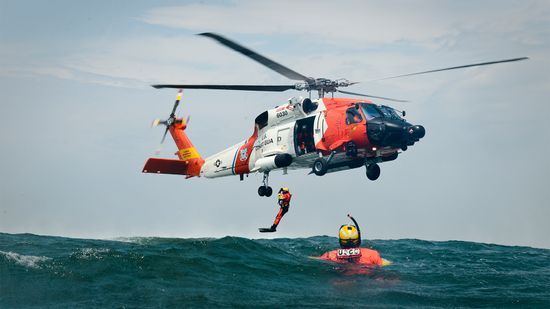
Sonar equipment is carried by ASW helicopters and airplanes as well as by submarines and naval surface vessels. Helicopters and airplanes drop expendable sonar-equipped floats called sonobuoys into the water where the presence of an enemy submarine is suspected. Each sonobuoy has a radio transmitter to send sonar data to monitoring aircraft or surface ships in the vicinity. Helicopters also use dunking sonar, or dipping sonar, a sonar array that is lowered into the water while the helicopter hovers.

Thermoclines—layers of water in which the temperature of the water changes rapidly with increasing depth—tend to reflect sound waves. Sonar equipment called variable-depth sonar is designed to be lowered by cable through a thermocline to detect any submarines positioned below it.

Networks of seabed sonar devices have been installed in navigational channels through which submarines must usually pass. The United States maintains such a network, called SOSUS (sound surveillance system), at several strategic locations.

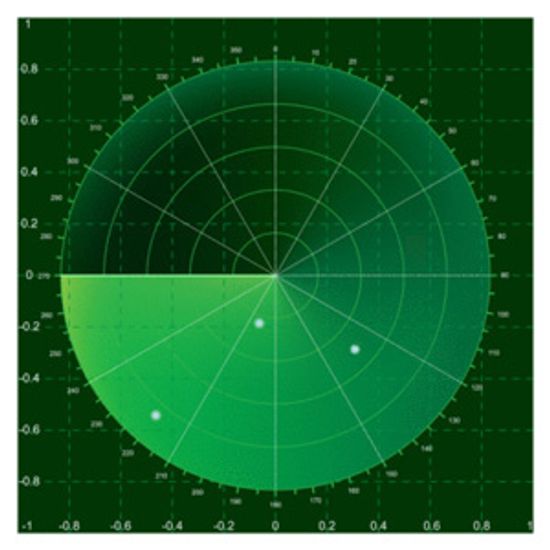
Radar, usually located on retractable masts, can detect surfaced submarines at distances as far as the horizon but cannot detect submerged submarines because the electromagnetic waves used in radar will not penetrate water effectively.

The radio direction-finder “net,” consisting of a widely scattered group of ships equipped to pick up enemy radio transmissions, was used in World War II to locate enemy submarines. The positions of the submarines were obtained by using cross bearings (compass bearings taken simultaneously from two or more ships). Electronic-countermeasures (ECM) equipment installed on aircraft, surface ships, and submarines is used to locate enemy submarines while on the surface by picking up their electronic transmissions.

The magnetic-anomaly detector (MAD) is a device that detects distortions (anomalies) in the earth's magnetic field that are caused by submarines. It works on the principle that a piece of magnetic material (for example, a steel submarine), when placed in a magnetic field, will distort the lines of force associated with the field. The magnetic-anomaly detector is carried by an aircraft, and its chief component is an instrument called a magnetometer. The range of the MAD is so short that a MAD-equipped aircraft has to be almost directly above a submarine before the device will indicate the submarine's presence.

Some artificial satellites carry equipment that has been developed for detecting submarines. This equipment includes infrared (thermal) detectors that are sensitive enough to detect the low levels of heat in a submarine's wake.

Destruction of Submarines

At the beginning of World War I, the first war in which submarines were used extensively, the only measures available against enemy submarines were gunfire, ramming, minefields, and antisubmarine nets. Minefields and nets were used to prevent enemy submarines from passing through certain areas, such as entrances to harbors, and are still available for this purpose..

Torpedoes orginally were intended to be used only against surface ships but subsequently were developed into effective antisubmarine weapons. They can be launched from airplanes, surface ships, or submarines. A subroc is a rocket-propelled torpedo.

Homing torpedoes (also called acoustic torpedoes) were developed during World War II. A passive homing torpedo is designed to detect the sound of a submarine's propellers or engines and home in on it; an active homing torpedo uses a tiny echo-sounding device to find its target. A wire-guided torpedo is controlled by signals transmitted through a wire connecting it to the launching ship. The variable-speed torpedo moves slowly as it approaches a target ship. Once it is at close range, the torpedo accelerates greatly, to make evasive maneuvers by the target ship very difficult.

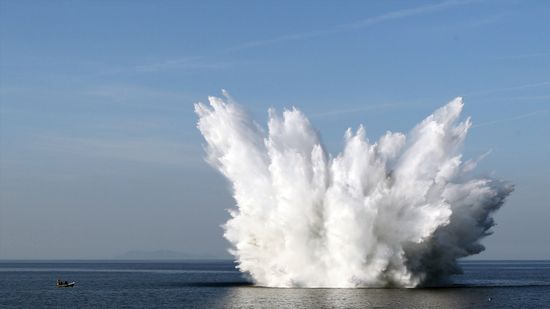
Depth charges were developed during World War I. They are carried by surface ships and are either fired from deck guns or dropped over the side or stern of the attacking ship. The depth at which they explode can be preset. Depth bombs are similar to depth charges but are dropped from aircraft.

The hedgehog, a rocket-propelled antisubmarine weapon, was developed during World War II. Twenty-four hedgehog charges are fired simultaneously from a 24-tube gun and land ahead of the attacking ship in a circular pattern about 200 feet (60 m) in diameter. A hedgehog charge—unlike a depth charge—explodes only if it hits the target, and therefore the sonar search for the enemy submarine can continue without being adversely affected by explosions in the water. Its short range, about 285 feet (87 m), is ill-suited for modern warfare.