Key Takeaways
- The myth that turkeys will drown if they look up during a rainstorm is false, though they do sometimes look up due to a genetic condition called tetanic torticollar spasms.
- Turkeys have monocular vision, meaning they can look at two different things simultaneously, but this doesn't cause them to drown in rain.
- Despite their reputation, turkeys are social and intelligent birds, capable of running, flying short distances and even swimming.
Turkeys are the mainstay of in the U.S. Maybe it's their awkward gait, the wobbly red wattles under their necks or the strange sounds they make, but turkeys have gained a reputation for being stupid creatures. Some people even use the word "turkey" to mean inept or stupid.
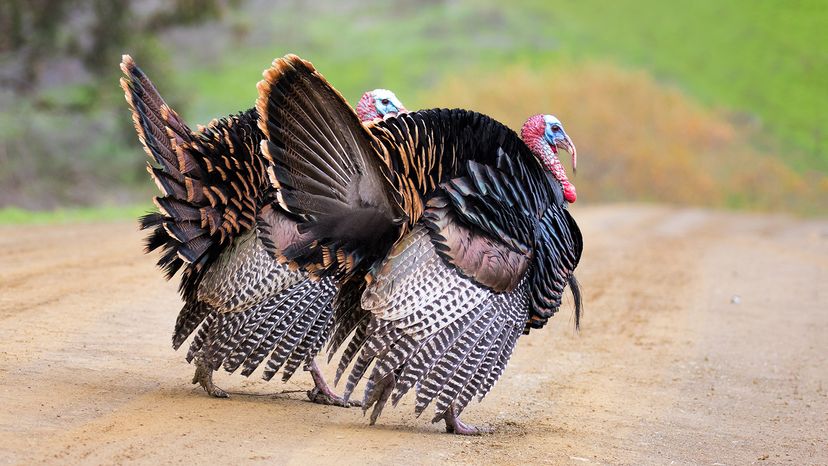
Perhaps the "dumb bird" reputation is the reason behind the tale that during a rainstorm, turkeys will stare up at the sky with their beaks hanging open, transfixed, until they drown. Although turkeys sometimes do tilt their heads up at the sky and remain there for several moments, scientists say the idea that turkeys drown that way is just a myth.
Advertisement
Turkeys have monocular vision. Their eyes are located on each side of their head so they can look at two things at once, but both eyes can't focus on the same image at the same time like human eyes. (We humans have binocular vision.) Although this feature helps turkeys avoid potential predators, it doesn't give them very much depth of vision. Turkeys tend to tilt their heads to the side to get a better look at something. If a turkey were to tilt its head backward to look at the rain, it would likely have trouble focusing on the raindrops.
So why do turkeys sometimes stare skyward? Tom Savage, a former professor of animal science at Oregon State University, said that the root of this behavior is not stupidity, but genes. In the early 1990s, he discovered an inherited condition in turkeys, called tetanic torticollar spasms. This condition can cause turkeys to exhibit abnormal behaviors, such as looking at the sky for 30 seconds or more at a time.
Turkeys actually aren't as dumb as they may look. They socialize with each other, and if humans are around, they will come over to greet them.
Here are some real facts about turkeys:
- Domestic turkeys can't fly; they lose their aerodynamic properties because of how they are bred for heavy meat production, although they will sometimes try to hop around. Wild turkeys, however, can fly for short bursts. They're surprisingly fast, on the ground or in the air, reaching speeds of 25 mph (40 kph) on land and 60 mph (97 kph) in the air, says Scientific American.
- Turkeys get spooked by loud noises, and when they do, they often crowd together along a fence.
- Benjamin Franklin was a fan of the turkey, calling it a "bird of courage" and comparing it favorably to the bald eagle, which he said was a bird of "bad moral character," according to the Franklin Institute.
Advertisement