WK2 and SS2 Flight Plans

The flight plan for Virgin Galactic's WK2/SS2 flights calls for a suborbital flight. A suborbital flight has a parabolic flight path -- like the shape that's made when you throw a rock into the air and it falls back down. The spacecraft won't fly fast enough to go into low Earth orbit as the space shuttle does (meaning it won't travel around the globe). The flights will be somewhat like the early Mercury flights of Alan Shepard and Virgil I. Grissom, but will last longer.

earth from space
Photo courtesy Virgin Galactic
A view of the Earth from SpaceShipOne

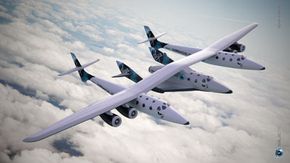
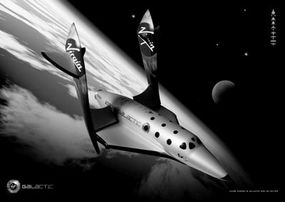
WK2 will take off from the ground like any jet aircraft -- but with SS2 attached to the underside. When it gets to an altitude of 50,000 feet, it will release SS2. When the SS2 pilots ignite the hybrid rocket motor, SS2 will accelerate vertically to Mach 3 in about 90 seconds (the crew and passengers will experience 3 to 4 Gs during this time) and climb to more than 300,000 feet (91,440 meters). After the engine is shut off, the wings will be feathered in preparation for re-entry (see previous page). During this time, SS2 will be at its highest point -- about 360,000 feet (109,728 m) -- and the crew and passengers will experience weightlessness.

Mach Numbers
In physics, velocity is expressed in terms of meters per second. In aerodynamics, velocity is often expressed relative to the speed of sound (1,100 ft/s or 343 m/s). The unit is called the Mach number after physicist Ernst Mach. An aircraft traveling at the speed of sound moves at Mach 1. An aircraft flying at twice the speed of sound is moving at Mach 2. So, the Mach number is a multiple of the speed of sound.

Then the passengers return to their seats and recline for re-entry. During re-entry, the passengers will pull about 6 Gs. SS2 will feather until it falls to an altitude of 70,000 feet, when the pilots reconfigure the wings from feather mode to glider mode, and SS2 will glide to a landing back at the spaceport. The total flight time will have been two and a half hours. Upon return, the passengers will celebrate and receive their astronaut wings.

In the United States, people who fly more than 50 miles (264,000 feet) above the Earth are designated as astronauts (the Fédération Aéronautique Internationale considers those who fly above 62 miles (327,000 feet) to be astronauts). Virgin Galactic will award passengers astronaut wings after their flight, and the Federal Aviation Administration may give them astronaut badges as well.

G-forces
Acceleration is the rate of change of velocity. When your car is going from zero to 60 mph in 30 seconds, you're accelerating. In physics, acceleration is measured in meters per second squared. However, because we're familiar with that we experience due to Earth's gravity (g = 9.8 m/s2), acceleration is sometimes expressed in terms of Gs (1 G = 9.8 m/s2, 2 Gs = 19.6 m/s2, 3 Gs = 29.4 m/s2, etc.). According to Newton's second law of motion, acceleration is directly proportional to the force experienced divided by the mass of an object -- so, Gs are also associated with the force that a given mass experienced during acceleration. For example, when you start, corner or brake a typical car, you experience anywhere from 0.3 to 1 G. A roller coaster may accelerate you to 3 or 4 Gs for brief periods. Fighter pilots can experience as much as 8 Gs.

Accelerations affect the human body in various ways depending on the g-force and the length of time that you are exposed to those forces. At 2 Gs, your body will feel heavy (actually, because weight is equal to mass times acceleration (g), at 2 Gs you'll feel twice your body weight). At G forces above 4, people black out as it becomes harder for the heart to pump blood to the brain. To counteract this, spacecraft designs place astronauts in sitting positions in the direction of motion to distribute the g-forces equally across the body and limit the acceleration of the spacecraft, if possible. Fighter pilots wear special pressure suits that inflate and squeeze the abdomen to force blood to the pilot's head. Extreme accelerations (more than 15 Gs) can be fatal.