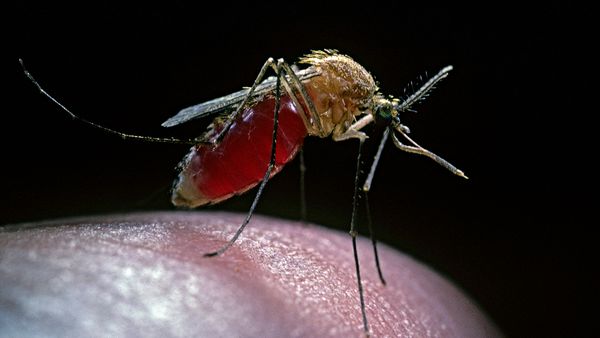
Not only do cockroaches creep most of us out, they can be responsible for allergies or aggravating asthma. See more insect pictures.
Entomologists estimate that there are between 5 and 10 million species of insects on Earth. But if asked which insect they hate the most, many people would have no trouble choosing just one -- the cockroach.
There are plenty of reasons to dislike cockroaches. Their flattened bodies, leathery wings, skittering legs and long, waving antennae give some people the creeps. Because roaches eat garbage and waste, they can spread bacteria like Salmonella and Shigella from place to place. As they walk, they leave trails of fecal matter, which they use to find their way around. On top of being gross, these trails can cause stains and odors. The proteins in cockroach saliva and waste can also cause allergies and aggravate asthma.
Advertisement
People also hate roaches because they can be extremely difficult to get rid of. One reason is because of their natural behavior. They reproduce quickly and are hard to kill. Since they're nocturnal, many people don't notice their presence until there are so many that they've run out of places to hide. Roaches are particularly good at dodging and running from shoes, newspapers and other weapons, and several species have become resistant to insecticides.
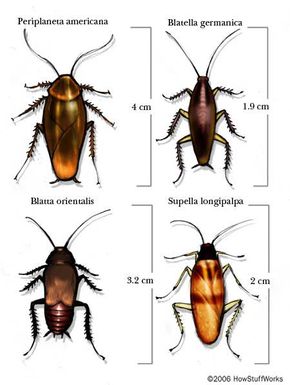
But of the 4,000 roach species that exist in the world, only a handful of them plague homes and businesses. These pest species include:
Blatella germanica, the German cockroach
Periplaneta americana, the American cockroach or palmetto bug
Supella longipalpa, the brown-banded cockroach
Blatta orientalis, the oriental cockroach
In fact, in many parts of the world, just one species -- the German cockroach -- is responsible for most infestations. Unfortunately, people take much of the blame for this worldwide prevalence. Most cockroach pests have spread across the planet by hitchhiking on boats, airplanes, trucks and even in moving boxes and grocery bags.
While Blatella germanica and a few others make nuisances of themselves, most species of cockroach generally mind their own business. Many cockroaches live in warm, tropical areas and feed on decaying wood and leaves. They help break down this organic debris; in the process, they add nutrients to the soil through their waste. They're also a food source for small reptiles and mammals. In other words, in spite of their bad reputation, cockroaches are an important part of many ecosystems.
Whether they're digesting wood pulp in a rainforest or hiding under a refrigerator, cockroaches are fascinating. They're primitive insects -- they existed millions of years before dinosaurs did and have evolved very little since then. In spite of their unchanging nature, they've survived when other species have not. For example, dinosaurs became extinct 65 million years ago, but cockroaches have thrived for 320 million years. We'll look at the physical features behind this uncanny survival next.
Most people can recognize cockroaches instantly. They're brown or black insects that are usually between half an inch and two inches long (12-50 millimeters), minus their long antennae. Their heads point downward, almost as if they're built for ramming. Males usually have wings, but females often don't. Those that do usually have vestigial wings -- small, undeveloped wings that often don't allow the roach to fly.
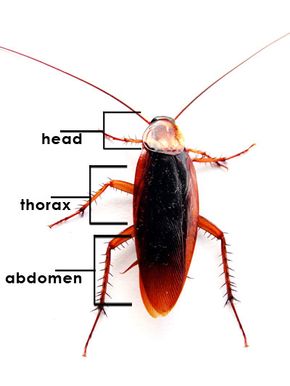
Although their reputation often sets them apart, roaches have a lot in common with other insects. Their bodies have three primary regions -- the head, the thorax and the abdomen. They have three pairs of jointed legs, one pair of antennae and a rigid exoskeleton. Roaches shed their exoskeleton, or molt, several times during their lives. After molting, most roaches are white and easily injured until a hormone called bursicon causes the exoskeleton to darken and harden. Sometimes, a roach can re-grow a lost limb when it molts and even put off molting to allow the new limb to grow.
Advertisement
Roaches' heads house their eyes, antennae and mouthparts. Contrary to popular perception, their heads also house their brains. However, much of their nervous system activity takes place in nerve ganglia located throughout their bodies. This is one of the reasons why a headless roach can live for more than a week. The other is that roaches don't breathe through a nose or mouth. Instead, they draw air through spiracles, or holes in their sides. Tubes called tracheae deliver oxygen from the spiracles to organs and tissues. When a headless roach finally dies, it dies of thirst.
Although not as distinctive as the eyes of dragonflies or houseflies, cockroaches' eyes are compound and are made of photoreceptor cells called ommatidia. A hard ring called the ocular sclerite surrounds the photoreceptors. Because of this compound structure, cockroaches see the world as a mosaic.
Movable antennae, also known as antennal flagella, allow roaches to feel and smell the world around them. Although the antennae look like threads, they're really made of lots of tiny, hair-covered segments. These segments are shorter and thicker near the roach's head, and they're longer and thinner near the tips.
Roaches' mouths, like those of other insects, are significantly different from mammals' mouths. However, many mouthparts serve the same function as parts of a mammal's mouth:
The labrum and labium form lips.
Two mandibles have cutting and grinding surfaces like teeth.
Two maxillae manipulate the food while the roach chews.
The Thorax
A roach's thorax houses the attachments for three pairs of legs and, if the roach has them, two pairs of wings. Each of the three pairs of legs is named after the region of the thorax to which it attaches:
The prothoracic legs are closest to the roach's head. These are the roach's shortest legs, and they act like brakes when the roach runs. A portion of the prothorax also covers the roach's head.
The middle legs are the mesothoracic legs. They move back and forth to either speed the roach up or slow it down.
The very long metathoracic legs are the roach's back legs, and they move the roach forward. Using its metathoracic legs, a roach can move about 50 body lengths in a second. A human moving that quickly would be running about 200 miles per hour. When a roach runs this quickly, it sometimes raises up and runs on its back legs only. The force of the air it encounters keeps it upright.
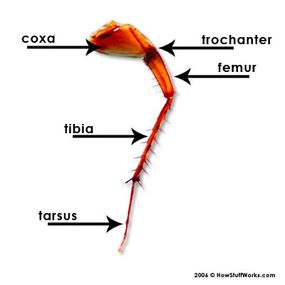
Anatomy of a cockroach leg
These three pairs of legs have substantially different lengths and functions, but they have the same parts and move the same way. The upper portion of the leg, called the coxa, attaches the leg to the thorax. The other parts of the leg approximate parts of a human leg:
The trochanter acts like a knee and lets the roach bend its leg.
The femur and tibia resemble thigh and shin bones.
The segmented tarsus acts like an ankle and foot. The hook-like tarsus also helps roaches climb walls and walk upside down on ceilings.
Each leg moves up and down like a pogo stick and back and forth like a pendulum. The front and back legs on one side move at the same time as the middle leg on the other side. In this way, the roach can move over nearly any terrain.
When a roach is running as fast as it can, its legs move back and forth about 27 times per second. When it runs upside down on a ceiling, it takes longer steps in an attempt not to fall down. In fact, it takes significantly more energy for a roach to run upside down than to run up a vertical wall.
The Abdomen
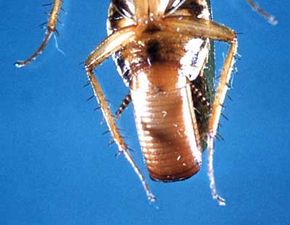
Most insects have a segmented abdomen that contains most of their internal organs, and roaches are no exception. Inside a roach's abdomen, a tube-like heart moves blood to organs and tissues. Unlike human blood, a roach's blood doesn't use hemoglobin to carry oxygen, so it is colorless instead of red. The blood also doesn't travel through an extensive circulatory system. Although an aorta carries blood to specific organs, much of the blood travels through a network of spaces called a hemocoel. Roaches also store fat a little differently than people do. Instead of spreading it throughout most of their physical structure, they store it in one centralized location called the fat body.
A roach's digestive system is located in its abdomen, and much of it resembles a simplified version of a mammal's digestive system. However, a roach's digestive system has a few modifications that let it eat cellulose and other tough materials. One of these is a crop, which holds swallowed food until a toothy section of the digestive tract, called the proventriculus, can pulverize it. Sacs called the gastric cacea hold enzymes and microbes that continue to digest the food. This extra digestive help is particularly important if the roach eats cellulose or wood. Only after the material is thoroughly broken down can the roach's midgut absorb the food's nutrients.
Two segmented cerci lie on the exterior of the lower part of a roach's abdomen. These somewhat resemble antennae, and they can behave as sensory organs. A nerve inside the roach allows it to detect air movement around its cerci. This is one reason roaches can move out of the way very quickly if you try to catch or crush them.
Roaches' reproductive systems are also located in their abdomen. We'll look at this system and at the cockroach life cycle next.
Straight from the Roach's Antenna and Cockroaches as Prey
Often, an antenna will continue to react to stimuli even after it has been removed from a roach. Scientists have taken advantage of this phenomenon to create theelectroantennogram -- an antenna attached to an oscilloscope. Researchers have used this device to study cockroach pheromones, or chemicals used to attract other roaches. These pheromones could be used to make more effective roach baits.
Cockroaches may seem indestructible, but they are food for a variety of other animals. Some species of wasp use cockroaches as incubators for their eggs. A female wasp will sting a roach or remove its antennae to disable it. Then, she will lay her eggs inside the roach, where they will grow until they hatch. In addition, another household pest, the common house centipede, eats cockroach nymphs.
Advertisement
The Cockroach Life Cycle and Behavior
Female Blatella germanica with ootheca
Image courtesy CDC
As with many animals, cockroach reproduction relies on eggs from a female and sperm from a male. Usually, the female releases pheromones to attract a male, and in some species, males fight over available females. But exactly what happens after the male deposits his sperm into the female varies from species to species.
Most roaches are oviparous -- their young grow in eggs outside of the mother's body. In these species, the mother roach carries her eggs around in a sac called an ootheca, which is attached to her abdomen. The number of eggs in each ootheca varies from species to species. Many female roaches drop or hide their ootheca shortly before the eggs are ready to hatch. Others continue to carry the hatching eggs and care for their young after they are born. But regardless of how long the mother and her eggs stay together, the ootheca has to stay moist in order for the eggs to develop.
Advertisement
Other roaches are ovoviviparous. Rather than growing in an ootheca outside of the mother's body, the roaches grow in an ootheca inside the mother's body. In a few species, the eggs grow inside the mother's uterus without being surrounded by an ootheca. The developing roaches inside feed on the eggs' yolks, just as they would if the eggs were outside the body. One species is viviparous -- its young develop in fluid in the mother's uterus the way most mammals do. Ovoviviparous and viviparous species give birth to live young.
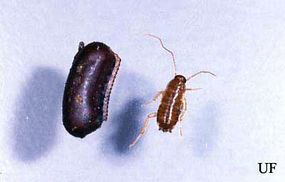
Oootheca and nymph of the oriental cockroach
Image courtesy Paul M. Choate, University of Florida
Whether mother roaches care for their young also varies from one species to another. Some mothers hide or bury their ootheca and never see their offspring. Others care for their offspring after birth, and scientists believe that some offspring have the ability to recognize their mothers. The number of young that one roach can bear also varies considerably. A German cockroach and her young can produce 300,000 more roaches in one year. An American cockroach and her young can produce a comparatively small 800 new roaches per year.
Newly hatched roaches, known as nymphs, are usually white. Shortly after birth, they turn brown, and their exoskeletons harden. They begin to resemble small, wingless adult roaches.
Nymphs molt several times as they become adults. The period between each molt is known as an instar. Each instar is progressively more like an adult cockroach. In some species, this process takes only a few weeks. In others, like the oriental cockroach, it takes between one and two years. The overall life span of cockroaches differs as well -- some live only a few months while others live for more than two years.
Cockroaches generally prefer warm, humid, dark areas. In the wild, they are most common in tropical parts of the world. They are omnivores, and many species will eat virtually anything, including paper, clothing and dead bugs. A few live exclusively on wood, much like termites do.
Although cockroaches are closely related to termites, they are not as social as termites are. Termite colonies have an organized social structure in which different members have different roles. Cockroaches do not have these types of roles, but they do tend to prefer living in groups. A study at the Free University of Brussels in Belgium revealed that groups of cockroaches make collective decisions about where to live. When one space was large enough for all of the cockroaches in the study, the cockroaches all stayed there. But when the large space was not available, the roaches divided themselves into equal groups to fit in the smallest number of other enclosures.
Another study suggests that cockroaches have a collective intelligence made up of the decisions of individual roaches. European scientists developed a robot called InsBot that was capable of mimicking cockroach behavior. The researchers applied cockroach pheromones to the robot so real roaches would accept it. By taking advantage of roaches' tendencies to follow each other, InsBot was able to influence the behavior of entire groups, including convincing roaches to leave the shade and move into lighted areas. Scientists theorize that similar robots could be used to herd animals or to control cockroach populations.
In addition to robotic intervention, there are several steps that people can take to reduce or eliminate cockroach populations. We'll look at these next.
Advertisement
Getting Rid of Roaches
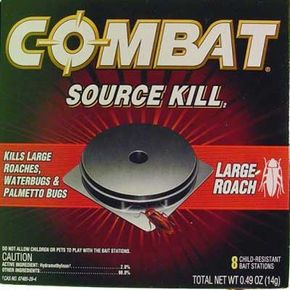
Example of a roach trap.
Image courtesy Amazon
Most pest control experts recommend two primary methods for controlling roaches. First, seal off any cracks or holes that roaches could use to get into your home. Roaches can fit into extremely small spaces, including cracks that are only 1/16 of an inch (1.5 millimeters) thick. For this reason, completely blocking all roach entrances can be very difficult. Determining which species of roach has entered your home can help you narrow down which parts of your home to focus on. The University of California has descriptions of the main pest species of cockroach and information on how to identify them.
Second, keep your home clean. Even spotless homes can become infested with roaches, but leaving food or garbage out in the open is likely to attract pests. Cover and seal all of your food, and wipe down counters and tables after eating. Sweep or mop your floor after cooking, and eat only in your dining area. Always wash dirty dishes promptly, since even tiny spots of food or grease can become food for roaches.
Advertisement
If these steps do not reduce the cockroach population in your home, the next step is to use traps to kill the roaches. Many experts suggest using traps before resorting to sprays or powders since you can look in the traps to see whether you've caught any roaches. If you haven't, you can move the traps to another location. This can help you figure out where the roaches are coming from and where to focus spray or powder treatments if they become necessary.
Many people prefer not to use poisons in their homes. However, experts caution that many natural devices for cockroach control, like ones that emit sound, do not really work. Fortunately, studies have shown that some natural substances can repel cockroaches:
Nepetalactone, which is present in two forms in catnip
Ceneole, also known as eucalyptol, which is present in bay leaves
Osage orange oil, although scientists have not determined the exact active ingredient
Some infestations respond only to chemical deterrents or poisons. Your best bet may be to contact an exterminator who can determine exactly which species of cockroach is present and which chemicals to use to kill it. The University of California has more information about which chemicals are best to use on which species of cockroach.
Check out the links on the next page for lots more information on cockroaches, insects and related topics.
Nuclear Cockroaches?
One common perception is that cockroaches will outlive humans, even in the event of a full-scale nuclear war. Opinions differ about whether this is the case. Some studies have shown that cockroaches, while hardier than humans, are more susceptible to radiation than other insects [source: ABC]. However, others believe that since roaches' cells do not constantly divide the way people's cells do, they will be more likely to survive [source: Kunkel]. Regardless of whether roaches could survive the initial blast, their need for warmth and moisture makes it unlikely that they could survive nuclear winter.
Leurre: Artificial life Control in Mixed Societies
Sources
Breene, Robert Gale. "Hissing Cockroaches: The Battletanks of the Cockroach World."http://www.anapsid.org/hissingroaches.html
Burdick, Alan. "The Biomechanics of…Cockroaches." Discover. July 2004.http://www.discover.com/issues/jul-04/departments/biomechanics-of-cockroaches/?page=1
Discover. "Inverted Insects." June 1996. http://www.discover.com/issues/jun-96/departments/invertedinsects795/
Discovery: Yucky Roach World http://yucky.discovery.com/flash/roaches/index.html
Elzinga, Richard J. Fundamentals of Entomology. Prentice-Hall. 1987.
EPA: Indoor Environmental Asthma Triggers: Cockroaches and Pests.http://www.epa.gov/asthma/pests.html
EPA: Roach Prevention Activity Web Site for Kids http://www.epa.gov/opp00001/kids/roaches/english/
Guterman, Lila. "Trail of Dung Spells Disaster for Roaches." NewScientist. November 14, 1998. http://www.newscientist.com/article/mg16021601.900-trail-of-dung-spells-disaster-for-roaches.html
Hadfield, Peter. “Robo Roach is Born." New Scientist. March 22, 1997. http://www.newscientist.com/article/mg15320744.100;jsessionid=GDLLELDFHHDB
Harvard University. "American Cockroach Fact Sheet and Gallery." http://www.uos.harvard.edu/ehs/pes_american_cockroach.shtml
Hecht, Joe. "Love it or Hate It." NewScientist. August 28, 1999. http://www.newscientist.com/article/mg16322013.900-love-it-or-hate-it.html
Kruszelnicki, Carl. "Cockroaches and Radiation." Great Moments in Science. http://www.abc.net.au/science/k2/moments/s1567313.htm
Lowenstein, Frank and Sheryl Lechner. Bugs. Black Dog & Leventhal Publishers. 1999.
Lyon, William F. "American Cockroach." Ohio State University. http://ohioline.osu.edu/hyg-fact/2000/2096.html
Lyon, William F. "Brown Banded Cockroach." Ohio State University. http://ohioline.osu.edu/hyg-fact/2000/2098.html
Lyon, William F. "Oriental Cockroach." Ohio State University. http://ohioline.osu.edu/hyg-fact/2000/2097.html
National Institutes of Health. "Asthma Research at NIEHS." http://www.niehs.nih.gov/airborne/research/enviro/cockroach.htm
NewScientist. "Nimble Pets." August 24, 2002. http://www.newscientist.com/article/mg17523573.500-nimble-pests.html
Recer, Paul. "Cockroach Love: A Secret That Could Finally Kill Them."http://www.livescience.com/animalworld/ap_050217_cockroaches.html
Rust, M.K. et al. "Cockroaches." University of California. http://www.ipm.ucdavis.edu/PMG/PESTNOTES/pn7467.html
Scriven, Rory and Clifton E. Meloan. "Determining The Active Component In L,3,3-Trimethyl-2-Oxabicyclo [2,2,2] Octane (Cineole) That Repels The American Cockroach, Periplaneta Americana." 1984.
Simonite, Tom. "Robo-roach Could Betray Real Cockroaches." New ScientistTech. May 2006. http://www.newscientisttech.com/channel/tech/dn9136-roboroach-could-betray-real-cockroaches.html
Virginia Tech. Cyber Cockroach. http://www.ento.vt.edu/roach/
Zimmer, Carl. "See How they Run." Discover. September 1994. http://www.discover.com/issues/sep-94/features/seehowtheyrun418/
Cite This!
Please copy/paste the following text to properly cite this HowStuffWorks.com article: