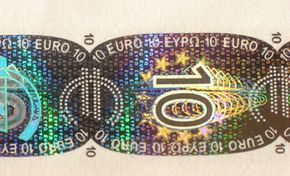
If you want to see a hologram, you don't have to look much farther than your wallet. There are holograms on most driver's licenses, ID cards and credit cards. If you're not old enough to drive or use credit, you can still find holograms around your home. They're part of CD, DVD and software packaging, as well as just about everything sold as "official merchandise."
Unfortunately, these holograms — which exist to make forgery more difficult — aren't very impressive. You can see changes in colors and shapes when you move them back and forth, but they usually just look like sparkly pictures or smears of color. Even the mass-produced holograms that feature movie and comic book heroes can look more like green photographs than amazing 3-D images.
Advertisement
On the other hand, large-scale holograms, illuminated with lasers or displayed in a darkened room with carefully directed lighting, are incredible. They're two-dimensional surfaces that show absolutely precise, three-dimensional images of real objects. You don't even have to wear special glasses or look through a View-Master to see the images in 3-D.
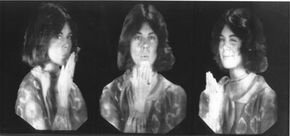
If you look at these holograms from different angles, you see objects from different perspectives, just like you would if you were looking at a real object. Some holograms even appear to move as you walk past them and look at them from different angles. Others change colors or include views of completely different objects, depending on how you look at them.
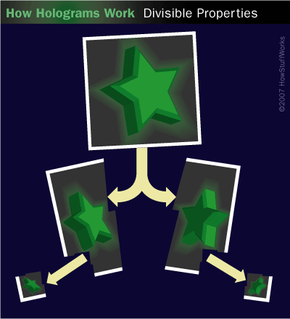
Holograms have other surprising traits as well. If you cut one in half, each half contains whole views of the entire holographic image. The same is true if you cut out a small piece — even a tiny fragment will still contain the whole picture. On top of that, if you make a hologram of a magnifying glass, the holographic version will magnify the other objects in the hologram, just like a real one.
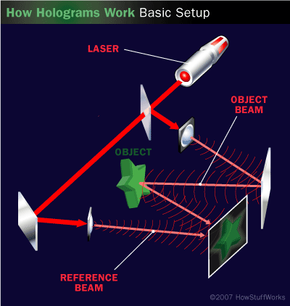
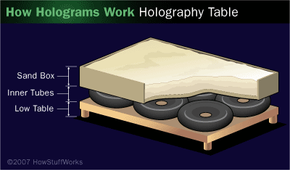
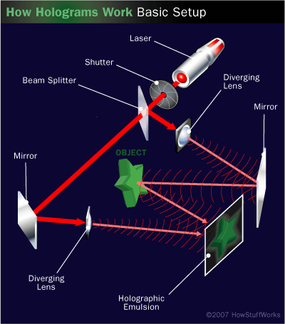
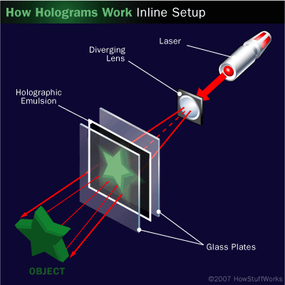
Once you know the principles behind holograms, understanding how they can do all this is easy. This article will explain how a hologram, light and your brain work together make clear, 3-D images. All of a hologram's properties come directly from the process used to create it, so we'll start with an overview of what it takes to make one.
Advertisement