Capturing the Fringes

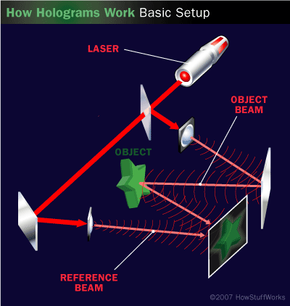
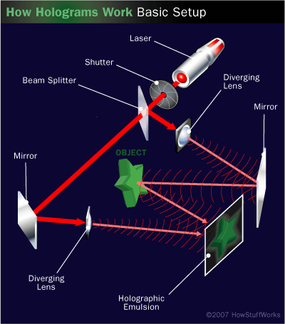
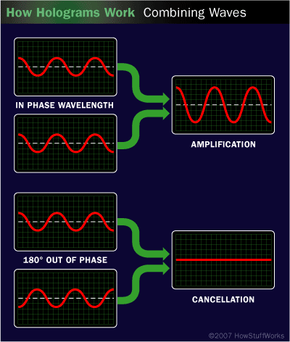
The light-sensitive emulsion used to create holograms makes a record of the interference between the light waves in the reference and object beams. When two wave peaks meet, they amplify each other. This is constructive interference. When a peak meets a trough, they cancel one another out. This is destructive interference. You can think of the peak of a wave as a positive number and the trough as a negative number. At every point at which the two beams intersect, these two numbers add up, either flattening or amplifying that portion of the wave.

Constructive and destructive interference

This a lot like what happens when you transmit information using radio waves. In amplitude modulation (AM) radio transmissions, you combine a sine wave with a wave of varying amplitudes. In frequency modulation (FM) radio transmissions, you combine a sine wave with a wave of varying frequencies. Either way, the sine wave is the carrier wave that is overlaid with a second wave that carries the information.


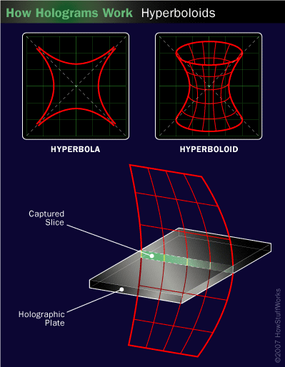
In a hologram, the two intersecting light wave fronts form a pattern of hyperboloids -- three-dimensional shapes that look like hyperbolas rotated around one or more focal points. You can read more about hyperboloidal shapes at Wolfram MathWorld.

Holographic film captures a cross-section of a three-dimensional wave front of light.

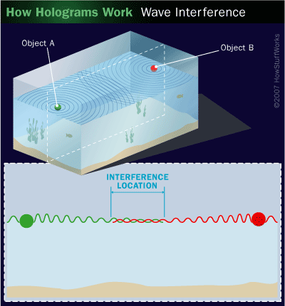
The holographic plate, resting where the two wave fronts collide, captures a cross-section, or a thin slice, of these three-dimensional shapes. If this sounds confusing, just imagine looking through the side of a clear aquarium full of water. If you drop two stones into the water at opposite ends of the aquarium, waves will spread toward the center in concentric rings. When the waves collide, they will constructively and destructively interfere with each other. If you took a picture of this aquarium and covered up all but a thin slice in the middle, what you'd see is a cross-section of the interference between two sets of waves in one specific location.

You can visualize the interaction of light waves by imagining waves on water.
You can visualize the interaction of light waves
by imagining waves on water.

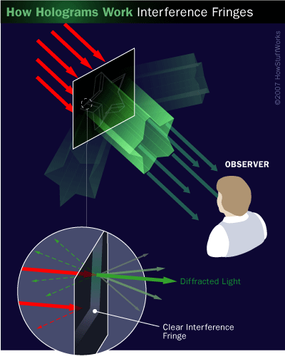
The light that reaches the holographic emulsion is just like the waves in the aquarium. It has peaks and troughs, and some of the waves are taller while others are shorter. The silver halide in the emulsion responds to these light waves just like it responds to light waves in an ordinary photograph. When you develop the emulsion, parts of the emulsion that receive more intense light get darker, while those that receive less intense light stay a little lighter. These darker and lighter areas become the interference fringes.


The amplitude of the waves corresponds to the contrast between the fringes. The wavelength of the waves translates to the shape of each fringe. Both the spatial coherence and the contrast are a direct result of the laser beam's reflection off of the object.


Turning these fringes back into images requires light. The trouble is that all the tiny, overlapping interference fringes can make the hologram so dark that it absorbs most of the light, letting very little pass through for image reconstruction. For this reason, processing holographic emulsion often requires bleaching using a bleach bath. Another alternative is to use a light-sensitive substance other than silver halide, such as dichromated gelatin, to record the interference fringes.


Once a hologram is bleached, it is clear instead of dark. Its interference fringes still exist, but they have a different index of refraction rather than a darker color. The index of refraction is the difference between how fast light travels through a medium and how fast it travels through a vacuum. For example, the speed of a wave of light can change as it travels through air, water, glass, different gasses and different types of film. Sometimes, this produces visible distortions, like the apparent bending of a spoon placed in a half-full glass of water. Differences in the index of refraction also cause rainbows on soap bubbles and on oil stains in parking lots. In a bleached hologram, variations in the index of refraction change how the light waves travel through and reflect off of the interference fringes.


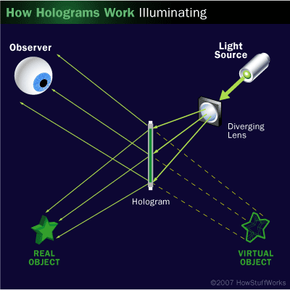
These fringes are like a code. It takes your eyes, your brain and the right kind of light to decode them into an image. We'll look at how this happens in the next section.

Holographic Magnifying Glasses
If you make a hologram of a scene that includes a magnifying glass, the light from the object beam passes through the glass on its way to the emulsion. The magnifying glass spreads out the laser light, just like it would with ordinary light. This spread-out light is what forms part of the interference pattern on the emulsion.

You can also use the holographic process to magnify images by positioning the object farther from the holographic plate. The light waves reflected off of the object can spread out farther before they reach the plate. You can magnify a displayed hologram by using a laser with a longer wavelength to illuminate it.