Other Hologram Types
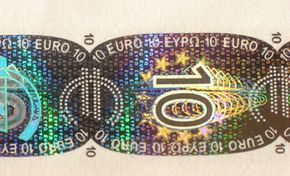
The holograms you can buy as novelties or see on your driver's license are reflection holograms. These are usually mass-produced using a stamping method. When you develop a holographic emulsion, the surface of the emulsion collapses as the silver halide grains are reduced to pure silver. This changes the texture of the emulsion's surface. One method of mass-producing holograms is coating this surface in metal to strengthen it, then using it to stamp the interference pattern into metallic foil. A lot of the time, you can view these holograms in normal white light. You can also mass-produce holograms by printing them from a master hologram, similar to the way you can create lots of photographic prints from the same negative.
![]() Image courtesy Dreamstime The holograms found on credit cards and other everyday objects are mass-produced by stamping the pattern of the hologram onto the foil. |
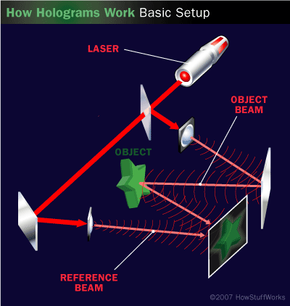
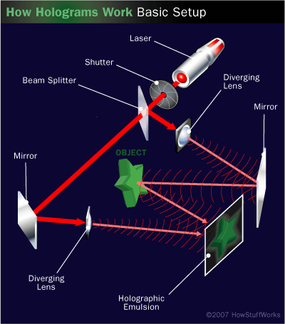
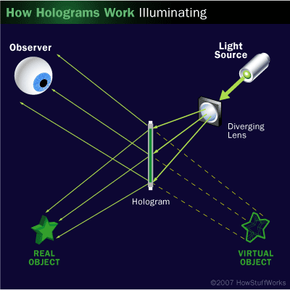
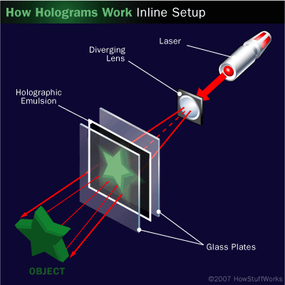
But reflection holograms can also be as elaborate as the transmission holograms we already discussed. There are lots of object and laser setups that can produce these types of holograms. A common one is an inline setup, with the laser, the emulsion and the object all in one line. The beam from the laser starts out as the reference beam. It passes through the emulsion, bounces off the object on the other side, and returns to the emulsion as the object beam, creating an interference pattern. You view this hologram when white or monochrome light reflects off of its surface. You're still seeing a virtual image -- your brain's interpretation of light waves that seem to be coming from a real object on the other side of the hologram.
![]() |
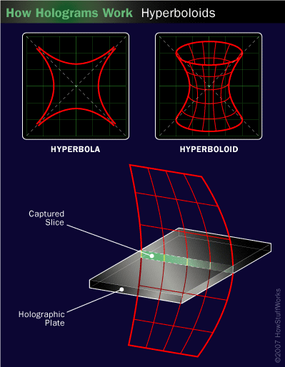
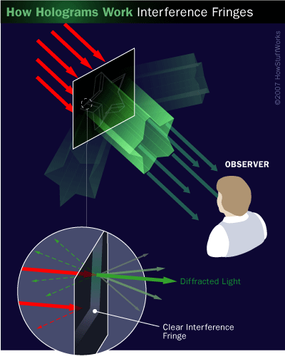
Reflection holograms are often thicker than transmission holograms. There is more physical space for recording interference fringes. This also means that there are more layers of reflective surfaces for the light to hit. You can think of holograms that are made this way as having multiple layers that are only about half a wavelength deep. When light enters the first layer, some of it reflects back toward the light source, and some continues to the next layer, where the process repeats. The light from each layer interferes with the light in the layers above it. This is known as the Bragg effect, and it's a necessary part of the reconstruction of the object beam in reflection holograms. In addition, holograms with a strong Bragg effect are known as thick holograms, while those with little Bragg effect are thin.
The Bragg effect can also change the way the hologram reflects light, especially in holograms that you can view in white light. At different viewing angles, the Bragg effect can be different for different wavelengths of light. This means that you might see the hologram as one color from one angle and another color from another angle. The Bragg effect is also one of the reasons why most novelty holograms appear green even though they were created with a red laser.
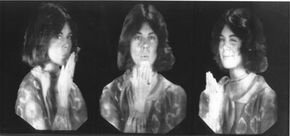
In movies, holograms can appear to move and recreate entire animated scenes in midair, but today's holograms can only mimic movement. You can get the illusion of movement by exposing one holographic emulsion multiple times at different angles using objects in different positions. The hologram only creates each image when light strikes it from the right angle. When you view this hologram from different angles, your brain interprets the differences in the images as movement. It's like you're viewing a holographic flip book. You can also use a pulsed laser that fires for a minute fraction of a second to make still holograms of objects in motion.
![]() Image © 1996-2007 Holophile, Inc. The famous hologram "The Kiss" shows a sequence of similar, stationary images. Your eye sees many frames simultaneously, and your brain interprets them as moving images. |
Multiple exposures of the same plate can lead to other effects as well. You can expose the plate from two angles using two completely different images, creating one hologram that displays different images depending on viewing angle. Exposing the same plate using the exact same scene and red, green and blue lasers can create a full-color hologram. This process is tricky, though, and it's not usually used for mass-produced holograms. You can also expose the same scene before and after the subject has experienced some kind of stimulus, like a gust of wind or a vibration. This lets researchers see exactly how the stimulus changed the object.
Using lasers to make three-dimensional images of objects may sound like a novelty or a form of art. But holograms have an increasing number of practical uses. Scientists can use holograms to study objects in three dimensions, and they can use acoustical holography to create three-dimensional reconstructions of sound waves. Holographic memory has also become an increasingly common method of storing large amounts of data in a very small space. Some researchers even believe that the human brain stores information in a manner that is much like a hologram. Although holograms don't currently move like they do in the movies, researchers are studying ways to project fully 3-D holograms into visible air. In the future, you may be able to use holograms to do everything from watching TV to deciding which hair style will look best on you.
To learn more about holograms, follow the links on the next page.