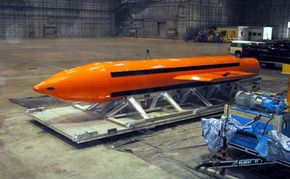
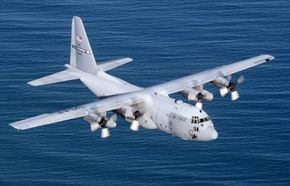
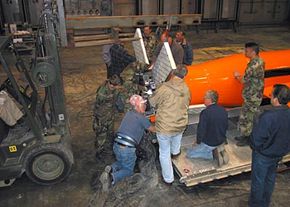
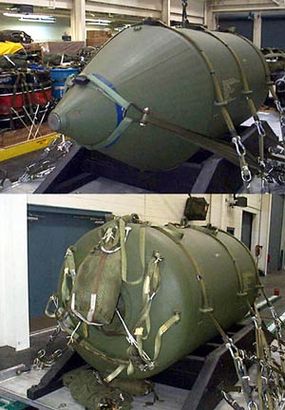
Here are the basic facts about the MOAB:
- It is currently the largest conventional bomb (as opposed to a nuclear bomb) in the U.S. arsenal.
- The bomb weighs 21,000 pounds (9,525 kg).
- The bomb is 30 feet long and 40.5 inches in diameter.
- It is satellite-guided, making it a very large "smart bomb."
- It bursts about 6 feet (1.8 meters) above the ground.
The idea behind an "air burst" weapon, as opposed to a weapon that explodes on impact with the ground, is to increase its destructive range. A bomb that penetrates the ground and then bursts tends to send all of its energy either down into the ground or straight up into the air. An air burst weapon sends a great deal of its energy out to the side.
The MOAB will replace the BLU-82, also known as the Daisy Cutter, a 15,000-pound (6,800-kg) air-burst bomb developed during the Vietnam war. The Air Force could drop a Daisy Cutter to create an instant helicopter landing site. The explosive force would clear out trees in a 500-foot-diameter (152-meter) circle.
The MOAB is not the largest bomb ever created. In the 1950s the United States manufactured the T-12, a 43,600-pound (19,800-kg) bomb that could be dropped from the B-36.
Compared to a nuclear bomb, the MOAB produces a tiny explosion. The smallest known nuclear bomb -- the Davy Crockett fission bomb -- has a 10-ton yield. The difference is that a nuclear bomb that small weighs less than 100 pounds (45 kg) and produces significant amounts of lethal radiation when it detonates. For comparison, the nuclear bomb dropped on Hiroshima had a yield of 14,500 tons of TNT and weighed only 10,000 pounds (4,500 kg) -- half the weight of the MOAB. See How Nuclear Bombs Work for details.