Introduction to Is it possible to test a nuclear weapon without producing radioactive fallout?


Photo courtesy Nuclear Weapon Archive
In what may prove to be the first nuclear explosion since 1998, North Korea claims is has conducted an underground test of a nuclear weapon in its own territory. South Korean reports of seismic activity appear to confirm the test.

Regarding any potential radioactive fallout, the official press release from North Korea states, "It has been confirmed that there was no such danger as radioactive emission in the course of the nuclear test." One has to wonder if it's even possible to test a nuclear weapon to its full extent (carrying it through to its final nuclear stage instead of just simulating that final stage using conventional weaponry) without releasing some amount of radiation into the atmosphere. If past instances of nuclear testing are any indication, a safe test is possible; but even under ideal conditions there are no guarantees.
Let's start with a quick look at what happens to produce a nuclear explosion. It occurs when a radioactive atom -- usually either uranium-235 or plutonium-239 -- comes into contact with free-moving neutrons. What makes these atoms different from most others is that they are fissile, and they are able to sustain a chain reaction. Both of these characteristics hinge on the atom absorbing one of those free neutrons. With the addition of this neutron, the atom splits into several pieces, including multiple neutrons. With more and more free neutrons available, more and more atoms start fissioning. Under ideal circumstances, or "critical mass," the fissioning atoms can double the number of neutrons in a contained environment more than 80 times in one microsecond, causing the device to expand with tremendous force. The result is not only a massive explosion but also the release of tremendous amounts of radioactive particles that can spread hundreds of miles, depending on the size of the device.

So we return to the question: Under what circumstances can you detonate this kind of device without causing damage to the surrounding area? For our answer, we'll look to methods that have been used in the past and find out what kind of harm, if any, these nuclear-weapon tests have produced.

There are four primary methods of testing nuclear weapons: high-altitude, underground, underwater and atmospheric.

Atmospheric tests release all the radioactive fallout of, well, a nuclear bomb exploding in mid-air or on the surface of the ground. In these tests, the nuclear device may be fixed atop a tower, dropped from a plane, or carried into the atmosphere by a balloon.


Photo courtesy National Nuclear Security Administration / Nevada Site Office
Atmospheric test XX-12 GRABLE at the Nevada Test site, 1953


Photo courtesy National Nuclear Security Administration / Nevada Site Office
Destruction of test house located 3,500 feet (1,000 meters) from detonation site of atmospheric test at Nevada Proving Ground in 1953 - The first photo and the last photo were taken 2.3 seconds apart.

Tremendous amounts of fallout result from these tests, and the safety measures in place to prevent damage to humans, animals, crops, buildings, ecosystems and everything else within a radius of hundreds of miles involves clearing the area, pure and simple. These tests are normally carried out in desolate areas like the Nevada desert, where damage from the fallout can be reduced because there is so little life in the area. Still, the biggest nuclear-testing disaster in U.S. history was an atmospheric test in which engineers had taken all necessary precautions. Unfortunately, it turns out they took all the necessary precautions for a much smaller-yield bomb. The Castle Bravo test in 1954, conducted on a man-made island in the Pacific, far exceeded expectations. The explosion was twice the size they had expected, and the radioactive fallout was far greater than they had predicted. When weather patterns changed, the wind carried this mass of radioactive particles into areas that had not been evacuated before the test. Island populations that were not supposed to be subject to any damage at all ended up with radiation burns, high cancer rates and next-generation birth defects that most experts attribute to Castle Bravo. In broader terms, the high number of atmospheric tests performed by France in the 1960s and '70s appears to have led to three times the rate of thyroid cancer and four times the rate of acute myeloid leukemia in French Polynesia than in other comparable populations not in the vicinity of extensive nuclear testing.

Underwater testing carries a lot of the same risks at atmospheric testing, since the explosion rises well out of the water. But the amount of radioactive fallout in the atmosphere is decreased because a good portion of it is contained in the water. This causes its own problems, of course.


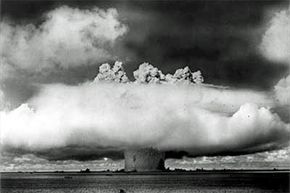
Photo courtesy Los Alamos National Laboratory, Atomic Archive
90-foot (30-meter) underwater test at Bikini Atoll, central Pacific, 1946

While effects of underwater testing on sea life have been surprisingly absent from most literature, environmental groups document complete destruction of coral reefs and death and contamination of other marine life as resulting from these tests. By extension, fishing villages and their seafood-subsisting populations can be severely affected by underwater nuclear tests conducted hundreds miles from their shores.

The safest approach to nuclear testing by far is the underground method, although "safe" is a relative term. Underground testing provides the possibility of containment, but containing a nuclear blast is no simple task. The smallest nuclear bomb imaginable will break through 20 meters (65 feet) of earth as if it were a tissue paper.

A 1-kiloton-yield bomb needs to be at least 90 meters (300 feet) underground in order for its explosion to be fully contained. For comparison, the Castle Bravo accident involved a 15 megaton yield. And these depths are just estimates; it's unlikely to know exactly how a new nuclear technology is going to react until you test it. Even under the most tightly controlled conditions, underground nuclear tests can break through into the atmosphere, which is a worst-case scenario because an underground nuclear explosion irradiates tons of soil that then rains down on everything in the surrounding area. Ground contact can be the most damaging aspect of a nuclear explosion, so if an underground nuclear detonation does break through the surface, you're looking at fairly serious fallout.


Photo courtesy National Nuclear Security Administration / Nevada Site Office
In 1970, the Baneberry underground nuclear test at the Nevada Test Site released radioactivity into the atmosphere. Baneberry had a yield of 10 kilotons and was buried 275 meters (900 feet) below the surface.

The final nuclear-testing method falls under the "Are you kidding? What were they thinking?" category: detonating a nuclear bomb in outer space. Both the United States and Russia performed these high-altitude tests during the Cold War, sending up the devices by way of rockets, for the purpose of testing the efficacy of the weapons in decommissioning enemy satellites.


Photo courtesy U.S. Department of Defense
High-altitude nuclear explosion in 1962

While radioactive fallout on Earth was not a problem (the radiation gets deflected by Earth's atmosphere), they stopped performing these tests when several things became apparent:

  1. Nuclear blasts can't tell which satellites are yours and which are the enemy's.
  2. The deflection of radiation in the Earth's atmosphere resulted in a powerful electromagnetic pulse that wiped out electrical systems in major cities on Earth.
  3. The blasts left bands of radiation in space the posed risks to any future manned spaceflights.

Besides the most far-reaching effects of nuclear testing, there are also significant dangers to those involved in carrying out the test. More than 4,000 workers at a former French testing facility have filed suits against the government alleging that radiation exposure has compromised their health. Many of those workers have been diagnosed with serious cancers. France conducted nuclear tests until 1996, long after most other countries has stopped.

For more information on nuclear testing and related topics, check out the following links: