
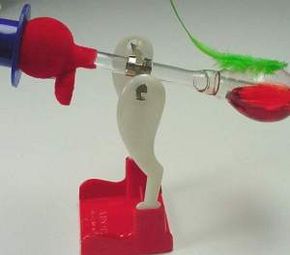
The Dippy Bird (also called the Drinking Bird or the Dunking Bird) is a popular novelty item or toy in the United States and other countries.
A Dippy Bird has the following parts:
Advertisement
- Two equal-sized, hollow glass bulbs
- A long glass tube that connects the bulbs
- Fuzzy, water-absorbent material covering the head
- Two plastic legs with a pivot connection
- Methylene chloride in the abdomen. Methylene chloride is an industrial paint stripper and solvent (one thing that dissolves easily in methylene chloride is caffeine, so you can use methylene chloride to decaffeinate things -- see Question 480). Methylene chloride helps makes a Dippy Bird work because it evaporates very easily -- it boils at just 100 degrees Fahrenheit (40 degrees Celsius).
To operate the Dippy Bird, you get its head wet. As the water evaporates, fluid moves up into the head, causing the bird to become top-heavy and dip forward. Once the bird dips forward, fluid moves back into the abdomen, causing the bird to become bottom-heavy and tip up.
Here is how a Dippy Bird works:
- When water evaporates from the fuzz on the Dippy Bird's head, the head is cooled.
- The temperature decrease in the head condenses the methylene chloride vapor, decreasing the vapor pressure in the head relative to the vapor pressure in the abdomen.
- The greater vapor pressure in the abdomen forces fluid up through the neck and into the head.
- As fluid enters the head, it makes the Dippy Bird top-heavy.
- The bird tips. Liquid travels to the head. The bottom of the tube is no longer submerged in liquid.
- Vapor bubbles travel through the tube and into the head. Liquid drains from the head, displaced by the bubbles.
- Fluid drains back into the abdomen, making the bird bottom-heavy.
- The bird tips back up.
If the bird dips into a cup of water, the fuzzy material absorbs water again and the cycle starts over.
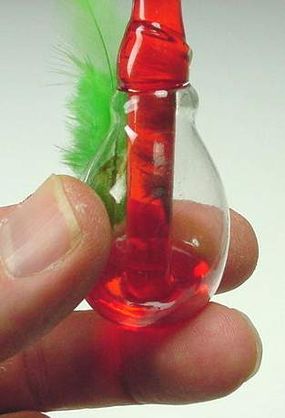
If you hold a Dippy Bird upright in your hand, touching the abdomen, the following happens:
- Your body heat warms the fluid in the abdomen.
- The heat increases the vapor pressure in the abdomen relative to the head (the reverse of what happens when you wet the head).
- The fluid rises into the head in response to the pressure difference (moving from high pressure to low pressure).
- The bird becomes top-heavy, and tips.
Here are some interesting links:
Advertisement