Introduction to How Stem Cells Work
Inside an embryo no bigger than the period at the end of this sentence are dozens of stem cells. Initially, these cells are blank slates, meaning that their fate is undecided. But they have great potential. Stem cells are pluripotent, which means that they can develop into every cell, every tissue and every organ in the human body.
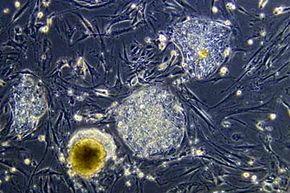
![]() Photo courtesy University of Wisconsin Board of Regents Microscopic 10x view of a colony of embryonic stem cells (The stem cell colonies are the rounded, dense masses of cells.) |
Their almost limitless potential has made stem cells a significant focus of medical research. Imagine having the ability to return memory to an Alzheimer's patient, replace skin that was lost during a terrible accident or enable a wheelchair-bound person to walk again. But before scientists can use stem cells for medical purposes, they must first learn how to harness their power. They can't treat disease until they learn how to manipulate stem cells to get them to develop into specific tissues or organs.
In this article, we will look at stem cells, find out how they work, discover their potential to treat disease and get inside the fierce debate surrounding their research and use.
Stem Cell Basics
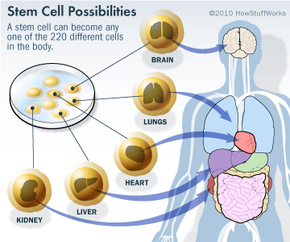
A stem cell is essentially the building block of the human body. The stem cells inside an embryo will eventually give rise to every cell, organ and tissue in the fetus's body. Unlike a regular cell, which can only replicate to create more of its own kind of cell, a stem cell is pluripotent. When it divides, it can make any one of the 220 different cells in the human body. Stem cells also have the capability to self-renew -- they can reproduce themselves many times over.
There are two types of stem cells: embryonic stem cells and adult stem cells. Embryonic stem cells come from an embryo -- the mass of cells in the earliest stage of human development that, if implanted in a woman's womb, will eventually grow into a fetus. When the embryo is between three and five days old, it contains stem cells, which are busily working to create the various organs and tissues that will make up the fetus.
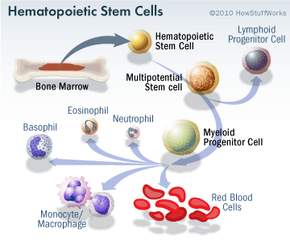
Adults also have stem cells in the heart, brain, bone marrow, lungs and other organs. They are our built-in repair kits, regenerating cells damaged by disease, injury and everyday wear and tear. Adult stem cells were once believed to be more limited than stem cells, only giving rise to the same type of tissue from which they originated. But new research suggests that adult stem cells may have the potential to generate other types of cells, as well. For example, liver cells may be coaxed to produce insulin, which is normally made by the pancreas. This capability is known as plasticity or transdifferentiation.
So where do scientists get the stem cells they use in their research? We'll look at two ways -- reproduction and cloning -- in the next section.
Acquiring Stem Cells for Research
In the early 1980s, scientists learned how to pull embryonic stem cells from a mouse and grow them in a laboratory. In 1998, they first reproduced human embryonic stem cells in a lab.
![]() Photo courtesy University of Wisconsin Board of Regents Culture trays containing human embryonic stem cells are stored in heat-controlled conditions and studied by developmental biologist James Thomson's research lab at the University of Wisconsin in Madison |
Where do researchers get human embryos? Embryos can either be made via reproduction -- merging sperm and egg -- or by cloning. Researchers aren't likely to create an embryo with sperm and egg, but many use fertilized embryos from fertility clinics. Sometimes, couples who are trying to have a baby create several fertilized embryos and don't implant them all. They may donate the ones that are left over to science.
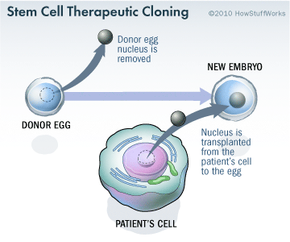
Another way to create an embryo is via a technique called therapeutic cloning. This technique merges a cell (from the patient who needs the stem cell therapy) with a donor egg. The nucleus is removed from the egg and replaced with the nucleus of the patient's cell. (See How Cloning Works for a detailed look at the process.) This egg is stimulated to divide either chemically or with electricity, and the resulting embryo carries the patient's genetic material, which significantly reduces the risk that his or her body will reject the stem cells once they are implanted.
![]() |
Both methods -- using existing fertilized embryos and creating new embryos specifically for research purposes -- are controversial. But before we get into the controversy, let's find out how scientists get stem cells to replicate in a laboratory setting in order to study them.
Replicating Stem Cells in a Lab
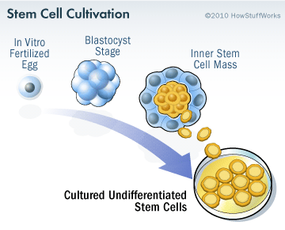
An embryo that has developed for three to five days is called a blastocyst. A blastocyst is a mass of about 100 or so cells.
![]() Photo courtesy Michael Vernon, West Virginia University Blastocyst |
The stem cells are the inner cells of the blastocyst. They will ultimately develop into every cell, tissue and organ in the body.
![]() |
Scientists remove stem cells from the blastocyst and culture them (grow them in a nutrient-rich solution) in a Petri dish in the laboratory. After the cells have replicated several times and are becoming too numerous for the culture dish, they are removed and placed into several other dishes. In just a few months, several stem cells can become millions of stem cells. Embryonic stem cells that have been cultured for several months without differentiating are referred to as a stem cell line. Cell lines can be frozen and shared between laboratories.
![]() Photo courtesy University of Wisconsin Board of Regents Microscopic 5x view of a colony of undifferentiated human embryonic stem cells: The embryonic stem cell colonies are the rounded, dense masses of cells. The flat, elongated cells are fibroblasts used as "feeder cells." |
Adult stem cells are much harder for scientists to work with because they are more difficult to extract and culture than their embryonic counterparts. Stem cells not only are hard to find in adult tissue, but scientists also have difficulty getting them to replicate in the laboratory.
But even embryonic stem cells, which can be grown effectively in the lab, are not easy to control. Scientists are still struggling to get them to grow into specific tissue types.
Stem Cell Research Challenges
Ideally, scientists would like to be able to grow a particular type of cell in the laboratory and then inject it into a patient, where it would replace diseased tissue. But stem cells are not yet being used to treat disease because scientists still haven't learned how to direct a stem cell to differentiate into a specific tissue or cell type (brain vs. liver, for example) and to control that differentiation once the cells are injected into a person.
![]() Scientists have not yet reached the stage where they can get stem cells to differentiate reliably. |
Take the example of diabetes. To treat diabetics, scientists must not only create insulin-producing cells, but they must be able to regulate how those cells produce insulin once they are in the body.
In nature, stem cells are triggered to differentiate by internal and external cues. The internal cues are genes inside each cell, which are like a series of instructions that dictate how it should function. The external cues are chemicals released by other cells or contact with other cells, either of which may change the way the stem cell functions.
Scientists do know that turning genes on and off is crucial to the process of differentiation, so they have been experimenting by inserting certain genes into the culture dish and then using those genes to try to coax stem cells to differentiate into specific types of cells. But some sort of signal is needed to actually trigger the stem cells to differentiate. Scientists are still searching for that signal.
![]() Photo courtesy University of Wisconsin Board of Regents Differentiation success: Derived from human embryonic stem cells, precursor neural cells grow in a lab dish and generate mature neurons (red) and glial cells (green), in the lab of University of Wisconsin at Madison stem-cell researcher and neurodevelopmental biologist Su-Chun Zhang. |
![]() Photo courtesy University of Wisconsin Board of Regents After transplantation into the brains of young mice, the neural precursor cells give rise to functioning neurons (red in A) and astrocytes (red in B), a star-shaped cell of the brain and spinal cord. |
And there are other obstacles standing in the way of stem cell use. One is the problem of rejection. If a patient is injected with stem cells taken from a donated embryo, his or her immune system may see the cells as foreign invaders and launch an attack against them. Using adult stem cells could overcome this problem somewhat, since stem cells taken from the patient would not be rejected by his or her immune system. But adult stem cells are less flexible than embryonic stem cells and are harder to manipulate in the lab.
Next, let's examine how stem cells could potentially treat diseases.
Using Stem Cells to Treat Disease
If scientists can ultimately learn how to direct stem cells to differentiate into one type of tissue or another, they can use them for two very important medical purposes.
![]() Photo courtesy University of Wisconsin Board of Regents Culture trays containing human embryonic stem cells are viewed under a microscope in developmental biologist James Thomson's research lab at the University of Wisconsin in Madison |
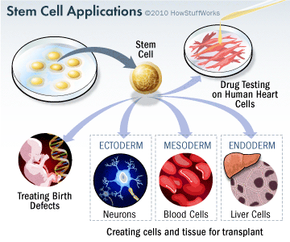
First, pluripotent stem cells can be used to test new medications for safety and effectiveness. A medication could be tried out on a specific type of cell to gauge its response far more quickly than it could be tested in clinical trials. For example, scientists could use a cancer stem cell line to investigate whether a new anti-tumor drug stopped the cancer from growing.
Stem cells could also be used to repair cells or tissues that have been damaged by disease or injury. This type of treatment is known as cell-based therapy. One potential application is to inject embryonic stem cells into the heart to repair cells that have been damaged by a heart attack. In one Mayo Clinic study, researchers induced a heart attack in rats, then injected rodent embryonic stem cells into the damaged hearts. Eventually, the stem cells regenerated the damaged muscle tissue, improving the rats' heart function.
Stem cells may also one day be used to repair brain cells in patients with Parkinson's disease. Parkinson's patients are lacking the cells that produce a chemical messenger called dopamine. Without dopamine, their movements become jerky and uncoordinated, and they suffer from uncontrollable tremors. In studies, researchers have injected rodent embryonic stem cells into the brain of rats with Parkinson's disease. The stem cells generated dopamine-producing nerve cells, improving the rats' condition. Scientists hope they can one day replicate their success in human patients.
Eventually, scientists might even be able to grow entire organs in a laboratory to replace ones that have been damaged by disease. The idea is this: They would create a sort of scaffold out of a biodegradable polymer to shape the organ, and then seed it with either embryonic or adult stem cells. Growth factors specific to the organ would be added to guide the organ's development. The tissue-covered scaffold would then be implanted into the patient. As the tissue grew from the stem cells, the scaffold would degrade, leaving a complete ear, liver or other organ.
Some of the diseases that may one day be treated with cell-based therapy are:
|
Former First Lady Nancy Reagan also became an advocate for stem cell research when her husband, former President Ronald Reagan, was stricken with Alzheimer's, another degenerative brain disease. He died of Alzheimer's in the summer of 2004. |
Stem Cell Research Controversy
Stem cell research has become one of the biggest issues dividing the scientific and religious communities around the world. At the core of the issue is one central question: When does life begin?
![]() Photo courtesy University of Wisconsin Board of Regents Microscopic 20x view of a colony of undifferentiated human embryonic stem cells |
To get stem cells, scientists either have to use an embryo that has already been conceived or else clone an embryo using a cell from a patient's body and a donated egg. Either way, to harvest an embryo's stem cells, scientists must destroy it. Although that embryo may only contain four or five cells, some religious leaders say that destroying it is the equivalent of taking a human life.
![]() Photo courtesy Roslin Institute Dolly (left) |
Even as scientists move forward in their understanding of stem cells and their ability to manipulate them, the ethical and political debates rage on. Many governments have placed tight restrictions on stem cell research or have tightly limited funding for it.
To bridge the debate, scientists are exploring less controversial avenues of research, using adult stem cells that are trained to act like embryonic stem cells, instead of creating a new embryo. Although they are not as pluripotent as embryonic stem cells, new research suggests that adult stem cells might be more flexible than scientists once imagined. Even if the outcome of the debate favors the use of stem cells, it will likely be at least a few more decades until stem cell therapies come into widespread use.
|
|
To learn more about stem cells, cloning and related topics, check out the links on the next page.
Lots More Information
Related HowStuffWorks Articles
- How Cells Work
- How Cloning Works
- How Diabetes Works
- Parkinson's Disease
- Alzheimer's Disease
- How Pregnancy Works
- How Human Cloning Will Work
- What are stem cells and what are they used for?
More Great Links
- Embryonic Stem Cells: Research at the University of Wisconsin - Madison
- National Institutes of Health: Stem Cell Information
- CNN.com: The Stem Cell Debate
- Time.com: The Stem Cell Debate
- PBS.org: Political Science
Sources
- Embryonic Stem Cells: Research at the University of Wisconsin - Madison
- Ferber, Dan. "Stem-Cell Therapies Inch Their Way Closer to the Clinic." WebMD Medical News. August 18, 2000.
- National Institutes of Health. Department of Health and Human Services. Stem Cells: Scientific Progress and Future Research Directions. June 2001.
- Pellegrino, Edmund. "Cloning and Stem Cell Research: Too High a Price." WebMD Medical News. September 29, 2000.
- Pence, Gregory. "The Lifesaving Promise of Cloning Technology." WebMD Medical News. September 29, 2000.
- "Political Science." PBS.org. Newshour Extra, July 25, 2001.
- National Institutes of Health: Stem Cell Information
- The Stem Cell Debate. CNN.com.
- The Stem Cell Debate. Time.com.
- Wilmut, Ian, Keith Campbell, and Colin Tudge. The Second Creation: Dolly and the Age of Biological Control. New York, NY: Farrar, Straus and Giroux, 2000.