What's the Hardest Math Problem in the World? Try These 9

By: Grant Virellan  | 
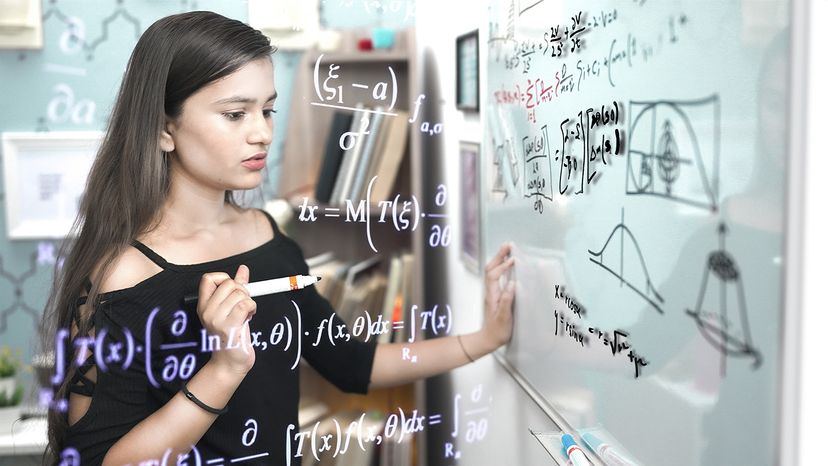
These math problems are a lot more complicated than the Pythagorean theorem. Raushan_films / Shutterstock

Mathematics is filled with complex challenges, but the hardest math problem in the world isn’t just a difficult question on a school test: It’s one that defies centuries of logic, calculation, and creativity.

Some of these problems—spanning concepts from geometry to algebra to real analysis involve—simple-looking equations and others require understanding infinite sequences, graph intersections, or functions on the complex plane.

Advertisement

They require understanding how a function satisfies conditions, how values correspond across dimensions, and how sequences evolve. The challenge is proving the solution holds for all values, functions, and variables across mathematical space.

Here’s a list of the most mind-bending unsolved problems and legendary puzzles in mathematics.

Advertisement

1. The Riemann Hypothesis

Possibly the most important problem in mathematics, the Riemann Hypothesis involves the distribution of prime numbers. It states that all non-trivial zeros of the Riemann zeta function lie on the line where the real number part is 1/2.

This connection between the zeta function and the prime numbers influences everything from algorithms to cryptography.

Advertisement

Despite many attempts to prove it, the problem remains unsolved. It’s one of the Millennium Prize Problems and has deep ties to probability, complex functions, and infinite series.

2. P vs. NP Problem

In simple terms, this problem asks if every problem whose solution can be verified in polynomial time (NP) can also be solved in polynomial time (P).

This question affects real-world scenarios like verifying solutions in Sudoku puzzles or determining the shortest path in a graph.

Advertisement

The answer could redefine computer science and impact security algorithms, optimization, and mathematics itself. It remains one of the most important unsolved problems.

3. Collatz Conjecture

Start with any positive integer. If it’s even, divide by 2. If it’s odd, multiply by 3 and add 1. Repeat. The Collatz Conjecture posits that no matter what number you start with, you’ll eventually reach 1.

It’s an unsolved problem involving integer sequences, recursion, and basic functions, but proving it has remained beyond reach. Even advanced graphing and algorithmic techniques haven’t cracked this deceptively simple problem.

Advertisement

4. Goldbach’s Conjecture

This famous statement claims that every even number greater than 2 can be written as the sum of two prime numbers. Despite being tested on millions of examples, no general proof exists.

It’s an active area of research involving integers, sums, and the properties of prime numbers. The simplicity of the statement hides the depth of mathematical insight required to prove it.

Advertisement

5. Navier-Stokes Existence and Smoothness

These equations describe fluid motion, yet proving that smooth solutions always exist remains a massive challenge. Mathematicians must verify whether the equations hold true under all physical conditions.

This Millennium Prize Problem involves partial differential equations, volume, flow, and probability, and has real-world applications in weather, ocean currents, and airplane design.

Advertisement

6. The Birch and Swinnerton-Dyer Conjecture

This problem connects elliptic curves to solutions over rational numbers. Specifically, it uses a complex function to predict how many rational points exist on a given curve.

The challenge lies in connecting abstract algebra, functions, and real-world calculations in a way that matches observed patterns. Solving it requires understanding values of the curve's L-function at specific points.

Advertisement

7. Beal’s Conjecture

Beal’s equation (Ax + By = Cz) suggests that for positive integers where x, y, and z are all greater than 2, A, B, and C must share a common prime factor.

Like Fermat’s Last Theorem, this problem seems accessible to students yet remains unsolved by the world’s top mathematicians.

Advertisement

8. Hadamard’s Conjecture

This conjecture proposes that for any multiple of 4, there exists a Hadamard matrix of that order. These matrices, filled with +1 and -1 values, are used in coding theory, signal processing, and error detection.

The problem combines graph theory, logic, and matrix algebra.

Advertisement

9. Euler’s Sum of Powers Conjecture

Euler hypothesized that at least n nth powers are needed to sum to another nth power. For instance, a4 + b4 + c4 + d4 = e4.

Though counterexamples have been found for specific cases (notably the fourth and fifth powers), the general form remains a puzzle involving equations, symmetry, and number theory.

Advertisement

We created this article in conjunction with AI technology, then made sure it was fact-checked and edited by a HowStuffWorks editor.

Advertisement

Loading...