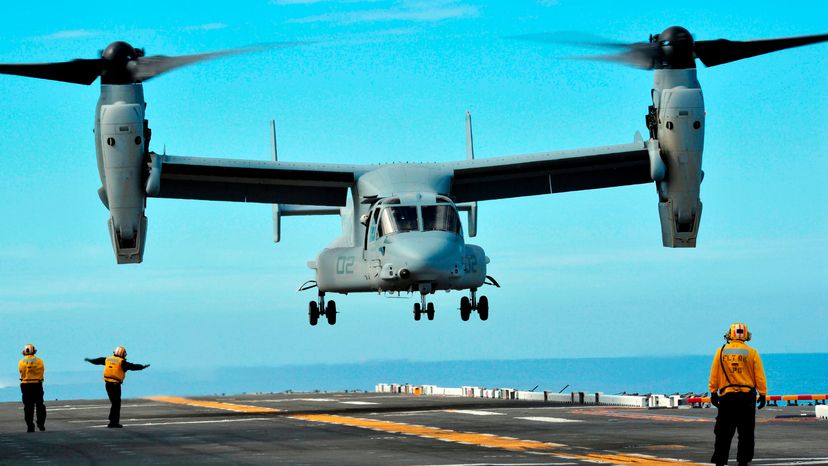
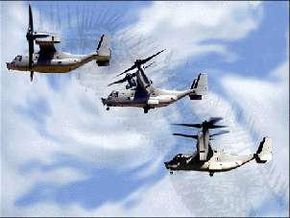
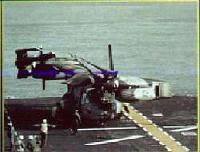
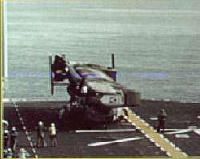
The Osprey is a military aircraft that can fly long distances while carrying heavy cargo. It has the ability to hover and land like a helicopter. Stocktrek Images / Getty Images/Stocktrek Images
Aircraft designers have long dreamed of creating an airplane that not only can fly long ranges at high speeds and carry heavy cargo but can also take off, hover and land like a helicopter. Such a plane would have the flexibility to handle many different types of military missions and combat operations, as well as have civilian and commercial uses.
The V-22 Osprey plane is such a vehicle. Bell Boeing developed this versatile craft for the military. Through the use of a tilt rotor, the Osprey can take off and land like a helicopter, but convert to a turboprop airplane while in flight.
Advertisement
Or as Boeing describes it, the plane combines "the vertical performance of a helicopter with the speed and range of a fixed-wing aircraft." The aircraft's rotors can fold, and the wings can rotate so it can be stored on an aircraft carrier.
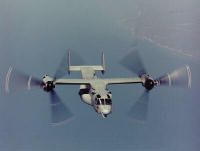
The V-22 Osprey can fly like a helicopter (left) or an airplane (right).
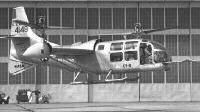
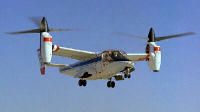
Tilt-rotor aircraft: Bell XV-3 (left) and Bell XV-15 (right).
Photo courtesy NASA
The Osprey is a type of vertical takeoff and landing (VTOL) aircraft with a tilt-rotor design. The VTOL concept is an old idea stemming from the German air force at the end of World War II.
After the war, the U.S. Navy developed two experimental VTOL fighter aircraft: the Pogo and the Salmon. However, the programs were canceled because of technical difficulties.
Advertisement
In 1958, the U.S. Air Force developed the Bell XV-3, which was the first successful VTOL to hover (it was not tested in airplane flight).
Tilt-rotor aircraft: Bell XV-3 (left) and Bell XV-15 (right).
Photo courtesy NASA
After the XV-3 program proved that the tilt-rotor concept was feasible, Bell developed the XV-15 tilt-rotor that NASA tested.
In July 1979, the XV-15 became the first aircraft to tilt from helicopter to airplane and back. It was also capable of traveling 346 miles per hour (557 kph) in airplane mode. The success of the tests lead to the expansion of the program, which was subsequently renamed the V-22 Osprey.
There are three configurations of the Osprey depending on its intended use, such as search-and-rescue, medium-range assault or long-range special operations. For the Navy, the plane's primary functions are carrier onboard delivery and transporting mail, supplies and cargo.
While three branches of the U.S. Armed Forces — the Marines, Navy and Air Force — use or have used the Osprey, Bell is also exploring its design for possible civilian uses.
The Air Force and the V-22 Osprey
The Air Force Special Operations Command received its first operational Osprey — called the CV-22 — in January 2007. It achieved initial operational capability in 2009.
Advertisement
Advantages of the Osprey
A V-22 osprey transitioning from helicopter to airplane mode.
Photo courtesy U.S. Navy
The Osprey has two, large, three-bladed rotors that rotate in opposite directions and produce lift. Because the rotors turn in opposite directions, there is no need for a tail rotor to provide stability as in a helicopter.
The wing tilts the rotors between airplane and helicopter modes and generates lift in the airplane mode. The rotary-wing aircraft can convert smoothly from helicopter mode to airplane mode in as few as 12 seconds.
Advertisement
The major advantages of the Osprey over a helicopter are:
Longer range: The Osprey's operational range falls between 270 to 580 miles (453 to 933 km).
Higher speed: The Osprey's top speed is 315 mph (507 kph), which is twice as fast as a helicopter's top speed.
Increased cargo capacity: The Osprey can carry 10,000 pounds (4,536 kg) of cargo or 24 troops.
The advantage of the Osprey, which is capable of fleet logistics support, over an airplane is that it can take off, hover and land like a helicopter. This makes it more versatile than an airplane for such missions as moving troops to remote areas, especially those without landing strips, or conducting long-range rescue operations at sea.
Advertisement
Inside the Osprey
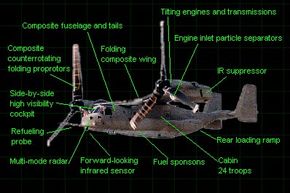
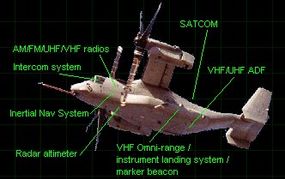
Osprey's external features.
Photo courtesy U.S. Navy
Like any aircraft, the Osprey has the following systems:
Propulsion: generates power and lifts to propel the aircraft
Fuel
Cockpit controls
Communications: allows for communication with air controllers and military operations
Payload: carries cargo
Stowage: especially important when storing on aircraft carriers
Propulsion
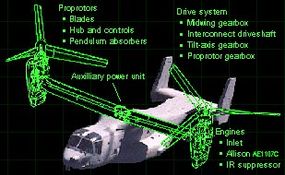
The Osprey has two rotors with three-bladed, 38-foot (11.6-m) propellers. An Allison AE 1107C turboshaft engine that is capable of producing over 6,000 horsepower drives each propeller.
Advertisement
Each engine drives its own rotor and transfers some power to a mid-wing gearbox. This gearbox drives the tilting mechanism.
In the event of an engine failure, the Osprey can run on only one engine. In this case, power from the remaining engine is distributed to the two rotors through an interconnecting drive shaft.
Osprey propulsion.
Photo courtesy U.S. Navy
Fuel
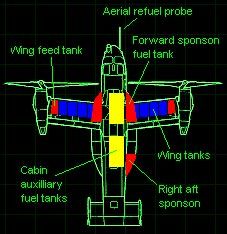
The Osprey has 16 fuel tanks, 10 integrated into the wings and six in the fuselage. The feed tanks directly supply the engines with fuel from the other tanks, and fuel transfer is automatic.
As the fuel flows from the tanks, pressurized nitrogen gas fills the tanks to reduce the possibility of fire. Depending upon the configuration of the Osprey, it can hold from 1,450 to 3,640 gallons (5,489 to 13,779 liters) of fuel.
Osprey fuel tanks.
Photo courtesy U.S. Navy
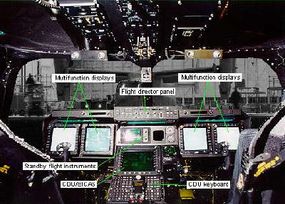
Cockpit Controls
The cockpit of the Osprey holds a pilot and copilot. In addition, there is a fold-down seat in the center behind the pilots for a flight engineer (other models have space to accommodate two flight engineers).
The instrument panels have multifunctional displays, similar to the new glass cockpit of the space shuttle. The displays hold information about the engines (such as oil pressure, temperatures and hydraulic pressures) and flight (such as fuel data, attitude and engine performance).
There are also keypads used to interact with the flight computer and sticks used to control the flight maneuvers.
Osprey control panels.
Photo courtesy U.S. Navy
Communications
The Osprey comes equipped with multiband radios (AM, FM, UHF, VHF) for voice transmission and radio reception. It also has navigational beacons and radios, radar altimeters and an internal intercom/radio system for communications among the crew and troops onboard.
Osprey control panels.
Photo courtesy U.S. Navy
Payload
The Osprey can hold up to 24 troops and carry up to 20,000 lb (9,072 kg) in its cargo bay, which is 5.7 feet wide by 5.5 feet high by 20.8 feet long (1.72 x 1.68 x 6.35 m).
The cargo bay has fold-down seats along the walls and a ramp to load or deploy cargo and troops. Deployment can also take place in the air by parachute.
In addition to the 20,000-pound load in the cargo bay, the Osprey has an external hook-and-winch system that allows it to carry up to 15,000 pounds (6,803 kg) of cargo in tow.
Stowage
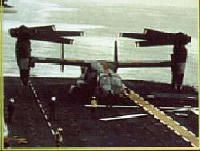
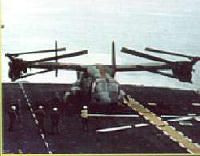
When the Osprey lands on the deck of a ship, it can be folded up for downtime. The blades and the wings are both foldable. The sequence is shown below:
The blades fold inward (top left and right); the wings turn up (bottom left); the wings fold back (bottom right).
Photo courtesy U.S. Navy
The blades fold inward (top left and right); the wings turn up (bottom left); the wings fold back (bottom right).
Photo courtesy U.S. Navy
The blades fold inward (top left and right); the wings turn up (bottom left); the wings fold back (bottom right).
Photo courtesy U.S. Navy
The blades fold inward (top left and right); the wings turn up (bottom left); the wings fold back (bottom right).
Photo courtesy U.S. Navy
Advertisement
How the Osprey Flies
A V-22 Osprey transitioning from helicopter to airplane mode.
Photo courtesy U.S. Navy
A V-22 Osprey transitioning from helicopter to airplane mode.
To understand how the Osprey flies, the basic thing to understand is that airplane wings create lift by deflecting air downward, benefiting from the equal and opposite reaction that results.
Advertisement
Helicopters do the same thing with blades, which are rotating wing shapes like the airfoils of an airplane wing. Helicopter blades are thinner and narrower than airplane wings because they have to rotate so fast. These rotating wings are mounted on a central shaft. When the shaft is spun, lift is created.
When the Osprey is ready to take off, its rotors are in a vertical position. With the rotors mounted on the wings, it looks like a two-bladed helicopter. When the Osprey is in helicopter mode (on takeoff, landing and when hovering), the rotors generate lift.
While in flight, the Osprey's rotors move down to a horizontal position. In this position, it is the wings that generate lift, like on a traditional airplane, and the rotors function as they do in a propeller aircraft. The Osprey lands like a helicopter by reversing the process, raising the rotors from a horizontal to a vertical position.