
Magnetic Confinement: The ITER Example
Courtesy ITER
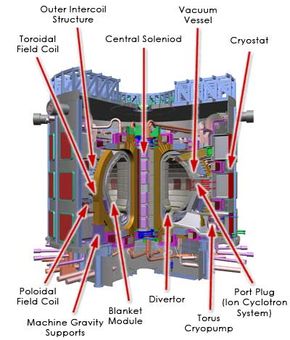
The main parts of the ITER tokamak reactor are:
- Vacuum vessel - holds the plasma and keeps the reaction chamber in a vacuum
- Neutral beam injector (ion cyclotron system) - injects particle beams from the accelerator into the plasma to help heat the plasma to critical temperature
- Magnetic field coils (poloidal, toroidal) - super-conducting magnets that confine, shape and contain the plasma using magnetic fields
- Transformers/Central solenoid - supply electricity to the magnetic field coils
- Cooling equipment (crostat, cryopump) - cool the magnets
- Blanket modules - made of lithium; absorb heat and high-energy neutrons from the fusion reaction
- Divertors - exhaust the helium products of the fusion reaction
Here's how the process will work:
Advertisement
Courtesy ITER
- The fusion reactor will heat a stream of deuterium and tritium fuel to form high-temperature plasma. It will squeeze the plasma so that fusion can take place. The power needed to start the fusion reaction will be about 70 megawatts, but the power yield from the reaction will be about 500 megawatts. The fusion reaction will last from 300 to 500 seconds. (Eventually, there will be a sustained fusion reaction.)
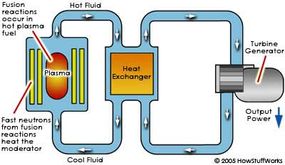
- The lithium blankets outside the plasma reaction chamber will absorb high-energy neutrons from the fusion reaction to make more tritium fuel. The blankets will also get heated by the neutrons.
- The heat will be transferred by a water-cooling loop to a heat exchanger to make steam.
- The steam will drive electrical turbines to produce electricity.
- The steam will be condensed back into water to absorb more heat from the reactor in the heat exchanger.
Initially, the ITER tokamak will test the feasibility of a sustained fusion reactor and eventually will become a test fusion power plant.