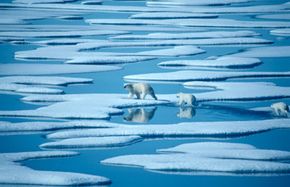
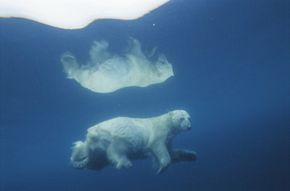
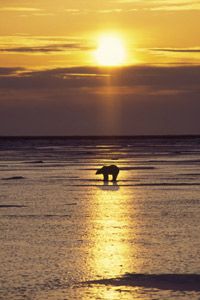
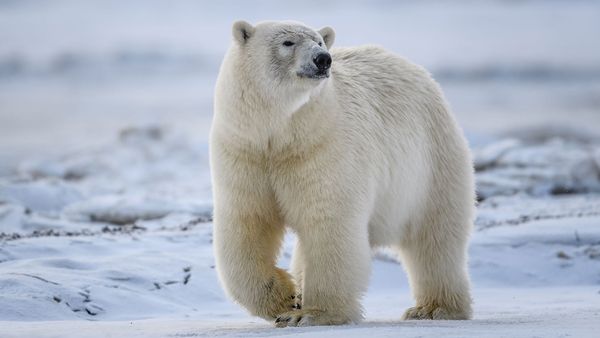
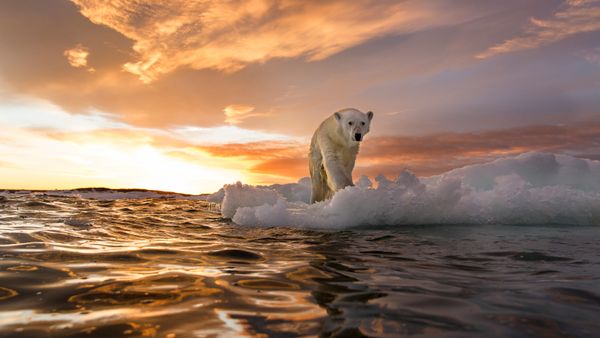
One of the world's 19 polar bear populations lives in Hudson Bay, Canada. In a Washington Post article, Dr. Ian Stirling of the Canadian Wildlife Service says that the ice sheets in that region are starting to crumble two and a half weeks earlier in the season than they did 30 years ago [source: Washington Post].
Fewer Polar Bear Cubs
In another CNN article, researchers of a study published in Ecological Applications found that this shrinking ice is causing polar bears to spend more time on land [source: CNN]. As a result, their health is declining leading to fewer cubs.
It used to be normal for polar bears to give birth to two cubs at a time, but now Kristin Laidre, professor of aquatic and fishery sciences at the University of Washington worries this "norm" could disappear if sea ice loss continues. The possibility of extinction is very real [source: CNN].
So, What's Being Done to Help?
But scientists haven't given up on polar bears. An innovative program called Warm Waters for Cool Bears is trying a new approach to conserving the species. Typically, researchers have tracked the bears to see how many polar bears are around, where they're living and where they're moving to better focus conservation efforts. But this approach isn't working well enough, or quickly enough. Warm Waters for Cool Bears tackles the problem from the other end -- tracking the habitats instead of the bears. Using several decades of satellite imagery and meteorological data, researchers with the Wildlife Conservation Society are trying to determine which polar ice caps have the best chance of surviving the warming trend. Efforts to save the polar bear populations living in those areas will then receive the greatest attention, since those conservation efforts are the most likely to succeed.
Are Polar Bears Endangered?
In 2007, The U.S. Fish and Wildlife Service filed a proposal to the U.S. government for polar bears to be classified as a threatened species under the Endangered Species Act (ESA). This would give the bears increased protection under the law. In May 2008, Arctic wide polar bears were listed as a threatened species in the U.S. under the ESA. Later in October 2019, the International Union for the Conservation of Nature (IUCN) Polar Bear Specialist Group released a new assessment showing more declines in polar bear subpopulations. In the meantime, the U.S. Geological Survey predicts a loss of two-thirds of the current polar bear population by 2060 if melting trends continue.
Today, it's not a question if polar bears are endangered. It's just a matter of how long. But even more, polar bears aren't the only ones in danger. Their prey is also being wiped out by global warming -- putting polar bears at greater risk of starving. The World Wildlife Fund announced in March 2008 that 1,500 newborn seals in the Arctic Circle are unlikely to survive their first few months. For about a month after they're born, seal cubs live burrowed in the ice as their bodies develop the fat layers that let them survive the frigid water. With the ice melting too quickly as a result of climate change, many of the cubs will find themselves in the water before they're ready. Like the polar bear population, Arctic seal numbers have dwindled drastically in the last century, shrinking from 180,000 to about 8,500 [source: Forbes].
With both polar bears and seals dying from starvation and drowning in record numbers, the animal life at the Arctic Circle could be changed forever.
For more information on polar bears, baby seals and global warming, look over the links on the next page.