
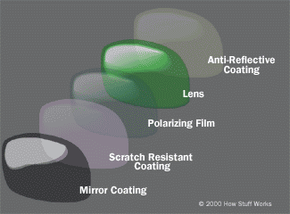
Reflective sunglasses often have a mirrored look. The lenses in these sunglasses have a reflective coating applied in a very thin, sparse layer -- so thin that it's called a half-silvered surface. The name half-silvered comes from the fact that at the molecular level, there are reflective molecules speckled over the glass in an even film, but only half of the glass is actually covered. The half-silvered surface will reflect about half the light that strikes it, letting the other half go straight through.
Often, the mirror coating is applied as a gradient that gradually changes shades from top to bottom. This provides additional protection from light coming in from above, while allowing more light to come in from below or straight ahead. This means that if you are driving, the sun's rays are blocked but you can still see the dashboard. Sometimes, the coating is bi-gradient, shading from mirrored at the top and bottom to clear in the middle.
Advertisement
The key problem with reflective sunglasses is that the coating is easily scratched. While glass itself is naturally scratch resistant, the coatings applied to glass, as well as to most plastic lenses, are not. To compensate for this, manufacturers have developed a variety of ways to apply optically clear, hard films to lenses. These films are made of materials such as diamond-like carbon (DLC) and polycrystalline diamond. Through a process of ionization, a thin but extremely durable film is created on the surface of the lens. See Patent #5,268,217 for details.
This scratch-resistant coating works well in most cases. But sunglass manufacturers have not been able to successfully apply a scratch-resistant layer on top of the reflective coating used on mirrored sunglasses. Therefore, the scratch-resistant coating is applied first, to protect the lenses, and the reflective coating is applied over it.
Advertisement