Introduction to How Radial Engines Work
![]() Photo courtesy NASA B-25 bomber's are equipped with radial engines. See more pictures of radial engines. |
In this article, you will learn how the radial engine works, what makes it different from other engine configurations and why it fits in so well with airplanes.
The Basic Idea
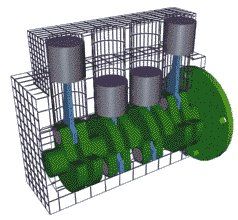
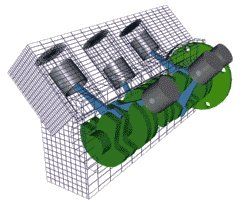
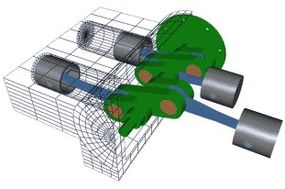
If you have read How Car Engines Work, then you are familiar with the concept behind the four-stroke engine. Car engines arrange pistons in three typical patterns, as shown here:
![]() (Click on image to see animation) Inline - The cylinders are arranged in a line in a single bank. |
![]() (Click on image to see animation) V - The cylinders are arranged in two banks set at an angle to one another. |
![]() (Click on image to see animation) Flat - The cylinders are arranged in two banks on opposite sides of the engine. |
Each different configuration has different smoothness, manufacturing cost and shape characteristics that make it more suitable for certain vehicles.
A radial engine is yet another configuration for the pistons, as we will see in the next section.
Inside a Radial Engine
The radial engine idea is very simple -- it takes the pistons and arranges them in a circle around the crankshaft, as shown here:
You can see in the illustration that this is a five-cylinder engine -- radial engines typically have anywhere from three to nine cylinders. The radial engine has the same sort of pistons, valves and spark plugs that any four-stroke engine has. The big difference is in the crankshaft.
Instead of the long shaft that's used in a multi-cylinder car engine, there is a single hub -- all of the piston's connecting rods connect to this hub. One rod is fixed, and it is generally known as the master rod. The others are called articulating rods. They mount on pins that allow them to rotate as the crankshaft and the pistons move.
Applications
Radial engines have several advantages for airplanes:- They can produce a lot of power. A typical radial engine in a B-17 has nine cylinders, displaces 1,800 cubic inches (29.5 liters) and produces 1,200 horsepower.
- Radial engines have a relatively low maximum rpm (rotations per minute) rate, so they can often drive propellers without any sort of reduction gearing.
- Because all of the pistons are in the same plane, they all get even cooling and normally can be air-cooled. That saves the weight of water-cooling.
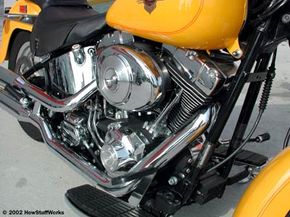
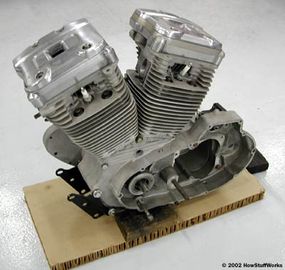
One place where you can still see the influence of the radial engine concept is in the two-cylinder engine of a Harley Davidson motorcycle.
![]() |
![]() The engine from a Harley can be thought of as two cylinders from a radial engine. |
It can be thought of, in a way, as two pistons from a radial engine. In a Harley, both pistons share a single connection point to the crankshaft, like in a radial engine.
For more information on radial engines and related topics, check out the links on the next page.
Lots More Information
Related HowStuffWorks Articles
- How WWII Fighter Planes Worked
- How Airplanes Work
- How Gas Turbine Engines Work
- How Car Engines Work
- How Stirling Engines Work
- How Rotary Engines Work
- How Horsepower Works
- What makes a Harley-Davidson motorcycle have that special sound?
More Great Links
- The Hodgson Nine - very detailed photos of a model radial engine
- The Radial Engine Handbook
- USAF Museum Engine Gallery
- Mixture distribution in a single-row radial engine
- High-speed tests of conventional radial-engine cowlings