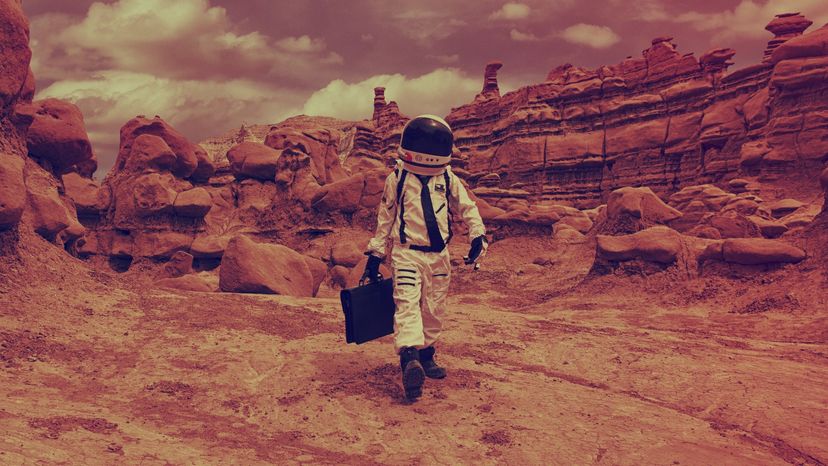
Would you even imagine how it would be to live there? Rich Vintage/Getty IMages
We have been going to space for decades now, but until the year 2000, those stays in orbit were always temporary. However, when three astronauts moved into the International Space Station (ISS) for a four-month stay, it marked the beginning of a decade and a half of a permanent human presence in space. The arrival of these three astronauts at the ISS on Nov. 2, 2000, sparked one NASA official to remark, "We're going into space forever with people first circling this globe, and then we're going to Mars...."
Why would we ever want to go to Mars? As pictures beamed back from planetary probes and rovers since 1964 have shown, Mars is a desolate, lifeless planet with seemingly little to offer humans. It has a very thin atmosphere and no signs of existing life -- but Mars does hold some promise for the continuation of the human race. There are more than six billion people on Earth, and that number continues to grow unabated. This overcrowding, or the possibility of planetary disaster, will force us to eventually consider new homes in our solar system, and Mars may have more to offer us than the photos of its barren landscape now show.
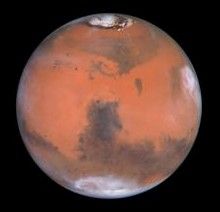
Mars has all of the elements needed to support life.
Photo courtesy NASA
Mars has long held a special fascination in the human imagination, as is witnessed by the scores of books and movies that have been produced about the planet in the last century alone. Each story creates its own unique image of what might exists on the red planet. What is it about Mars that makes it the subject of so many tales? While Venus is often referred to as Earth's sister planet, the conditions that exist on that fiery planet are far too uninhabitable. On the other hand, Mars is the next closest planet to us. And although it is a cold, dry planet today, it holds all of the elements that are needed for life to exist, including:
Water, which may be frozen at the polar ice caps
Carbon and oxygen in the form of carbon dioxide (CO2)
Nitrogen
There are amazing similarities between the Martian atmosphere that exists today and the atmosphere that existed on Earth billions of years ago. When the Earth was first formed, no oxygen existed on our planet and it, too, looked like a desolate, unlivable planet. The atmosphere was made entirely of carbon dioxide and nitrogen. It wasn't until photosynthetic bacteria developed on Earth that enough oxygen was produced to allow for the development of animals. Similarly, the thin Mars atmosphere today is almost totally composed of carbon dioxide. Here is the composition of Mars' atmosphere:
Advertisement
95.3 percent carbon dioxide
2.7 percent nitrogen
1.6 percent argon
0.2 percent oxygen
In contrast, Earth's atmosphere consists of 78.1 percent nitrogen, 20.9 percent oxygen, 0.9 percent argon and 0.1 percent carbon dioxide and other gases. As you can see by this breakdown, any humans visiting Mars today would have to carry with them huge amounts of oxygen and nitrogen in order to survive. However, the similarity to the early Earth and modern Mars atmospheres has led some scientists to speculate the same process that turned the Earth's atmosphere from mostly carbon dioxide into breathable air could be repeated on Mars. To do so would thicken the atmosphere and create a greenhouse effect that would heat the planet and provide a suitable living environment for plants and animals.
The average surface temperature on Mars is a frigid minus 81 degrees Fahrenheit (-62.77 degrees Celsius) with extremes that range from 75 degrees Fahrenheit (23.88 Celsius) to less than minus 100 degrees Fahrenheit (-73.33 Celsius). In comparison, Earth's average surface temperature is about 58 degrees Fahrenheit (14.4 degrees Celsius). However, there are a few Martian features that are close enough to Earth's to consider it for habitation, including:
A rotation rate of 24 hours 37 min (Earth: 23 hours 56 min.).
An axial tilt of 24 degrees (Earth 23.5 degrees).
A gravitational pull one-third of Earth's
It is close enough to the sun to experience seasons. Mars is about 50 percent farther from the sun than Earth.
Other worlds have been considered as possible candidates for terraforming, including Venus, Europa (a Jupiter moon), and Titan (a Saturn moon). However, Europa and Titan are too far from the sun, and Venus is too close (the average temperature on Venus is about 900 degrees Fahrenheit (482.22 Celsius)). Mars stands alone as the one planet in our solar system, not including Earth, that might be able to support life. In the next section, learn how scientists plan to transform the dry, cold landscape of Mars into warm, livable habitat.
Creating a Martian Greenhouse
Mars before and after terraformation.
Photo courtesy Lightworld
Terraforming Mars will be a huge undertaking, if it is ever done at all. Initial stages of terraforming Mars could take several decades or centuries. Terraforming the entire planet into an Earth-like habitat would have to be done over several millennia. Some have even suggested that such a project would last thousands of millennia. So, how are we supposed to transform a dry, desert-like land into a lush environment, where people, plants and other animals can survive. Here are three terraforming methods that have been proposed:
Large orbital mirrors that will reflect sunlight and heat the Mars surface.
Greenhouse gas-producing factories to trap solar radiation.
Smashing ammonia-heavy asteroids into the planet to raise the greenhouse gas level.
NASA is currently working on a solar sail propulsion system that would use large reflective mirrors to harness the sun's radiation to propel spacecraft through space. Another use for these large mirrors would be to place them a couple hundred thousand miles from Mars and use the mirrors to reflect the sun's radiation and heat the Martian surface. Scientists have proposed building mylar mirrors that would have a diameter of 250 km (155.34 miles) and cover an area larger than Lake Michigan. These gigantic mirrors would weigh about 200,000 tons, which means they would be far too large to launch from Earth. However, there is the possibility that the mirrors could be constructed from material found in space.
Advertisement
If a mirror this size were to be directed at Mars, it could raise the surface temperature of a small area by a few degrees. The idea would be to concentrate the mirrors on the polar caps to melt the ice and release the carbon dioxide that are believed to be trapped inside the ice. Over a period of many years, the rise in temperature would release greenhouse gases, such as chlorofluorocarbons (CFCs), which you can find in your air conditioner or refrigerator.
Another option for thickening the atmosphere of Mars, and, in turn, raising the temperature of the planet, would be to set up solar-powered, greenhouse-gas producing factories. Humans have had a lot of experience with this over the last century, as we have inadvertently released tons of greenhouse gases into our own atmosphere, which some believe is raising the Earth's temperature. The same heating effect could be reproduced on Mars by setting up hundreds of these factories. Their sole purpose would be to pump out CFCs, methane, carbon dioxide and other greenhouse gases into the atmosphere.
These greenhouse-gas factories would either have to be ferried to Mars or made out of materials already located on Mars, which would take years to process. In order to transport these machines to Mars, they would have to be lightweight and efficient. These greenhouse machines would mimic the natural process of plant photosynthesis, inhaling carbon dioxide and emitting oxygen. It would take many years, but the Mars atmosphere would slowly be oxygenated to the point that Mars colonists would need only a breathing-assistance apparatus, and not a pressure suit as worn by astronauts. Photosynthetic bacteria could also be used in place of or in addition to these greenhouse machines.
Space scientist Christopher McKay and Robert Zubrin, author of "The Case For Mars", have also proposed a more extreme method for greenhousing Mars. They believe that hurling large, icy asteroids containing ammonia at the red planet would produce tons of greenhouse gases and water. For this to be done, nuclear thermal rocket engines would have to be somehow attached to asteroids from the outer solar system. The rockets would move the asteroids at about 4 kilometers per second, for a period of about 10 years, before the rockets would shut off and allow the 10-billion-ton asteroids to glide, unpowered, toward Mars. Energy released upon impact would be about 130 million megawatts of power. That's enough energy to power Earth for a decade.
If it is possible to smash an asteroid of such enormous size into Mars, the energy of one impact would raise the temperature of the planet by 3 degrees Celsius. The sudden raise in temperature would melt about a trillion tons of water, which is enough water to form a lake, with a depth of one meter, that could cover an area larger than the state of Connecticut. Several of these missions over 50 years would create a temperate climate and enough water to cover 25 percent of the planet's surface. However, the bombardment by asteroids, each releasing energy equivalent to 70,000 one-megaton hydrogen bombs, would delay human settlement of the planet for centuries.
While we may reach Mars this century, it could take several millennia for the idea of terraforming to be fully realized. It took the Earth billions of years to transform into a planet on which plants and animals could flourish. To transform the Mars landscape into one that resembles Earth is not a simple project. It will take many centuries of human ingenuity and labor to develop a habitable environment and bring life to the cold, dry world of Mars.