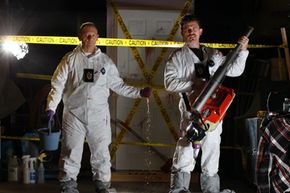
Introduction to How Crime-scene Clean-up Works
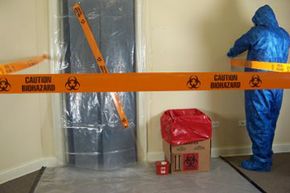
![]() Photo courtesy NECSC |
| Crime-scene cleaners charge up to $600 an hour. See more crime pictures. |
The police, the fire department and the crime-scene investigators who arrive at a crime scene perform crucial tasks in the aftermath of a violent death. But they don't, as a general rule, clean up. Mopping up after someone who dies violently is the responsibility of that person's family. And until recently, there were very few cleaning companies that would handle that kind of job, so the family members ended up having to do it themselves. If ever there were a situation begging for capitalism to step in and take over, this was it.
Crime-scene cleaners charge up to $600 an hour for their service, and most people would pay a lot more. In this article, we'll find out what crime-scene clean-up involves, what special knowledge the cleaners need to have and who in the world would be able to do this job.
The Basics
Crime-scene clean-up is a niche market within the cleaning industry. It's called CTS Decon -- crime and trauma scene decontamination -- and it involves cleaning up dangerous material. This could mean the biologically contaminated scene of a violent death (homicide, suicide or accidental) or the chemically contaminated scene of a methamphetamine lab or anthrax-exposure site. Crime-scene cleaners come in and restore the scene to its pre-incident state.
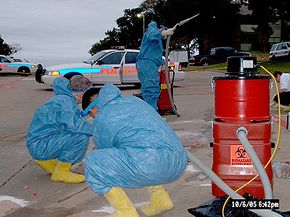
![]() Photo courtesy AMDECON Cleaning up after a murder outside an apartment complex |
Up Next |
When a violent death occurs in someone's home, the family typically doesn't move out of the house. The cleaners' job is to remove any sign of what happened and any biohazards that result from such an incident. Federal regulations deem all bodily fluids to be biohazards, so any blood or tissue at a crime scene is considered a potential source of infection. You need special knowledge to safely handle biohazardous material and to know what to look for at the scene -- for instance, if there's a thumbnail-size bloodstain on the carpet, there's a good chance that there's a 2-foot-diameter bloodstain on the floorboards underneath it. You can't just clean the carpet and call it a day. You also need permits to transport and dispose of biohazardous waste. Companies that clean up crime scenes have all of the necessary permits, training and, perhaps most important, willingness to handle material that would send most of us running out the door to throw up in the bushes.
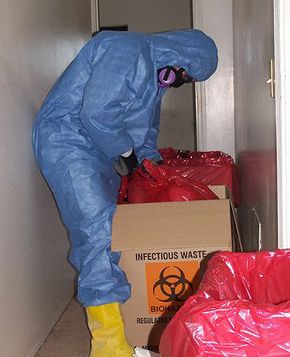
![]() Photo courtesy NECSC Packaging biohazardous waste for transport |
So who are these people who stay put in the face of a wall splattered with blood, brain matter and skull fragments? A lot of them come from medical fields that prepare them for the gore -- they may have been EMTs or emergency room nurses. A construction background is helpful, too, because some clean-ups (especially meth labs) require walls and built-in structures to be removed. Regardless of background, any crime-scene cleaner needs at least three qualities: a strong stomach, the ability to emotionally detach from his work and a sympathetic nature.
Why sympathetic? Because cleaning up a crime scene has one very big difference from cleaning up after, say, a hazardous spill at a chemical plant: Grieving family members. People who loved the deceased are often at the scene while the cleaners are scrubbing blood off the walls. They might be sobbing and looking for support from the only non-grieving people still there -- the clean-up crew. Crime-scene cleaners are in the awkward position of having to be stoic in the face of stomach-churning physical remains and yet sensitive in the face of a family's tragedy. Not everyone can do both.
Crime-scene cleaners handle a wide variety of messy situations, each of which carries its own dangers and particularly nauseating characteristics.
|
|
The Clean-up
![]() Photo courtesy HowStuffWorks Shopper Filtered respirator |
Crime-scene cleaners are usually "secondary responders" -- they arrive after the police, firefighters, paramedics and coroner. The scene is typically already secured, but the clean-up crew needs to confirm this and continue to make sure the public can't enter the scene, because it's a biohazard. The most common clean-up scenes include:
- Violent death (homicide/suicide/accidental)
- Decomp (a decomposing body)
- Methamphetamine labs
In all of these clean-ups, the cleaners arrive with the same equipment. Once they assess the scene and the damage, they have a lot of tools to choose from to help them return the room, apartment or house to its pre-incident state.
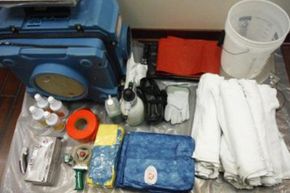
Their gear typically includes:
- Personal protective gear - a non-porous, one-time-use suit, gloves, filtered respirators and chemical-spill boots
- Biohazard waste containers - 55-gallon heavy duty bags and sealed, hard-plastic containers
- Traditional cleaning supplies - Mops, buckets, spray bottles, sponges, brushes, etc.

Photo courtesy HowStuffWorks Shopper
Protective suit
- Hard-core cleaning supplies - Can include:
- Ozone machine (to remove odors)
- Foggers (to thicken a cleaning chemical so it can get all the way into tight places like air ducts, usually for odor removal)
- Hospital-grade disinfectants (bleach, hydrogen peroxide)
- Industrial-strength deodorizers
- Enzyme solvent (to kill bacteria and viruses and liquify dried blood)
- No-touch cleaning system (to clean blood-coated surfaces from a safe distance -- includes heavy-duty sprayer, long scrubbing brush, wet vacuum)
- Putty knives (to scrape up brain matter, which dries into a cement-like consistency)
- Razor blades (to cut out portions of carpet)
- Shovels (in about two hours, large amounts of blood coagulate into a Jell-O-like goo that can be shoveled into bags)
- Truck-mounted steam-injection machine (to melt dried brain matter that cleaners can't remove with putty knives)
- Chemical treatment tank (to disinfect and store matter sucked up by vacuum systems)
- Carpentry/restoration tools - sledgehammers, saws, spackle, paint brushes
- Ladders
- Camera (to take before-and-after shots for insurance purposes)
- Van or truck for transporting all of this stuff (and hauling waste to disposal site after clean-up)
Up Next |
Each type of clean-up scene comes with its own unique horrors, none of which seem to bother the people who do this job. In the case of a violent death, there are bodily fluids to deal with, each tiny drop carrying germs, bacteria and, possibly, infectious diseases. In something like a suicide where a person cuts his wrists or shoots himself in the head, there's tons of blood; if someone is shot in the chest, though, there's very little blood because the lungs suck it in. But no matter how much of it there is, the cleaners have to approach it as if it were carrying bloodborne pathogens like HIV, hepatitis and hantavirus.
The thing about crime-scene clean-up is that the scene has to be truly clean, not just apparently clean. In addition to the infection that can result from bloodborne pathogens, any bodily fluids that remain in floors, carpets, baseboards or walls can lead to mold, bacteria and fungus, which can cause sickness months or years later.
To truly clean the scene of a messy homicide, suicide, accidental death or undiscovered death and restore the area to its previous state can take anywhere from an hour to 40 hours. It all depends on the "degree of trauma" and the amount of biohazardous material at the site. Cleaners use a hospital grade disinfectant to wipe or scrub every drop of blood off of all surfaces, including counters, ceilings, walls, light fixtures, little glass trinkets, family pictures, artwork and appliances. They scrape brain matter off of walls and collect any bone fragments embedded in the drywall. They rip out and discard any blood-soaked carpeting and get rid of any blood-soaked upholstery, window treatments or rugs. Sometimes, they need to collect and remove small pieces of the body -- the coroner takes most of it, but if it was a particularly violent death, there may parts left behind.
In a decomp, the scene is usually not quite as spread out as in a violent death, but a decomposing body can be even more gruesome than a suicide. A body that has been deceased for days, weeks or months has gone through some changes. In decomposition, the body swells, insects move in, the organs digest themselves and the skin liquifies. It's not pretty, but most people will tell you that the sight of a decomposing body can't compare to the smell. Most people are brought to their knees by that smell, which is partly a result of ammonia gas released during decomposition. The coroner removes the body before the clean-up starts, but usually leaves behind lots of liquefied body matter and odors as well as maggots that are carrying the person's blood. In addition to cleaning up the mess, cleaners sometimes have to track down and kill (by burning) any maggots that scurry out of the body and try to hide, because they're carrying germs and might be carrying viruses.
The scene of a methamphetamine lab, on the other hand, typically doesn't have the "gross factor" of a death scene, but it's often a lot more dangerous to clean up in terms of health risks. The laundry list of poisons used to make street-grade methamphetamine (including acetone, methanol, ammonia, benzene, iodine and hydrochloric acid) leaves a toxic residue that coats and infuses every surface and stays in the air. Most of these poisonous substances are absorbed through the skin, making a meth lab one of the most dangerous places a person can walk into. Exposure to a meth lab can cause reproductive disorders, birth defects, blindness, lung damage, liver damage and kidney damage, and that's just for starters. The scene remains toxic indefinitely unless it's properly cleaned -- an apartment that housed a meth lab can make its tenants sick a decade after the lab has been removed.
Proper clean-up of a meth lab involves disposing of everything porous and everything that can't be submerged in detoxification chemicals (several times). Crime-scene cleaners get rid of all furniture, cabinetry, light fixtures, carpeting, electronics ... basically everything that isn't part of the structure. And in the worst cases, they also dispose of most of the structure -- they sometimes have to pull up all of the flooring and gut the walls, removing all of the drywall until nothing remains but studs.
Regardless of the type of scene, the final step in any clean-up is disposing of the evidence (unless the owners of the apartment or house have contracted the cleaners to do restoration work as well). This is actually a more complicated task than it may seem. You can't put hazardous or biohazardous waste in regular trash dump. Crime-scene cleaners need a special permit to transport it. To dispose of it, in the case of the blood and gore they have to pay (typically by the pound) to burn it in a medical-waste incinerator. Some incinerators have minimum amounts they'll burn, so the cleaning company might have to pay to store the refuse in a sealed, refrigerated area until they've collected the minimum amount. In the case of poisonous chemical waste, you can only dump it in special areas not accessible to the public, which costs additional cash. Transporting and disposing of waste can be a big percentage of a clean-up bill.
If cleaning up blood and brains and poisonous waste all sounds perfectly manageable to you, you might be a candidate for a career in crime-scene clean-up. In the next section, we'll take a look at the job and who's qualified to do it.
The Job
![]() Photo courtesy NECSC Decontaminating the company van after a clean-up |
Cleaning up a crime scene is on most people's list of worst possible jobs, but it's not on everybody's. There are people who are well-suited to the work. What makes a successful crime-scene cleaner? First on the list of necessary traits is a strong stomach (no pukers) and the right psychological makeup. A crime-scene cleaner needs to be mentally stable -- depressives are probably not great candidates for the work, and most companies will reject people who show signs of voyeurism or a great enthusiasm for gore. Crime-scene clean-up is work, not entertainment, and cleaners have to be respectful and professional at all times. Empaths shouldn't apply, either -- the last thing you want at a crime scene is a sobbing cleaner. But the ability to sympathize from a distance is an asset in this line of work, since devastated family members might be present at the clean-up site.
Now, even if you get a job with a crime-scene clean-up outfit, you don't just climb into a biohazard suit and dig in when the next suicide happens. There's a good deal of training involved, including bloodborne pathogen training (learning the dangers, characteristics and proper safety procedures regarding the handling of bodily fluids), training in the proper use of protective gear and learning how to properly transport and dispose of dangerous waste. Candidates will also have to pass a "gross factor" test to make sure they can handle the work without throwing up. This type of training ranges from a graphic visual presentation of photos from previous clean-ups to an actual clean-up of animal remains. Most of this preparation occurs through the crime-scene clean-up company, but it may also include training and certification programs offered by a trade group or the Occupational Safety and Health Administration (OSHA).
Workers in this field have to get a Hepatitis B vaccine every five years, and they need to be in good overall health and physical condition. A clean-up job can require eight hours of scrubbing in a plastic suit in close quarters in summer heat, breaking through walls and moving furniture. Combine that with being on call 24/7, and you're looking at a potentially exhausting line of work. The average time a person spends as a cleaner is eight months. People burn out pretty quickly, and both employers and employees need to be on the lookout for signs of Critical Incident Stress Syndrome (CISS) and Secondary Traumatic Stress Disorder (STSD). Both of these are stress disorders resulting from exposure to a traumatic situation and to people immediately involved in a traumatic situation. CISS and STSD can cause health problems, depression, anxiety disorders and chronic nightmares. Constant exposure to tragedy isn't good for anybody, and even the most stoic cleaners can be affected by the work. It can be worth the trouble, though: In a field that doesn't require a college degree, salaries typically start around $35,000 and move up to around $50,000 with experience, and it's possible to reach six figures in a big city with a lot of violent deaths and meth labs.
Which brings us to the thing about crime-scene clean-up that some people have issues with: The more people who die violently and/or alone, the more money crime-scene cleaners make. While these companies are providing a real service for people desperately in need, cleaning up crime scenes is a business, pure and simple.
The Business
Crime-scene clean-up companies might also handle tasks like cleaning up a chemical spill at a factory, disposing of a mouse (that may or may not be carrying the hantavirus) rotting in someone's wall, asbestos removal from an office building and getting a "garbage house" back up to code. A garbage house is a (typically rented) house or apartment that the tenants basically used as a trash dump (and sometimes a giant toilet). |
Cleaning up crime scenes isn't just a business -- it's a lucrative business. These companies charge anywhere from $100 to $600 an hour depending on the "degree of trauma" and the amount of hazardous or biohazardous material the cleaners have to handle and dispose of. Cleaning up a homicide in a single room with a lot of blood can run from $1,000 to $3,000. This service is often covered under auto, homeowner's or business insurance, and many crime-scene clean-up companies will handle the insurance paperwork for their clients. In the case of homicide, the company usually sends the bill to the federal Crime Victim Reparations agency, which pays for the clean-up.
CTS Decon is a quickly growing field. There are about 300 companies in the United States doing this work. One of those companies, Neil Smithers' Crime Scene Cleaners, Inc., began in San Francisco in 1988 and has subcontractors in 18 states as of 2006. The San Francisco branch handles more than 400 jobs per year.
Of course, in a field that deals with tragic death, advertising and marketing can be tricky. Some companies choose the standard phone-book route, and many advertise on the side of their van. Others avoid mainstream methods entirely and focus on more discreet options, like passing out cards at service-industry functions (hotels and motels need clean-ups more often than any other business), funeral homes and police stations. "Marketing" a crime-scene clean-up business means getting to know police detectives, firefighters, paramedics and morticians, who will provide a list of cleaning services to survivors when it's requested.
While it's ultimately a business like any other, succeeding in this industry means understanding the sensitive nature of the work. Some clean-up companies provide a grief counselor at no cost if the family needs one, and others offer a sliding scale so people who don't have thousands of dollars in their bank account can still afford the service. In some communities, religious organizations help cover the cost of a crime-scene clean-up.
Some people call this growing field a social trend toward the commercialization of death, some call it simple capitalism and others call it a godsend. No matter how you look at it, if you ever end up with blood and brains all over your living room walls, you'll probably be relieved there's someone you can hire to clean it up.
For more information on crime-scene clean-up and related topics, check out the links on the next page.
Lots More Information
Related HowStuffWorks Articles
- How Autopsies Work
- How Blood Works
- How Crime-scene Investigation Works
- How Luminol Works
- How the Mafia Works
- How Police Dogs Work
More Great Links
- AMDECON: Crime Scene Cleaners
- Austin American-Statesman: Job wanted: cleaning up after a bloody murder
- BBC Health: Human decomposition after death
- Boulder Weekly: The art of inhumation
- Washington State Department of Health: Hazards of Methamphetamine Production
Sources
http://ateammasters.com/regs.html
http://www.biohazardresponse.com/
http://www.slweekly.com/editorial/2002/feat_2002-11-07.cfm
http://www.cmmonline.com/article.asp?IndexID=6635354
http://www.doh.wa.gov/ehp/ts/CDL/methhazards.htm
http://www.bbc.co.uk/health/ask_the_doctor/decompostionafterdeath.shtml
http://www.sfbg.com/SFLife/34/47/lead.html
http://www.statesman.com/life/content/life/stories/other/02/26greig.html
http://www.bizjournals.com/birmingham/stories/2003/11/10/smallb1.html?t=printable
http://money.cnn.com/2005/02/28/pf/sixfigs_eleven/index.htm
http://beebo.org/smackerels/crime-scene.html
http://www.amdecon.com/forensicDetails.asp?nid=4
http://www.boulderweekly.com/archive/062603/coverstory.html