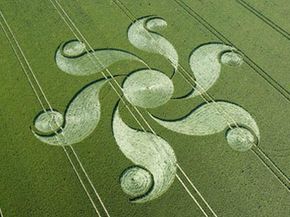
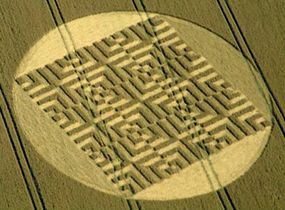
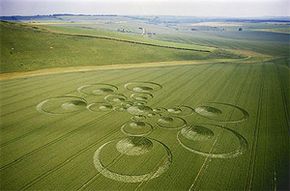
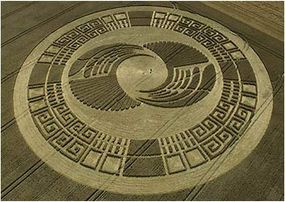
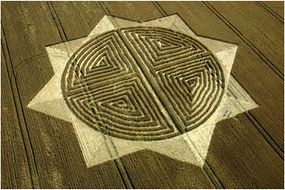
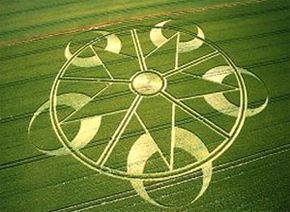
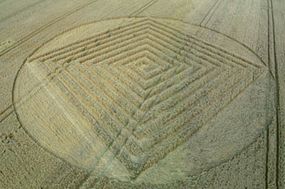
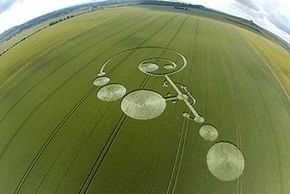
The answer of who or what is creating these crop formations is not an easy one to answer. Some people claim they are the work of UFOs. Others say they are a natural phenomenon. Still, others say they are elaborate hoaxes perpetrated by teams of circle makers.
UFOs and Aliens
Possibly the most controversial theory is that crop circles are the work of visitors from other planets — sort of like alien calling cards.
People who agree with this theory say that the circles are either the imprint left by UFO landings or messages brought from afar for us earthlings. Some eyewitnesses claim to have seen flying saucer-like lights and strange noises emanating from crop circle sites.
Winds
Probably the most scientific theory says that small currents of swirling winds — called vortices (similar to "dust devils") — created the crop circles. The spinning columns force a burst of air down to the ground, which flattened wheat and other crops. Vortices are common in hilly areas, such as parts of southern England.
Dr. Terence Meaden of the Tornado and Storm Research Organization (TORRO) in Wiltshire, England, says the vortices that create crop circles are charged with energy (his idea is called the Plasma Vortex Theory). When dust particles get caught up in the spinning, charged air, they can appear to glow, which may explain the UFO-like glowing lights many witnesses have seen near crop circles.
But the question remains: How can a few seconds' worth of spinning air create such intricate and perfectly defined crop circles?
Aircraft
A few researchers have theorized that small airplanes or helicopters stir up downdrafts that push the crops down into patterns. Recreation attempts so far have not successfully produced the types of downdrafts necessary to make the perfectly round edges seen in most crop circles.
Earth Energy
Some researchers believe that the earth creates its own energy, which forms the circles. One possible form of earth energy is electromagnetic radiation. In fact, scientists have measured strong magnetic fields inside crop circles, and visitors have sometimes reported feeling a tingling sensation in their bodies while in or near the circles.
In the early 1990s, American biophysicist Dr. William Levengood discovered that crops in circles were damaged much in the same way as plants heated in a microwave oven. He proposed the idea that the crops were being rapidly heated from the inside by some kind of microwave energy.
Other researchers say that the energy comes from under the ground or in the soil. Either the energy is natural, such as a fungus that attacks the crops and causes their stems to bend over, or it is a byproduct of something man-made, such as bombs that exploded during World War II.
Humans
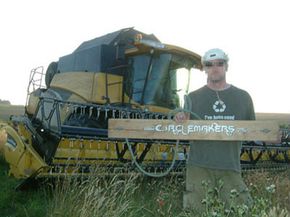
The easiest explanation for crop circles is that they are man-made hoaxes, created either for fun or to stump the scientists.
Among the most famous hoaxers are the British team of Doug Bower and Dave Chorley, known as "Doug and Dave." In 1991, the duo came out and announced that they had made hundreds of crop circles since 1978. To prove that they were responsible, they filmed themselves for the BBC making a circle with a rope-and-plank contraption in a Wiltshire field.
Joe Nickell, Senior Research Fellow of the Committee for the Scientific Investigation of Claims of the Paranormal (CSICOP) says that crop circles have all the hallmarks of hoaxes: They are primarily in southern England; they've become more elaborate over the years (indicating that hoaxers are getting better at their craft); and their creators never allow others to see them.
But even with crop circle makers claiming responsibility for hundreds of designs, hoaxes can't account for all of the thousands of crop circles created. Colin Andrews, cereologist and author of the book "Circular Evidence," admits that about 80 percent of crop circles are probably man-made, but says that the other 20 percent are probably the work of some "higher force."
Energy Effects
People close to the sites of crop circles have reportedly experienced strange physical and emotional reactions. Some have reported feeling dizzy, disoriented, peaceful or nervous. Others have said they heard a buzzing noise or felt a tingling sensation.
After visiting the Julia Set formation near Stonehenge in 1996, a group of women reported changes in their normal menstrual cycles. Most startling was a small group of post-menopausal women who suddenly began menstruating again after visiting the site.