Does Hollywood get it right on CSI, or not so much? adamkaz/E+/Getty Images
On TV shows like "CSI," viewers get to watch as investigators find and collect evidence at the scene of a crime, making blood appear as if by magic and swabbing every mouth in the vicinity. Many of us believe we have a pretty good grip on the process, and rumor has it criminals are getting a jump on the good guys using tips they pick up from these shows about forensics.
But does Hollywood get it right? Do crime scene investigators follow their DNA samples into the lab? Do they interview suspects and catch the bad guys, or is their job all about collecting physical evidence? In this article, we'll examine what really goes on when a CSI "processes a crime scene" and get a real-world view of crime scene investigation from a primary scene responder with the Colorado Bureau of Investigation.
Advertisement
CSI Basics
Crime scene investigation is the meeting point of science, logic and law. "Processing a crime scene" is a long, tedious process that involves purposeful documentation of the conditions at the scene and the collection of any physical evidence that could possibly illuminate what happened and point to who did it. There is no typical crime scene, there is no typical body of evidence and there is no typical investigative approach.
At any given crime scene, a CSI might collect dried blood from a windowpane — without letting his arm brush the glass in case there are any latent fingerprints there, lift hair off a victim's jacket using tweezers so he doesn't disturb the fabric enough to shake off any of the white powder (which may or may not be cocaine) in the folds of the sleeve, and use a sledge hammer to break through a wall that seems to be the point of origin for a terrible smell.
All the while, the physical evidence itself is only part of the equation. The ultimate goal is the conviction of the perpetrator of the crime. So while the CSI scrapes off the dried blood without smearing any prints, lifts several hairs without disturbing any trace evidence and smashes through a wall in the living room, he's considering all of the necessary steps to preserve the evidence in its current form, what the lab can do with this evidence in order to reconstruct the crime or identify the criminal, and the legal issues involved in making sure this evidence is admissible in court.
The investigation of a crime scene begins when the CSI unit receives a call from the police officers or detectives on the scene. The overall system works something like this:
The CSI arrives on the scene and makes sure it is secure. She does an initial walk-through to get an overall feel for the crime scene, finds out if anyone moved anything before she arrived, and generates initial theories based on visual examination. She makes note of potential evidence. At this point, she touches nothing.
The CSI thoroughly documents the scene by taking photographs and drawing sketches during a second walk-through. Sometimes, the documentation stage includes a video walk-through, as well. She documents the scene as a whole and documents anything she has identified as evidence. She still touches nothing.
Now it's time to touch stuff — very, very carefully. The CSI systematically makes her way through the scene collecting all potential evidence, tagging it, logging it and packaging it so it remains intact on its way to the lab. Depending on the task breakdown of the CSI unit she works for and her areas of expertise, she may or may not analyze the evidence in the lab.
The crime lab processes all of the evidence the CSI collected at the crime scene. When the lab results are in, they go to the lead detective on the case.
Every CSI unit handles the division between field work and lab work differently. What goes on at the crime scene is called crime scene investigation (or crime scene analysis), and what goes on in the laboratory is called forensic science. Not all CSIs are forensic scientists. Some CSIs only work in the field — they collect the evidence and then pass it to the forensics lab. In this case, the CSI must still possess a good understanding of forensic science in order to recognize the specific value of various types of evidence in the field. But in many cases, these jobs overlap.
Joe Clayton is a primary crime scene responder at the Colorado Bureau of Investigation (CBI). He has 14 years of field experience and also is an expert in certain areas of forensic science. As Clayton explains, his role in laboratory analysis varies according to the type of evidence he brings back from the crime scene:
Depending on what scientific examinations are needed or requested, I may be involved in the actual "bench work" once the evidence is submitted to the laboratory. I have expertise in blood pattern identification (blood spatter), trajectory determination, serology (blood and body fluids), and photography. I also have knowledge in many other areas (firearms, fingerprints, questioned documents...) that may assist me at the scene. As a primary crime scene responder at the CBI, my role at the scene may involve one or more of my particular disciplines. While I would not do a functionality test on a firearm here at the laboratory, my role at the crime scene would be to collect the gun and understand its potential evidentiary significance.
Crime scene investigation is a massive undertaking. Let's start at the beginning: scene recognition.
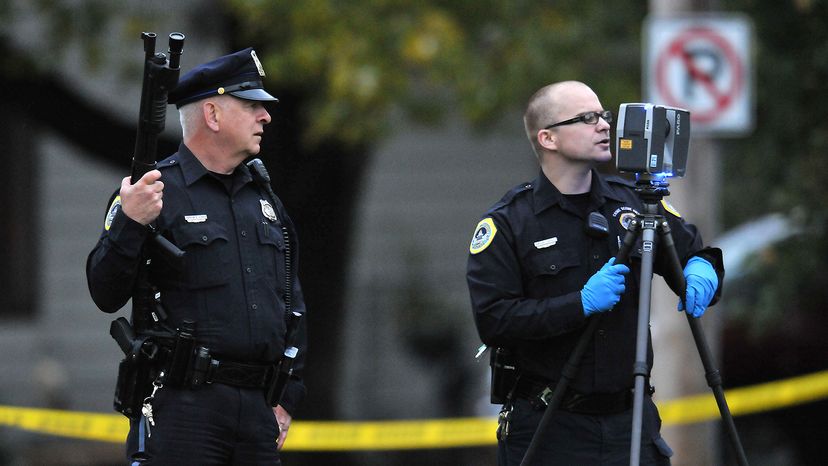
Des Moines police officers secure a crime scene related to a double homicide on Nov. 2, 2016, in Des Moines, Iowa. Steve Pope/Getty Images
When a CSI arrives at a crime scene, he doesn't just jump in and start recovering evidence. The goal of the scene recognition stage is to gain an understanding of what this particular investigation will entail and develop a systematic approach to finding and collecting evidence. At this point, the CSI is only using his eyes, ears, nose, some paper and a pen.
The first step is to define the extent of the crime scene. If the crime is a homicide, and there is a single victim who was killed in his home, the crime scene might be the house and the immediate vicinity outside. Does it also include any cars in the driveway? Is there a blood trail down the street? If so, the crime scene might be the entire neighborhood. Securing the crime scene -- and any other areas that might later turn out to be part of the crime scene -- is crucial. A CSI really only gets one chance to perform a thorough, untainted search -- furniture will be moved, rain will wash away evidence, detectives will touch things in subsequent searches, and evidence will be corrupted.
Advertisement
Usually, the first police officers on the scene secure the core area -- the most obvious parts of the crime scene where most of the evidence is concentrated. When the CSI arrives, he will block off an area larger than the core crime scene because it's easier to decrease the size of a crime scene than to increase it -- press vans and onlookers may be crunching through the area the CSI later determines is part of the crime scene. Securing the scene involves creating a physical barrier using crime scene tape or other obstacles like police officers, police cars or sawhorses, and removing all unnecessary personnel from the scene. A CSI might establish a "safe area" just beyond the crime scene where investigators can rest and discuss issues without worrying about destroying evidence.
Once the CSI defines the crime scene and makes sure it is secure, the next step is to get the district attorney involved, because if anyone could possibly have an expectation of privacy in any portion of the crime scene, the CSI needs search warrants. The evidence a CSI recovers is of little value if it's not admissible in court. A good CSI errs on the side of caution and seldom searches a scene without a warrant.
With a search warrant on the books, the CSI begins a walk-through of the crime scene. He follows a pre-determined path that is likely to contain the least amount of evidence that would be destroyed by walking through it. During this initial walk-through, he takes immediate note of details that will change with time: What's the weather like? What time of day of day is it? He describes any notable smells (gas? decomposition?), sounds (water dripping? smoke alarm beeping?), and anything that seems to be out of place or missing. Is there a chair pushed up against a door? Is the bed missing pillows? This is also the time to identify any potential hazards, like a gas leak or an agitated dog guarding the body, and address those immediately.
The CSI calls in any specialists or additional tools he thinks he'll need based on particular types of evidence he sees during the recognition stage. A t-shirt stuck in a tree in the victim's front yard may require the delivery of a scissor lift to the scene. Evidence such as blood spatter on the ceiling or maggot activity on the corpse requires specialists to analyze it at the scene. It's hard to deliver a section of the ceiling to the lab for blood spatter analysis, and maggot activity changes with each passing minute. Mr. Clayton happens to be an expert in blood spatter analysis, so he would perform this task in addition to his role as crime scene investigator.
During this time, the CSI talks to the first responders to see if they touched anything and gather any additional information that might be helpful in determining a plan of attack. If detectives on the scene have begun witness interviews, they may offer details that point the CSI to a particular room of the house or type of evidence. Was the victim yelling at someone on the phone a half-hour before the police arrived? If so, the Caller ID unit is a good piece of evidence. If an upstairs neighbor heard a struggle and then the sound of water running, this could indicate a clean-up attempt, and the CSI knows to look for signs of blood in the bathroom or kitchen. Most CSIs, including Mr. Clayton, do not talk to witnesses. Mr. Clayton is a crime scene investigator and a forensic scientist -- he has no training in proper interview techniques. Mr. Clayton deals with the physical evidence alone and turns to the detectives on the scene for any useful witness accounts.
The CSI uses the information he gathers during scene recognition to develop a logical approach to this particular crime scene. There is no cookie-cutter approach to crime scene investigation. As Mr. Clayton explains, the approach to a crime scene involving 13 deaths in a high school (Mr. Clayton was one of the CSIs who processed Columbine High School after the shootings there) and the approach to a crime scene involving a person who was raped in a car are vastly different. Once the CSI has formed a plan of attack to gather all of the evidence that could be relevant to this particular crime, the next step is to fully document every aspect of the scene in a way that makes it possible for people who weren't there to reconstruct it. This is the scene-documentation stage.
Who's at the Scene?
Police officers are typically the first to arrive at a crime scene. They arrest the perpetrator if he's still there and call for an ambulance if necessary. They are responsible for securing the scene so no evidence is destroyed. The CSI unit documents the crime scene in detail and collects any physical evidence. The district attorney is often present to help determine if the investigators require any search warrants to proceed and obtain those warrants from a judge. The medical examiner (if a homicide) may or may not be present to determine a preliminary cause of death. Specialists (entomologists, forensic scientists, forensic psychologists) may be called in if the evidence requires expert analysis. Detectives interview witnesses and consult with the CSI unit. They investigate the crime by following leads provided by witnesses and physical evidence.
Advertisement
Crime Scene Documentation
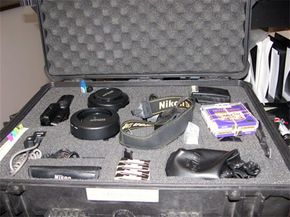
Joe Clayton's photography kit: He usually uses a digital Nikon D100 to photograph a crime scene. He might also use a Nikon N8008s (35-mm film format) for special applications.
The goal of crime-scene documentation is to create a visual record that will allow the forensics lab and the prosecuting attorney to easily recreate an accurate view of the scene. The CSI uses digital and film cameras, different types of film, various lenses, flashes, filters, a tripod, a sketchpad, graph paper, pens and pencils, measuring tape, rulers and a notepad at this stage of the investigation. He may also use a camcorder and a camera boom.
Scene documentation occurs during a second walk-through of the scene (following the same path as the initial walk-through). If there is more than one CSI on the scene (Mr. Clayton has been the sole CSI on a scene; he has also been one of dozens), one CSI will take photos, one will create sketches, one will take detailed notes and another might perform a video walk-through. If there is only one CSI, all of these jobs are his.
Advertisement
Notes
Note-taking at a crime scene is not as straightforward as it may seem. A CSI's training includes the art of scientific observation. Whereas a layperson may see a large, brownish-red stain on the carpet, spreading outward from the corpse, and write down "blood spreading outward from underside of corpse," a CSI would write down "large, brownish-red fluid spreading outward from underside of corpse." This fluid might be blood; it might also be decomposition fluid, which resembles blood at a certain stage. Mr. Clayton explains that in crime scene investigation, opinions don't matter and assumptions are harmful. When describing a crime scene, a CSI makes factual observations without drawing any conclusions.
Photographs
CSIs take pictures of everything before touching or moving a single piece of evidence. The medical examiner will not touch the corpse until the CSI is done photographing it and the surrounding area. There are three types of photographs a CSI takes to document the crime scene: overviews, mid-views, and close-ups.
Overview shots are the widest possible views of the entire scene. If the scene is indoors, this includes:
views of all rooms (not just the room where the crime seems to have occurred), with photos taken from each corner and, if a boom is present, overhead
views of the outside of the building where the crime happened, including photos of all entrances and exits
views of the building showing its relation to surrounding structures
photos of any spectators at the scene
These last shots might identity a possible witness or even a suspect. Sometimes, criminals do actually return to the scene of the crime (this is particularly true in arson cases).
Mid-range photos come next. These shots show key pieces of evidence in context, so the photo includes not only the evidence but also its location in a room and its distance from other pieces of evidence.
Finally, the CSI takes close-ups of individual pieces of evidence, showing any serial numbers or other identifying characteristics. For these pictures, the CSI uses a tripod and professional lighting techniques to achieve the best possible detail and clarity -- these photos in particular will provide the forensics lab with views to assist in analyzing the evidence. The CSI also takes a second set of close-up shots that includes a ruler for scale.
Every photo the CSI takes makes it into the photo log. This log documents the details of every photo, including the photograph number, a description of the object or scene in the photograph, the location of the object or scene, the time and date the photograph was taken and any other descriptive details that might be relevant. Without a good photo log, the pictures of the scene lose a lot of their value. In the investigation of John F. Kennedy's assassination, the FBI photographers who attended the autopsy didn't create descriptions of the pictures they were taking, and investigators were later unable to distinguish between entrance and exit wounds in the photos.
Sketches
In addition to creating a photographic record of the scene, CSIs also create sketches to depict both the entire scene, which is easier to do in a sketch than in a photograph because a sketch can span several rooms, and particular aspects of the scene that will benefit from exact measurements. The goal is to show locations of evidence and how each piece of evidence relates to rest of scene. The sketch artist may indicate details like the height of a door frame, the exact size of the room, the distance from the window to the door and the diameter of the hole in the wall above the victim's body.
Video
Scene documentation may also include a video walk-through, especially in major cases involving serial killers or multiple homicides. A video recording can offer a better feel for the layout of the crime scene -- how long it takes to get from one room to another and how many turns are involved, for instance. Also, once the investigation is further along, it may reveal something that was overlooked at the scene because the investigators didn't know to look for it. During a video walk-through, the CSI captures the entire crime scene and surrounding areas from every angle and provides a constant audio narrative.
After the CSI has created a full record of the crime scene exactly as it was when he arrived, it's time to collect the evidence. Now he starts touching things.
Cleanup Crews
Crime scene investigators do not clean up the scene -- neither do police officers, detectives or anyone else involved in the investigation. The task of cleaning up a gruesome crime scene often falls to the victim's family members. In the last 10 years, however, some people have recognized the need for hired crime-scene cleaners to take care of the job so family members and landlords don't have to, and some of these people have formed companies dedicated to the task. It's a dirty, sometimes hazardous, very high-paying job. Crime-scene clean-up can run up to $200 an hour on top of flat fees (in the thousands) and equipment costs. Cleaning up a meth lab is especially expensive because of the risk to anyone who enters the scene and the amount of work involved in making the area habitable again
Advertisement
Finding Crime Evidence
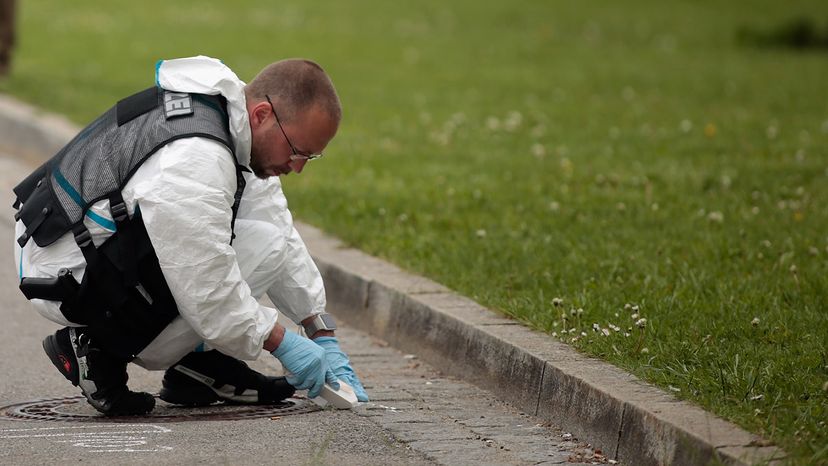
Forensic specialists of the German police secure the crime scene after a deadly knife attack on May 10, 2016, in Grafing, Bavaria. Johannes Simon/Getty Images
The goal of the evidence-collection stage is to find, collect and preserve all physical evidence that might serve to recreate the crime and identify the perpetrator in a manner that will stand up in court. Evidence can come in any form. Some typical kinds of evidence a CSI might find at a crime scene include:
Weapons and firearms evidence (knives, guns, bullet holes, cartridge casings)
Questioned documents (diaries, suicide note, phone books; also includes electronic documents like answering machines and caller ID units)
With theories of the crime in mind, CSIs begin the systematic search for incriminating evidence, taking meticulous notes along the way. If there is a dead body at the scene, the search probably starts there.
Advertisement
Examining the Body
A CSI might collect evidence from the body at the crime scene or he might wait until the body arrives at the morgue. In either case, the CSI does at least a visual examination of the body and surrounding area at the scene, taking pictures and detailed notes.
Before moving the body, the CSI makes note of details including:
Are there any stains or marks on the clothing?
Is the clothing bunched up in particular direction? If so, this could indicate dragging.
Are there any bruises, cuts or marks on body? Any defense wounds? Any injuries indicating, consistent with or inconsistent with the preliminary cause of death?
Is there anything obviously missing? Is there a tan mark where a watch or ring should be?
If blood is present in large amounts, does the direction of flow follow the laws of gravity? If not, the body may have been moved.
If no blood is present in the area surrounding the body, is this consistent with the preliminary cause of death? If not, the body may have been moved.
Are there any bodily fluids present beside blood?
Is there any insect activity on the body? If so, the CSI may call in a forensic entomologist to analyze the activity for clues as to how long the person has been dead.
After moving the body, he performs the same examination of the other side of the victim. At this point, he may also take the body temperature and the ambient room temperature to assist in determining an estimated time of death (although most forensic scientists say that time of death determinations are extremely unreliable -- the human body is unpredictable and there are too many variables involved). He will also take fingerprints of the deceased either at the scene or at the ME's office.
Once the CSI is done documenting the conditions of body and the immediately surrounding area, technicians wrap the body in a white cloth and put paper bags over the hands and feet for transportation to the morgue for an autopsy. These precautions are for the purpose of preserving any trace evidence on the victim. A CSI will usually attend the autopsy and take additional pictures or video footage and collect additional evidence, especially tissue samples from major organs, for analysis at the crime lab.
Examining the Scene
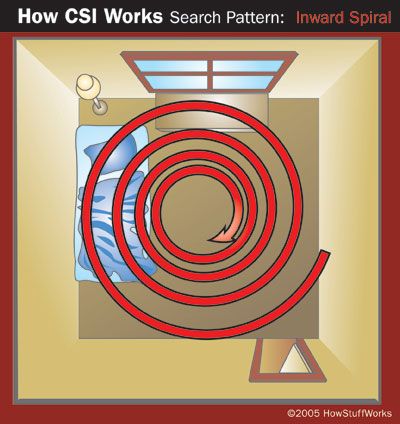
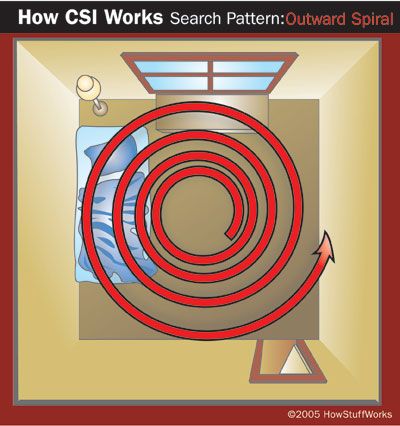
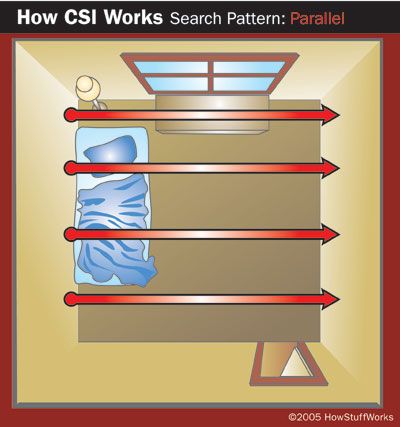
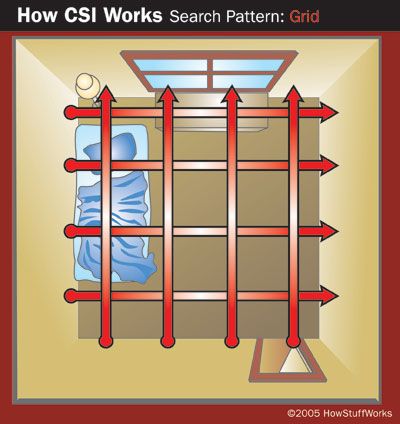
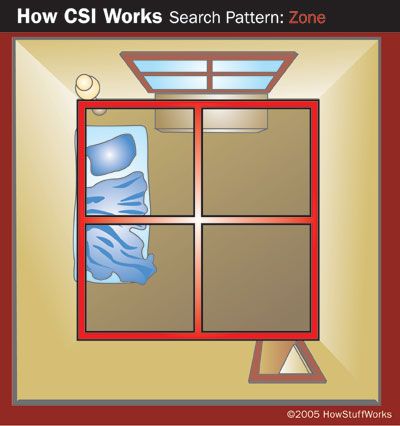
There are several search patterns available for a CSI to choose from to assure complete coverage and the most efficient use of resources.
The inward spiral search: The CSI starts at the perimeter of the scene and works toward the center. Spiral patterns are a good method to use when there is only one CSI at the scene.
The parallel search: All of the members of the CSI team form a line. They walk in a straight line, at the same speed, from one end of crime scene to the other.
The zone search: In a zone search, the CSI in charge divides the crime scene into sectors, and each team member takes one sector. Team members may then switch sectors and search again to ensure complete coverage.
While searching the scene, a CSI is looking for details including:
Are the doors and windows locked or unlocked? Open or shut? Are there signs of forced entry, such as tool marks or broken locks?
Is the house in good order? If not, does it look like there was a struggle or was the victim just messy?
Is there mail lying around? Has it been opened?
Is the kitchen in good order? Is there any partially eaten food? Is the table set? If so, for how many people?
Are there signs of a party, such as empty glasses or bottles or full ashtrays?
If there are full ashtrays, what brands of cigarettes are present? Are there any lipstick or teeth marks on the butts?
Is there anything that seems out of place? A glass with lipstick marks in a man's apartment, or the toilet seat up in a woman's apartment? Is there a couch blocking a doorway?
Is there trash in the trash cans? Is there anything out of the ordinary in the trash? Is the trash in the right chronological order according to dates on mail and other papers? If not, someone might have been looking for something in the victim's trash.
Do the clocks show the right time?
Are the bathroom towels wet? Are the bathroom towels missing? Are there any signs of a cleanup?
If the crime is a shooting, how many shots were fired? The CSI will try to locate the gun, each bullet, each shell casing and each bullet hole.
If the crime is a stabbing, is a knife obviously missing from victim's kitchen? If so, the crime may not have been premeditated.
Are there any shoe prints on tile, wood or linoleum floors or in the area immediately outside the building?
Are there any tire marks in the driveway or in the area around the building?
Is there any blood splatter on floors, walls or ceilings?
The actual collection of physical evidence is a slow process. Each time the CSI collects an item, he must immediately preserve it, tag it and log it for the crime scene record. Different types of evidence may be collected either at the scene or in lab depending on conditions and resources. Mr. Clayton, for instance, never develops latent fingerprints at the scene. He always sends fingerprints to the lab for development in a controlled environment. In the next section, we'll talk about collection methods for specific types of evidence.
Consider This
1) Crime scenes are three-dimensional. CSIs should remember to look up. 2) If a CSI shines a flashlight on the ground at various angles, even when there's plenty of lighting, he'll create new shadows that could reveal evidence. 3) It's easy to recover DNA from cigarette butts.
Advertisement
Evidence Collection
CBI Denver trace-evidence room
In collecting evidence from a crime scene, the CSI has several main goals in mind: Reconstruct the crime, identify the person who did it, preserve the evidence for analysis and collect it in a way that will make it stand up in court.
Trace Evidence
Trace evidence might include gun-shot residue (GSR), paint residue, chemicals, glass and illicit drugs. To collect trace evidence, a CSI might use tweezers, plastic containers with lids, a filtered vacuum device and a knife. He will also have a biohazard kit on hand containing disposable latex gloves, booties, face mask and gown and a biohazard waste bag.
Advertisement
If the crime involves a gun, the CSI will collect clothing from the victim and anyone who may have been at the scene so the lab can test for GSR. GSR on the victim can indicate a close shot, and GSR on anyone else can indicate a suspect. The CSI places all clothing in sealed paper bags for transport to the lab. If he finds any illicit drugs or unknown powders at the scene, he can collect them using a knife and then seal each sample in a separate, sterile container. The lab can identify the substance, determine its purity and see what else is in the sample in trace amounts. These tests might determine drug possession, drug tampering or whether the composition could have killed or incapacitated a victim.
Technicians discover a lot of the trace evidence for a crime in the lab when they shake out bedding, clothing, towels, couch cushions and other items found at the scene. At the CBI Denver Crime Lab, technicians shake out the items in a sterile room, onto a large, white slab covered with paper.
The technicians then send any trace evidence they find to the appropriate department. In the Denver Crime Lab, things like soil, glass and paint stay in the trace-evidence lab, illicit drugs and unknown substances go to the chemistry lab, and hair goes to the DNA lab.
Body Fluids
Body fluids found at a crime scene might include blood, semen, saliva, and vomit. To identify and collect these pieces of evidence, a CSI might use smear slides, a scalpel, tweezers, scissors, sterile cloth squares, a UV light, protective eyewear and luminol. He'll also use a blood collection kit to get samples from any suspects or from a living victim to use for comparison.
If the victim is dead and there is blood on the body, the CSI collects a blood sample either by submitting a piece of clothing or by using a sterile cloth square and a small amount of distilled water to remove some blood from the body. Blood or saliva collected from the body may belong to someone else, and the lab will perform DNA analysis so the sample can be used later to compare to blood or saliva taken from a suspect. The CSI will also scrape the victim's nails for skin -- if there was a struggle, the suspect's skin (and therefore DNA) may be under the victim's nails. If there is dried blood on any furniture at the scene, the CSI will try to send the entire piece of furniture to the lab. A couch is not an uncommon piece of evidence to collect. If the blood is on something that can't reasonably go to the lab, like a wall or a bathtub, the CSI can collect it by scraping it into a sterile container using a scalpel. The CSI may also use luminol and a portable UV light to reveal blood that has been washed off a surface.
If there is blood at the scene, there may also be blood spatter patterns. These patterns can reveal the type of weapon that was used -- for instance, a "cast-off pattern" is left when something like a baseball bat contacts a blood source and then swings back. The droplets are large and often tear-drop shaped. This type of pattern can indicate multiple blows from a blunt object, because the first blow typically does not contact any blood. A "high-energy pattern," on the other hand, is made up of many tiny droplets and may indicate a gun shot. Blood spatter analysis can indicate which direction the blood came from and how many separate incidents created the pattern. Analyzing a blood pattern involves studying the size and shape of the stain, the shape and size of the blood droplets and the concentration of the droplets within the pattern. The CSI takes pictures of the pattern and may call in a blood-spatter specialist to analyze it.
Hair and Fibers
A CSI may use combs, tweezers, containers and a filtered vacuum device to collect any hair or fibers at the scene. In a rape case with a live victim, the CSI accompanies the victim to the hospital to obtain any hairs or fibers found on the victim's body during the medical examination. The CSI seals any hair or fiber evidence in separate containers for transport to the lab.
A CSI might recover carpet fibers from a suspect's shoes. The lab can compare these fibers to carpet fibers from the victim's home. Analysts can use hair DNA to identify or eliminate suspects by comparison. The presence of hair on a tool or weapon can identify it as the weapon used in the crime. The crime lab can determine what type of animal the hair came from (human? dog? cow?); and, if it's human, analysts can determine the person's race, what part of the body the hair came from, whether it fell out or was pulled and whether it was dyed.
Fingerprints
Tools for recovering fingerprints include brushes, powders, tape, chemicals, lift cards, a magnifying glass and Super Glue. A crime lab can use fingerprints to identify the victim or identify or rule out a suspect. There are several types of prints a CSI might find at a crime scene:
Visible: Left by the transfer of blood, paint or another fluid or powder onto a surface that is smooth enough to hold the print; evident to the naked eye
Molded: Left in a soft medium like soap, putty or candle wax, forming an impression
Latent: Left by the transfer of sweat and natural oils from the fingers onto a surface that is smooth enough to hold the print; not visible to the naked eye
A perpetrator might leave prints on porous or nonporous surfaces. Paper, unfinished wood and cardboard are porous surfaces that will hold a print, and glass, plastic and metal are nonporous surfaces. A CSI will typically look for latent prints on surfaces the perpetrator is likely to have touched. For instance, if there are signs of forced entry on the front door, the outside door knob and door surface are logical places to look for prints. Breathing on a surface or shining a very strong light on it might make a latent print temporarily visible. When you see a TV detective turn a doorknob using a handkerchief, she's probably destroying a latent print. The only way not to corrupt a latent print on a nonporous surface is to not touch it. Proper methods for recovering latent prints include:
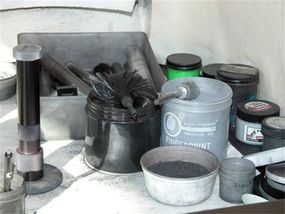
Powders and brushes at the CBI latent-fingerprint lab
Powder (for nonporous surfaces): Metallic silver powder or velvet black powder A CSI uses whichever powder contrasts most with the color of material holding the print. He gently brushes powder onto the surface in a circular motion until a print is visible; then he starts brushing in the direction of the print ridges. He takes a photo of the print before using tape to lift it (this makes it stand up better in court). He adheres clear tape to the powdered print, draws it back in a smooth motion and then adheres it to a fingerprint card of a contrasting color to the powder.
Chemicals (for porous surfaces): Iodine, ninhydrin, silver nitrate The CSI sprays the chemical onto the surface of the material or dips the material into a chemical solution to reveal the latent print.
Cyanoacrylate (Super Glue) fuming (for porous or nonporous surfaces) The CSI pours Super Glue into a metal plate and heats it to about 120 F. He then places the plate, the heat source and the object containing the latent print in an airtight container. The fumes from the Super Glue make the latent print visible without disturbing the material it's on.
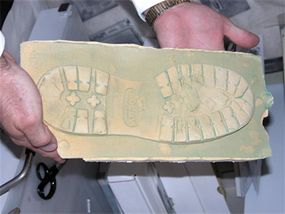
This cast is a student sample. According to Mr. Clayton, footprints found at a crime scene seldom produce such perfect specimens.
Footwear Impressions and Tool Marks
A latent fingerprint is an example of a two-dimensional impression. A footwear impression in mud or a tool mark on a window frame is an example of a three-dimensional impression. If it's not possible to submit the entire object containing the impression to the crime lab, a CSI makes a casting at the scene.
A casting kit might include multiple casting compounds (dental gypsum, Silicone rubber), snow wax (for making a cast in snow), a bowl, a spatula and cardboard boxes to hold the casts.
If a CSI finds a footwear impression in mud, she'll photograph it and then make a cast. To prepare the casting material, she combines a casting material and water in a Ziploc-type bag and kneads it for about two minutes, until the consistency is like pancake batter. She then pours the mixture into the edge of the track so that it flows into the impression without causing air bubbles. Once the material overflows the impression, she lets it set for at least 30 minutes and then carefully lifts the cast out of the mud. Without cleaning the cast or brushing anything off it (this would destroy any trace evidence), she puts the cast into a cardboard box or paper bag for transport to the lab.
For toolmark impressions, a cast is much harder to use for comparison than it is with footwear. If it's not feasible to transport the entire item containing the tool mark, a CSI can make a silicone-rubber cast and hope for the best. There are two types of tool marks a CSI might find at a crime scene:
Impressed: A hard object contacts a softer object without moving back and forth (for example, a hammer mark on a door frame). The tool mark is an impression of the tool's shape. It's difficult to make a definite match with an impressed tool mark.
Striated: A hard object contacts a softer object and moves back and forth (for example, pry marks on a window frame). The tool mark is a series of parallel lines. It's easier to make a definite match with a striated tool mark.
In toolmark analysis, the lab might determine what sort of tool made the mark and whether a tool in evidence is the tool that made it. It can also compare the tool mark in evidence to another toolmark to determine if the marks were made by the same tool.
Firearms
If a CSI finds any firearms, bullets or casings at the scene, she puts gloves on, picks up the gun by the barrel (not the grip) and bags everything separately for the lab. Forensic scientists can recover serial numbers and match both bullets and casings not only to the weapon they were fired from, but also to bullets and casings found at other crime scenes throughout the state (most ballistics databases are statewide). When there are bullet holes in the victim or in other objects at the scene, specialists can determine where and from what height the bullet was fired from, as well as the position of the victim when it was fired, using a laser trajectory kit. If there are bullets embedded in a wall or door frame, the CSI cuts out the portion of the wall or frame containing the bullet -- digging the bullet out can damage it and make it unsuitable for comparison.
Documents
A CSI collects and preserves any diaries, planners, phone books or suicide notes found at a crime scene. He also delivers to the lab any signed contracts, receipts, a torn up letter in the trash or any other written, typed or photocopied evidence that might be related to the crime. A documents lab can often reconstruct a destroyed document, even one that has been burned, as well as determine if a document has been altered. Technicians analyze documents for forgery, determine handwriting matches to the victim and suspects, and identify what type of machine was used to produce the document. They can rule out a printer or photocopier found at the scene or determine compatibility or incompatibility with a machine found in a suspect's possession.
Whenever a CSI discovers a piece of evidence at the scene, she photographs it, logs it, recovers it and tags it. An evidence tag may include identification information such as time, date and exact location of recovery and who recovered the item, or it may simply reflect a serial number that corresponds to an entry in the evidence log that contains this information. The crime scene report documents the complete body of evidence recovered from the scene, including the photo log, evidence recovery log and a written report describing the crime scene investigation.
Stuff You Might Find in a CSI Van
In a CSI van, you might see hack saws, pliers, a pipe wrench, a pry bar, wire cutters, bolt cutters, shovels, sifters, a slim jim, a pocket knife, measuring tapes, orange marker flags, a flashlight, batteries, chalk, forceps, Vise-Grips, a compass, a magnet, a metal detector, distilled water, kneeling pads, and stuffed animals for living child victims.
Advertisement
Analyzing the Evidence: Forensic Science
The first forensics lab in the United States opened in 1923 in Los Angeles. In 1932, the FBI established its own forensics lab to serve police departments and other investigating authorities all over the country. The FBI lab is one of the largest in the world.
The Denver Crime Lab at the Colorado Bureau of Investigation provides evidence collection and laboratory analysis for any police department in Colorado that requests its services. It also conducts state investigations that don't fall under the jurisdiction of any local authority.
Advertisement
Some specialty departments in the Denver Crime Lab include latent fingerprints and impressions, which develops latent fingerprints; analyzes and compares fingerprints, footwear and tire impressions; and runs fingerprints through the Automated Fingerprint Identification System (AFIS, which uses the FBI database) for comparison against hundreds of millions of prints.
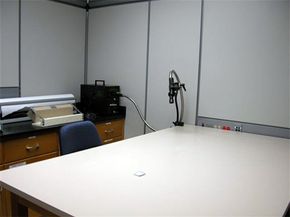
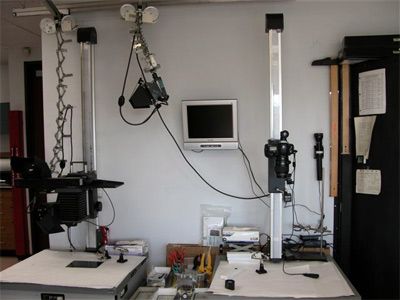
CBI technicians use these camera setups to photograph recovered prints to use in comparison and for running through the AFIS system. On the left is an old-school Polaroid setup, and on the right is a digital-camera setup. Mr. Clayton prefers the Polaroid results.
The trace evidence department runs GSR analysis, and identifies and compares samples of soil, glass, fibers and paint. The chemistry section conducts analysis and comparison of illicit drugs, explosives and unknown chemicals. The computer crimes team recovers evidence from computers and performs computer enhancement on audio or video evidence. There's also firearms and toolmark identification, which identifies firearms; tests firearms to establish barrel pattern and distance of gun from entrance wound; and identifies and compares bullets, casings and toolmark impressions. Then there's serology and DNA, which conducts body fluid analysis, including DNA analysis for blood stains, semen and hair for identification and comparison.
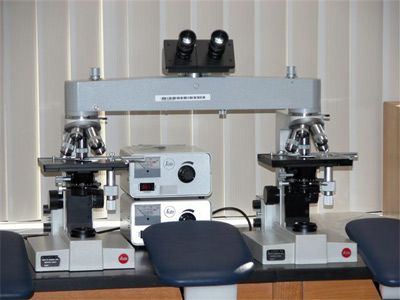
Comparison microscope setup in the CBI serology lab
Lastly, there's a questioned document section that detects forgery and alterations; conducts handwriting comparisons; reconstructs destroyed documents; and identifies and compares printers, typewriters or copiers used to produce a document.
Often, a piece of evidence passes through more than one department for analysis. Each department delivers a complete report of the evidence it analyzed for the case, including the actual results (numbers, measurements, chemical contents) and any expert conclusions the scientists have drawn from these results. The CSI in charge might compile the results and deliver them to the lead detective on the case, or the lab might send the results directly to the detective squad.
On the Stand
The role of a crime scene investigator doesn't end when he completes his evidence report. It doesn't even end when the lab results related to that evidence are delivered to the detectives on the case. A big part of a CSI's job is testifying in court about the evidence he collected, the methods he used to recover it and the number of people who came into contact with it before it ended up as the prosecution's Exhibit D. And the defense attorney's job is to attack the evidence, which sometimes means attacking the person who collected it. This is why search warrants, evidence logs, photographs and extremely detailed reports are so critical to the CSI process. The defense will try to get every piece of incriminating evidence thrown out of court. The legality of the search, the untainted preservation of the evidence and the full, undisputable documentation of the crime scene are prime considerations in a crime scene investigation.
Advertisement
CSI vs. 'CSI'
The cast from "CSI: Crime Scene Investigation" pose backstage during the 2004 People's Choice Awards. Left to right: Eric Szmanda, George Eads, Marg Helgenberger, Paul Guilfoyle and Gary Dourdan Carlo Allegri/Getty Images
So, does Hollywood get it right? When asked if the TV show "CSI" accurately depicts his job, Joe Clayton's short answer was, "No." The long answer was that the show does accurately represent certain aspects of crime scene investigation, but it leaves a lot out and it adds a lot because, well, it's Hollywood. Viewers don't want to watch a bunch of CSIs waiting around for a search warrant, and they would probably be unsatisfied if they never got a look at the suspect.
Scientifically speaking, "CSI" sometimes misses the mark. In reality, it's not possible to come up with a two-hour range for the time of death. Also, you don't just scan a fingerprint into a computer and wait for it to spit out a photo of the suspect. Fingerprint-comparison software returns several possible matches that an expert then analyzes visually to determine a definite match.
Advertisement
Other places where Hollywood gets it wrong involves investigative process. Crime scene investigators almost always get warrants before searching a scene. Pretty much the only scene that might not require a warrant is an apartment owned by the victim, who lived there alone and never shared the space with anyone else at any time. This means there's a lot of waiting involved -- it's pretty unusual for a CSI to arrive on a scene and just start searching. What usually happens is the CSI arrives and determines which areas need to be searched, and then someone gets a hold of the district attorney, who gets a hold of a judge, who signs whatever search warrants are requested. Once the district attorney brings the warrants to the scene, the search begins.
And the search involves the evidence, not the neighbors of the victim. CSIs do not deal with witnesses or suspects. They don't interview people at the scene, they don't interrogate anyone and they definitely don't pursue the perpetrator. These are all the jobs of the detectives on the case. Also, it's rare for a CSI to handle an entire investigation from beginning to end, even if we're just talking about the evidence. There are tons of people involved in collecting and analyzing evidence, including CSIs, forensic specialists, medical examiners and detectives. It's a rare CSI who has the time or expertise to do it all.
In Mr. Clayton's opinion, shows like "CSI" aren't making criminals any smarter. The truth is, crime scene investigation and forensic science are always trying to catch up with the criminals, not the other way around. And while there are certainly people who meticulously plan a crime and how to get away with it, Mr. Clayton's experience with crime scenes tells a different story: Most violent crimes are committed in the heat of the moment. The perpetrator is in an agitated state, possibly under the influence of drugs or alcohol, and doesn't have the presence of mind to meticulously cover his tracks. It's the rare criminal genius who studies forensic science so he can commit the perfect murder and get away with it.
For more information on crime scene investigation, forensic science and related topics, check out the links that follow.
Becoming a CSI
CSIs work long hours, must be available for emergencies 24/7 and often deal with gruesome scenes. For Joe Clayton, his job as a CSI involves constant reminders of man's inhumanity to man. But he views his job as a chance to use science to help people.
CSIs can be police officers or civilians. The most common way to become a CSI is to become a police officer first and then receive CSI training. All police departments and law-enforcement agencies have different criteria. Typically, a civilian CSI should have a two- or four-year degree. Mr. Clayton is not a police officer. He graduated from college with a bachelor's degree in biology and minors in chemistry and behavioral sciences. He applied for a CSI position at the Kansas Bureau of Investigation and received his training there.
Advertisement
CSI FAQs
What are the 5 steps of crime scene investigation?
The process begins by interviewing all those present and around the scene. The area is then examined to determine how far evidence can be spread. Photographs are taken of the scene and a sketch is made if anyone saw the culprit. All the information is them processed and investigated.
What are the different types of crime scenes?
The different types of crime scenes include: outdoor crime scenes; indoor crime scenes; and conveyance crime scenes.
What is the process of a crime scene investigation?
At every crime scene, investigators and officers work together to identify the details of what happened to eventually get a better understanding of who did it. All parameters are defined, evidence is obtained and preserved, and next steps are determined from there on.
What is the role of crime scene investigator?
They are law informant and private crime scene investigators alike, both of whom are responsible for identifying the different elements of the crime scene. Private investigators aren’t allowed to handle any evidence – only make deductions from observations and reports as generated by public offices.
Baldwin, Hayden B., M/Sgt, Retired. "Basic Equipment for Crime Scene Investigators." http://www.feinc.net/equipmt.htm
Byrd, Mike. "Duty Description for the Crime Scene Investigator." Crime Scene Investigation. http://www.crime-scene-investigator.net/dutydescription.html
Byrd, Mike. "Other Impression Evidence." Crime Scene Investigation. http://www.crime-scene-investigator.net/otherimpressionevidence.html
CBI Forensic Laboratory Physical Evidence Handbook, Version 4.02, September 2002 http://cbi.state.co.us/lab/pdf/Physical%20Evidence%20Handbook%20v4.02.pdf
Colorado Bureau of Investigation. http://cbi.state.co.us/lab/default.asp
"Crime pays for clean-up crew." Kansas City Business Journal. http://www.bizjournals.com/kansascity/stories/2001/03/12/smallb1.html
"Crime Scene Investigator." Forensic Enterprises, Inc. http://www.feinc.net/csi-desc.htm
"Crime Scene Response Guidelines." Crime Scene Investigation. http://www.crime-scene-investigator.net/respon1.html
"How to Become a CSI." ICSIA. http://www.icsia.org/faq.html
Interview with Joe Clayton, Laboratory Agent, Colorado Bureau of Investigation, November 3, 2005