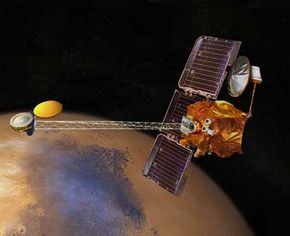
Introduction to How Mars Odyssey Works
|
The book and movie, "2001: A Space Odyssey," famously predicted that humans would have made great strides in exploring our solar system by the beginning of the 21st century. By 2001, Mars would have long been achieved, and we would already be flying manned missions to Jupiter. Of course, manned missions to Mars remain a very long-range goal, and Jupiter can only be reached in movies.
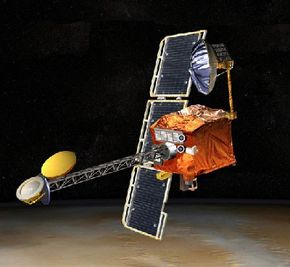
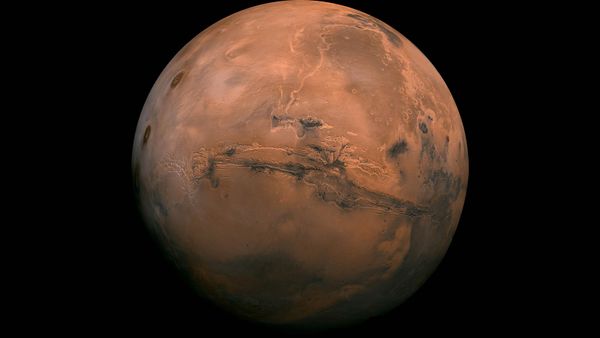
However, NASA is honoring the impact that Arthur C. Clarke's book and Stanley Kubrick's movie have had by naming its 2001 mission 2001: Mars Odyssey. The Mars Odyssey spacecraft journeyed for more than six months before placing itself in orbit around the red planet in October, 2001. Its main objective was to scour the planet's surface to find out what the planet is made of and if there is any water or ice to be found there. There's still much debate about whether water exists or ever existed on Mars. This is an important question, because if water does exist, it means that Mars might harbor life. It would also be very useful to astronauts who may one day go to Mars.

Photo courtesy NASA
Click on image to see a video of the Mars Odyssey launch from a rocket-mounted camera.
Requires Real Player plugin
See more Mars Odyssey pictures.
Mars continues to fascinate us, and NASA continues to move forward in its goal of sending a manned mission there within this century. In this article, we will look at this crucial step toward putting a person on Mars. You will learn how the Mars Odyssey spacecraft gets to Mars and how it examines and determines the elemental composition of the planet.
The Spacecraft
|
- Space Daily: Has Mars Always Been a Dry World
- Space.com: Water Discovery Increase Chances of Martian Life
- CNN: Visual evidence suggests water springs on Mars
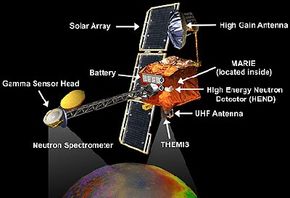
![]() Photo courtesy NASA A look at the various components of the Mars Odyssey Orbiter |
The Mars Odyssey Orbiter is equipped with three scientific instruments that it uses to explore the Martian surface and atmosphere. Let's take a look at each of these:
- Gamma-ray spectrometer (GRS) - This device measures just how much hydrogen exists in the upper 3 feet of the planet's soil. The amount of hydrogen found gives scientists some evidence about the existence of water on Mars. (more information on the GRS)
- Thermal emissions imaging system (THEMIS) - This instrument identifies rock and mineral types on the planet's surface and searches for traces of hydrothermal activity. Information gathered from THEMIS helps determine safe landing sites for future missions. (more information on the THEMIS)
- Martian radiation environment experiment (MARIE) - Scientists are curious about the amount of radiation humans will be exposed to during a possible manned mission. MARIE gathers data about radiation on the planet. (more information on the MARIE instrument)
Mission to Mars
On April 7, 2001, the Mars Odyssey Orbiter took off from Cape Canaveral, FL, onboard a Boeing Delta 7925 rocket. It traveled for approximately six months before positioning itself into an initial elliptical capture orbit. After a propulsive maneuver into a 25-hour capture orbit, aerocapture was used over the course of 76 days to achieve the two-hour science orbit. Aerocapture involves using the Mars atmosphere to slow down and attain orbit.Aerocapture replaces the conventional thrusters that were once needed for a spacecraft to change course and go into orbit around a planet. Without aerocapture, the spacecraft would have to carry much more fuel. The Mars Odyssey Orbiter is only the third spacecraft to use aerocapture. Before that, only the Mars Global Surveyor (1997) and the Mars Climate Orbiter (lost in 1999) had used it. Don't confuse aerocapture with aerobraking. While similar, aerobraking uses atmospheric drag to slow down a vehicle that will land on a planet's surface. Aerocapture is used to place a spacecraft into orbit.
The orbiter's final operational altitude is about 250 miles (400 km) above Mars in a sun-synchronous polar orbit. In the following two years, the orbiter maps the planet's surface and takes measurements about radiation and elemental composition.
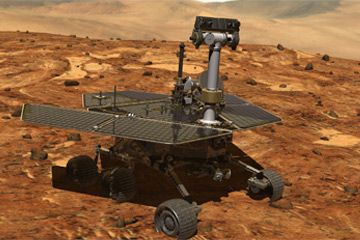
The Mars orbiter is just one in a series of orbiters, rovers and surveyors that NASA plans to launch toward Mars in an effort to learn as much as possible about the planet before sending a human mission there. In the next decade, the U.S. space agency will launch at least one Mars exploration spacecraft in every odd numbered year.
|
For more information on Mars Odyssey and related topics, check out the links on the next page.
Lots More Information
Related HowStuffWorks Articles
- How Mars Works
- How Terraforming Mars Will Work
- How Space Shuttles Work
- How Space Stations Work
- How Satellites Work
- Mars Explained
- NASA Video and Images of Mars Odyssey Launch
- 2001 Mars Odyssey Home
- Space.com: Special Report: 2001 Odyssey Mission to Mars
- Odyssey Orbiter Mission
- A Brief History of Mars Exploration
- Building Toward Mars: A Vision for the Future
- Send Your Name to Mars!