Chemistry of Plastics

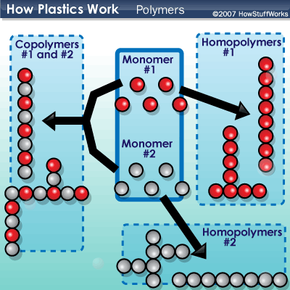
All plastics are polymers, but not all polymers are plastics. Some familiar nonplastic polymers include starches (polymers of sugars), proteins (polymers of amino acids) and DNA (polymers of nucleotides -- see How DNA Works). The simplified diagram below shows the relationship between monomers and polymers. Identical monomers can combine with each other to form homopolymers, which can be straight or branched chains. Different monomers may combine together to form copolymers, which also may be branched or straight.

The chemical properties of a polymer depend on:

  • The type of monomer or monomers that make up the polymer. The chemical properties of homopolymer 1 are different from those of homopolymer 2 or the copolymers.
  • The arrangement of monomers within the polymer. The chemical properties of the straight polymers are different from those of the branched polymers.
plastic chemistry illustration

The monomers that are found in many plastics include organic compounds like ethylene, propylene, styrene, phenol, formaldehyde, ethylene glycol, vinyl chloride and acetonitrile (we'll examine many of these as we discuss various plastics). Because there are so many different monomers that can combine in many different ways, we can make many kinds of plastics.

The Chemistry of Carbon
All plastic is made of carbon. Man-made plastic uses carbon derived from oil, while biopolymers or bioplastics use carbon derived from natural materials. Carbon is essential because it has a fairly unique ability to combine with itself in many ways. Carbon can make single, double or triple covalent bonds with itself (electrons are shared between two atoms). Carbon atoms in compounds have four bonds around them. Carbon atoms can combine in linear chains, branched chains, or rings (single- or multiple-ring structures). Often, carbon combines with hydrogen and oxygen atoms, but it can also form bonds with other atoms -- like nitrogen, phosphorus and chlorine. Carbon compounds can be small, simple molecules like methane, or large, complex molecules like proteins and plastics. The carbon atoms in the carbon-containing monomers make bonds with other carbon atoms in other monomers in a variety of ways to form plastics. The types of monomers and the ways that they are arranged give different chemical properties to various plastics.

All biological compounds are organic compounds (like sugars, fats and proteins). Benzene, alcohols, graphite and gasoline are nonbiological organic compounds. There are thousands upon thousands of organic compounds, both natural and man-made. Organic chemistry is devoted to the study of carbon compounds.