Photo courtesy Chris Hondros/Getty Images An Iraq War veteran who suffers from PTSD sits before a self-portrait he painted.
Introduction to How Post-traumatic Stress Disorder Works
Thirteen years after he returned home to Las Vegas, Nev., from fighting in Iraq, Adam Kelley, a specialist in the U.S. Army, took his own life. While fighting in the Persian Gulf during the first Iraq War, he watched as one of his friends died. He saw the killing of countless soldiers on both sides. He killed others with the mortar rounds he fired. He was under heavy fire for days at a time. After he returned home, he relived the terrifying events through nightmares and flashbacks. Ultimately, although he was treated with medications, he was unable to shake his demons. Kelley shot himself [source: Las Vegas Review Journal].
What Kelley endured for 13 years is what researchers now refer to as post-traumatic stress disorder (PTSD).
Previously called shell shock, it was first described by a doctor during the Civil War and was first noticed on a massive scale during World War I. The first diagnosis of the modern view of PTSD came in 1980. Research into this anxiety disorder began intensely after Congress requested a study of how Vietnam veterans were adjusting back to civilian life in 1983. The National Vietnam Veterans' Readjustment Study turned up a wealth of statistics and provided rare insight on a large scale into the nature of PTSD.
But there's still much to learn. For instance, there's no comprehensive data on the number of PTSD sufferers who, like Adam Kelley, commit suicide. And there's debate over how many soldiers fighting in the second Iraq War are vulnerable to developing the disorder later on. Also, many health-care professionals are still exploring the best type of counseling and medication to most effectively treat PTSD.
But the findings from the Vietnam study helped to advance human understanding of the effects of PTSD by leaps and bounds. We now know, for example, that the part of the brain that stores memories of fearful incidents can be directly related to the development of the disorder. We also now know that some people are more prone to develop PTSD after experiencing a trauma than others. And the duration, intensity and danger of a traumatic experience are known to be directly related to the development of PTSD.
It's also clear to researchers that PTSD can also develop in people who have never set foot on a battlefield. The disorder can be found in civilians, men, women and children. It can also result from a number of different traumatic experiences -- not just one.
It's this expanded understanding of PTSD that will eventually allow psychologists to properly treat the disorder and also help clinicians to create drugs that not only alleviate the symptoms of the disorder, but also the mental processes behind them. The military is even exploring the possibility of developing an "inoculation" against PTSD (more on that later).
But in many ways the disorder is still a mysterious one, and its sufferers are often misunderstood. In this article, we'll examine this disorder and the effects it has on the lives of people who suffer from it.
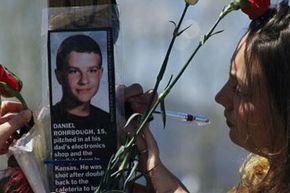
Seventy percent of Americans have endured a traumatic experience. Here, survivors of the 1999 Columbine High School shootings in Colorado remember one of the students killed that day.
Photo courtesy Sisse Brimberg/National Geographic/Getty Images.
What is PTSD?
Post-traumatic stress disorder is an anxiety disorder. In its simplest terms, it's a specific set of symptoms that result from a traumatic experience. These symptoms must present themselves in a certain way over within a certain period of time and for a certain duration to be considered PTSD.
The cornerstone symptom of PTSD is reexperience of the trauma. This means the sufferer is plagued with unwanted memories of the event that so badly scarred him. These memories can come in the form of dreams, flashbacks and recollections. In each of these instances, memories of the event suddenly and unexpectedly flood the mood of the sufferer, and it's like he's experiencing the event over and over again. This can be triggered by a cue (like seeing or hearing a car accident similar to the one the sufferer endured), or it can come unbidden. The sufferer's brain releases chemicals as if she is experiencing the trauma, creating a fear response that's both physical and mental.
Re-experience is one of four main symptoms found in adult PTSD sufferers. The other three are avoidance, numbness and hyper-arousal:
- Avoidance - the sufferer will go out of his way to avoid being reminded of the trauma. He'll avoid speaking about the trauma and will avoid any cues that may trigger memories of the trauma. In effect, the sufferer tries to push any memories of the experience from his mind.
- Numbness - in response to the pain created by the haunting memories, the sufferer may seek out anything that can keep away the pain, including alcohol and drugs. He may withdraw and can lose his ability to make and maintain relationships.
- Hyper-arousal - a state of continuous heightened awareness. PTSD sufferers who display this symptom are easily irritated, jumpy, and will also have difficulty sleeping. He may feel unsafe and be constantly guarded.
The tricky part in diagnosing the disorder is that, after a trauma, most people experience the same symptoms as a person with PTSD suffers. The distinction is that these symptoms fade voluntarily over time, whereas those with the disorder continue to be plagued by anxiety.
For example, anyone who is in a serious wreck will predictably be shaken by the event. Generally, a person will eventually get past the event and move on with his life. He will be able to remember the event without becoming terrified. He will be able to pass by another car wreck without reexperiencing in detail his own. A person with PTSD will not. The PTSD sufferer is continually negotiating the mental and physical side effects of his traumatic event.
So researchers have attached stipulations to the PTSD diagnosis. Chief among them is that for a person to be considered a PTSD sufferer, he must have the symptoms for more than one month. These symptoms may present themselves in various ways:
- Acute - symptoms last three months or less
- Chronic - symptoms last more than three months
- Delayed onset - symptoms don't show up for at least six months
A child who suffers from PTSD may present different symptoms. She may behave badly, become needier, and reexperience the event through drawings and explicit reenactment the trauma. As children with PTSD grow older, research has shown that these symptoms will come to more closely resemble adult symptoms [source: Perry].
Who are the people who suffer from PTSD? And why are some people more likely than others to develop it? In the next section, we'll find out what researchers have uncovered about susceptibility to PTSD.
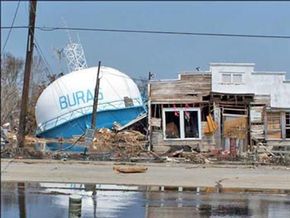
Although natural disasters like Hurricane Katrina can have an impact on the development of PTSD, it has been shown that the chances are increased when the trauma is man-made.
Photo courtesy EPA
Risk and Protective Factors
It's estimated that around 70 percent of Americans have endured some traumatic experience within their lifetime [source: Psychguides]. This may come in the form of a bad car wreck, a rape or an assault. It can be surviving a natural disaster, a loved one dying unexpectedly, or even killing another person, as in war.
From early research it was first believed that all people are at equal risk of developing PTSD after experiencing a trauma. Further study has revealed that there are some risk factors that make one person more likely to develop PTSD than another.
One of the biggest risk factors for the development of PTSD is a prior trauma. People who have already undergone one traumatic experience and then suffer another are more likely to develop PTSD than a person who experiences a single trauma [source: NCPTSD].
A hormone in the brain called glucocorticoid help control our response to stress, and after a traumatic experience, this hormone can become depleted. When another trauma is suffered, and the glucocorticoid levels are already low, the stress response to the experience can be more intensified. This condition can increase the likelihood of the person developing PTSD.
Personality traits have also been shown to play a part in the development of PTSD. People whose personalities involve an optimistic outlook on life -- a belief that there's order to the universe, and that other people are generally good -- have less of a chance of developing PTSD after suffering a trauma. So, too, do people who are resourceful -- individuals who tend to take obstacles and challenges head-on [source: NCPTSD].
Conversely, those who display problem-avoidance behavior have been shown to have an increased risk of developing PTSD. This indicates that part of the development of PTSD is increased by the avoidance symptom -- the desire to ignore the trauma rather than address it [source: NCPTSD].
Research has shown that a good relationship with your father may decrease the likelihood of developing PTSD.
Photo courtesy Sandy Huffaker/Getty Images
People who are college educated are less likely to suffer from chronic PTSD. So are people who have or had a good relationship with their father. At the same time, people who were raised in an abusive environment were more likely to develop PTSD. It also appears that women are less likely to develop PTSD, a finding from the Vietnam study.
What has come to be viewed as the most important factor in the development of PTSD is the existence of a strong social support network. Time and again, people who have close relationships with those around them have been shown to be much less likely to develop PTSD and are more likely to recover from PTSD. Trauma counselor Jacob Lindy referred to this network as a trauma membrane, the group of people who form a protective cover over the person who has suffered the trauma and protect that person from suffering further damage [source: Reason].
It should be noted, however, that what's most important about this social network is how it's perceived by the sufferer. A well-intentioned but overbearing support network will have a less positive effect than one which allows the sufferer to grieve on his own terms [source: Perry].
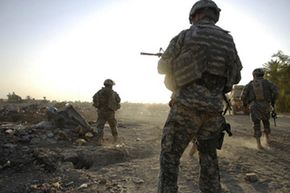
To combat some of the symptoms found in PTSD suffers, like this soldier, antidepressants are often prescribed.
Photo courtesy Charles Ommanney/Getty Images
PTSD and the Military
The world is ripe with potentially traumatic situations. Events like Hurricane Katrina, the Columbine High School shootings and the bombing of the federal building in Oklahoma City can all lead the people who experienced these events to develop PTSD. It's been shown, though, that man-made traumatic events have a greater impact on the incidence of PTSD than natural, unavoidable events do [source: NCPTSD].
This is just one reason that, on the whole, no other group is more vulnerable to developing PTSD than the military. Experiences like the killing of other people, the handling of corpses, being fired upon, witnessing others die and suffering dramatic injuries can all create trauma in a soldier. The development of PTSD has been shown to be directly related to the intensity of the traumatic experience, and soldiers are often faced with the most stressful of situations on a routine basis. For example, the Vietnam study showed that 15.2 percent of male Vietnam veterans and 8.5 percent of female Vietnam veterans overall suffered from PTSD. However, when only those who had fought in high-intensity combat were evaluated, those numbers jumped to almost 36 percent and 18 percent, respectively. Studies have also shown that people who develop military-related PTSD are more likely to develop it chronically [source: NCPTSD].
Soldiers can also be exposed to comorbidities. These are prior conditions or conditions that may have occurred at the time of the traumatic experience. Comorbidities can encourage the development of PTSD and vice versa. Prior drug and alcohol dependency, an existing personality disorder, a family history of mental issues, and brain injuries are all examples of comorbidities. These factors have been shown to directly and negatively affect the impact PTSD has on a person. PTSD can also aggravate an existing drug problem, as well as decrease the likelihood that a person will recover quickly from an injury or illness.
This is of particular concern for some researchers who are studying soldiers fighting in the Iraq. With brain injuries regarded as the "signature wound" of the Iraq War, and most of these injuries coming as the result of a traumatic experience like the explosion of a roadside bomb, the likelihood of soldiers fighting in Iraq developing PTSD is increasing. A 2004 study showed that soldiers fighting in Iraq have a 17 percent chance of developing PTSD [source: Hoge].
They're also at an added risk due to the type of guerilla warfare that is being carried out in this war. In the setting of guerilla warfare, the chances for witnessing and taking part in abusive violence, atrocities, and civilian casualties may be increased, and all of these factors have been shown to raise the likelihood that a person will suffer post-traumatic stress disorder as a result [source: NCPTSD].
In the next section, we'll learn how our expanded understanding of PTSD has led to more treatment options.
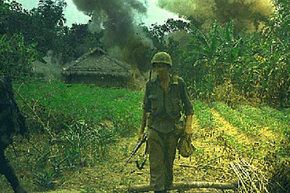
Findings from a comprehensive study in the ’80s and ’90s on the ability for Vietnam veterans to readjust to civilian life yielded a great deal of insight into PTSD.
Photo courtesy National Archives
Counseling for PTSD
Imagine sitting with your platoon, taking a break from patrol in the desert of Iraq. The sky is clear and blue. The sun is shining, and it's hot and dusty, but you and your buddies are cracking jokes. On the stereo, your favorite song is playing. You're still on guard, but for once you feel kind of relaxed.
Suddenly, out of nowhere, you encounter enemy fire. As shells zip past you and you return fire, you catch glimpses of the enemy firing from behind a burned-out truck. A buddy takes a bullet in his stomach and falls beside you, and you pull him to safety behind your patrol's armored car.
You return fire again, and this time it's clear to you that you killed one of the enemies. After a few more minutes, your patrol manages to flush the enemy from behind the burned-out truck, killing several more people.
You're alive, unhurt. Your buddy has died.
As time progresses, you find that you can't escape the experience. You're haunted by your friend who died and the man you killed. Hearing your favorite song now, the one that played on the radio just before the fight, reminds you of every detail. The still of the sunny day, one of the things that had calmed you just before the fight, comes to be remembered as ominous.
Our fear memories are among our most powerful. They can even become distorted and distort other memories associated with the experience. People with PTSD don't wish to be reminded of them, and they don't feel like anyone can understand what they've gone through, which leads to a sense of isolation. This is what makes PTSD so difficult to treat. The memories of the traumatic event become so largely distorted that they become overwhelming in their importance and magnitude. Isolation keeps sufferers from their family, friends, and counselors.
Some treatments have been proven to combat these symptoms of PTSD. Two of the most widely accepted forms of psychotherapy for treating the disorder, cognitive behavior counseling (CBC) and exposure therapy. Through cognitive restructuring, exaggerated memories are reduced back to a manageable size. The enemies in the above scenario may have come to be seen as faceless phantoms; the wounds of the friend may become gorier. Cognitive restructuring helps the patient remember the event on a more acceptable level. It can also involve pointing out any positive aspects that came out of the incident and have been overwhelmed by the trauma. In the CBC setting, the therapist may choose to focus on the valor shown by the solider when he retrieved his friend in an attempt to save his life -- adding balance to the memory of the experience and helping to develop perspective [source: Perry].
Dr. Aaron Beck, the father of Cognitive Behavior Therapy
Photo Courtesy Beck Institute
CBC also seeks to allow the sufferer to gain control of her unwanted recollections by allowing these memories to occur at a designated time of day, or investing protective associations in an everyday object.
In exposure, therapy patients are asked to purposely reexperience their trauma over and over -- either in a doctor's office or in the outside world in a setting similar to the one where they experienced their trauma. This is called imaginal therapy. The soldier in the scenario may be asked to recount the the experience in detail repeatedly. The song that played which reminds him so much of the incident may be played repeatedly as well.
Exposure therapy is based upon the idea that it's avoidance that continues to fuel the symptoms associated with PTSD. By bringing these memories into the forefront and addressing them, this type of therapy hopes to rid the patient of his negative associations.
In the next section, we'll learn about drug therapy for PTSD.
Antidepressant SSRIs like Prozac are the only type of drug approved by the FDA to treat PTSD.
Photo courtesy
Medication for PTSD
A combination of counseling and medication is often used to treat post-traumatic stress disorder. Prescription medicine has been shown to make patients more receptive to counseling and help reduce PTSD symptoms.
One type of drug, known as selective serotonin reuptake inhibitors (SSRIs), is already being used to treat some symptoms of PTSD. This type of drug is the only medication approved by the U.S. Food and Drug Administration for treatment of PTSD. Its most widely recognized brand names are Zoloft, Prozac and Paxil. SSRIs have been shown to reduce depression and anxiety in patients.
While SSRIs help to alleviate symptoms and can make PTSD sufferers more receptive to counseling, another drug, D-cycloserine (DCS) may have a more direct effect on treating PTSD. DCS is already known for its ability to separate memories from their association to a stimulus (memory extinction) and is being evaluated for its potential to diminish the fear esponse in PTSD patients by possibly removing the fears they associate with memories of a traumatic event.
Propranolol, a beta-blocker, is also being studied to determine its effects on PTSD symptoms like hyper-arousal and their secondary effects like sleeplessness. The drug may also prove to be useful as an agent that can block the creation of fear memories from an event.
In the next section, we'll learn about some cutting-edge research and therapy for PTSD.
The U.S. military is developing methods like “Battlemind” to combat PTSD in its troops.
Photo courtesy DVIC
Cutting-Edge Research
The more we learn about the brain and its processes involved in memory and response to stress, the more potential options are becoming available.
The military is investigating techniques for "inoculating" soldiers from PTSD. The Walter Reed Institute of Research-Psychiatry and Neuroscience has developed a program called "Battlemind" that helps soldiers to strengthen themselves mentally in order to lessen susceptibility to PTSD. This program stresses the development of traits like social interdependency and openness among soldiers and attempts to root out risk factors like avoidance. The program is also used by the military to help aid in the transition from deployment status to civilian life.
Research into the viability and usefulness of delivering counseling via the Internet or by phone is also being conducted. This kind of counseling could be helpful in cases of mass disasters that affect large numbers of people by delivering counseling to many people at the same time.
The field that may yield the most possibilities for treating PTSD in the future is neurology. Studying the brain's functions has already turned up some interesting facts about how we process our fear response. One chemical that has been studied is called stathmin, and it allows us to form fear memories from our experience. In a laboratory experiment, researchers treated mice to diminish their levels of stathmin. Those mice with lowered levels were less likely to form fear memories, and were thus less likely to be affected by panic (and handle the situation better) when confronted with traumatic experiences later [source: NIMH].
Another chemical, gastrin-releasing peptide, has been shown to signal a response in the brain. Research has suggested that a lack of this chemical could lead to an increased chance that a person will form stronger fear memories.
How we create and maintain our fearful memories of experiences is at the heart of physiological research on PTSD. Investigation into the amygdala, the part of the brain that allows us to create our fear memories, has shown that this same part of our brain also helps us to learn how to not fear. The ventromedial prefrontal cortex has been determined to be the part of the brain that maintains our long-term fear memories. Researchers have found that the size of this part of the brain may be related to the likelihood a person keeps fear memories after a traumatic event.
Researchers at Ft. Bragg, N.C. have studied soldiers who handle stressful situations better than others and believe they have found a chemical that's responsible for the difference. Neuropeptide Y is thought to be the brain's own anti-anxiety drug. As we're exposed to a stressful or traumatic situation, our levels of this drug become depleted. The more depleted it becomes, the more fearful and less prone to feel we can overcome an obstacle we become. Scientists are trying to synthesize Neuropeptide Y to restore the depleted levels of a person after a traumatic situation, and possibly guard against the development of PTSD [source: NCPTSD].
Virtual reality is also being used to help treat people suffering from PTSD. One group is using virtual reality simulations of the Sept. 11 attacks on the World Trade Center as part of exposure therapy to help survivors overcome their PTSD symptoms. Patients are exposed to their traumatic memories not by their own recollection, but as active observers. The results so far have been positive. One woman who was studied showed a reduction in her PTSD symptoms by 90 percent [source: HITL].
To learn more about PTSD and related topics, check out the links on the next page.
Lots More Information
Related HowstuffWorks Articles
- How the Brain Works
- How Fear Works
- Depression In-Depth
- How Stress Works
- How the U.S. Navy Works
- How the U.S. Army Works
- How the U.S. Marines Work
- How the U.S. Coast Guard Works
- Can I take a drug to wipe out one particular memory?
More Great Links
Sources
- Boodman, Sandra G. "EMDR, in the eye of the storm." Washington Post. October 30, 2001. http://www.washingtonpost.com/ac2/wp-dyn/A5987-2001Oct29?language=printer.
- Breslau, Naomi, Ph.D. "Epidemiologic Studies of Trauma, Posttraumatic Stress Disorder, and Other Psychiatric Disorders." Canadian Journal of Psychiatry. December 2002. http://ww1.cpa-apc.org:8080/Publications/Archives/CJP/2002/december/breslau.pdf
- Hoge, Charles W., M.D., et al. "Combat duty in Iraq and Afghanistan, Mental Health Problems, Barriers to Care." New England Journal of Medicine. July 1, 2004. http://content.nejm.org/cgi/content/full/351/1/13.
- Litz, Brett T. "The Unique Circumstances and Mental Health Impact of the Wars in Afghanistan and Iraq." National Center for Posttraumatic Stress Disorder. http://www.ncptsd.va.gov/ncmain/ncdocs/fact_shts/fs_iraq_afghanistan_lay_audien.html?opm=1&rr=rr140&srt=d&echorr=true.
- Price, Jennifer L. Ph.D. "Findings from the National Vietnam Veterans' Readjustment Study." National Center for Posttraumatic Stress Disorder. http://www.ncptsd.va.gov/ncmain/ncdocs/fact_shts/fs_nvvrs.html?opm=1&rr=rr45&srt=d&echorr=true.
- Perry, Bruce D., M.D., Ph.D. "Working with trauma survivors with PTSD: An overview of assessment, diagnosis and treatment." Counseling and Human Development. http://findarticles.com/p/articles/mi_qa3934/is_200109/ai_n8976041/pg_1.
- Rogers, Keith. "Post-traumatic stress disorder: Number of cases on the rise." Las Vegas Review-Journal. September 25, 2005. http://www.reviewjournal.com/lvrj_home/2005/Sep-25-Sun-2005/news/27253080.html.
- Sommers, Christina Hoff and Satel, Sally. "The mental health crisis that wasn't." Reason Magazine. August/September 2005. http://www.reason.com/news/show/33116.html.
- Nordenberg, Tamar. "Making the diagnosis: Simple stress or post-traumatic stress disorder?" FDA Consumer. http://www.fda.gov/fdac/features/2000/300_ptsd.html
- "Effects of Traumatic Stress after Mass Violence, Terror or Disaster: Normal Reactions to an Abnormal Situation." National Center for PTSD.http://www.ncptsd.va.gov/ncmain/ncdocs/fact_shts/fs_effects_disaster.html?opm=1&rr=rr53&srt=d&echorr=true
- "Glucocorticoids." Colorado State University. http://www.vivo.colostate.edu/hbooks/pathphys/endocrine/adrenal/gluco.html.
- "Post-traumatic stress disorder." National Institute of Mental Health. http://www.nimh.nih.gov/healthinformation/ptsdmenu.cfm.
- "PTSD Research at Fort Bragg: Prediction and Prevention
- An interview with Charles A. (Andy) Morgan III, M.D." National Center for PTSD. http://www.ncptsd.va.gov/ncmain/ncdocs/fact_shts/morgan.html?opm=1&rr=rr107&srt=d&echorr=true
- "Recommendations for Pharmacological Treatment of Acute Stress Reactions." National Center for PTSD. http://www.ncptsd.va.gov/ncmain/ncdocs/fact_shts/fs_medication_disaster.html?opm=1&rr=rr56&srt=d&echorr=true/
- "What is post-traumatic stress disorder?" AtHealth.com. http://www.athealth.com/Consumer/disorders/ptsdfacts.html