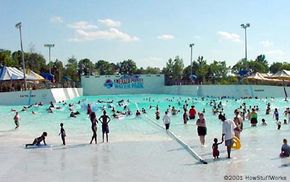
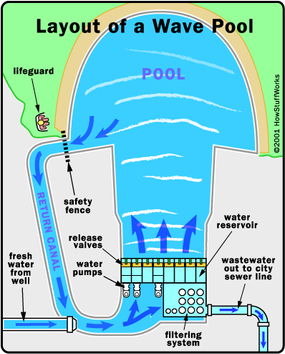
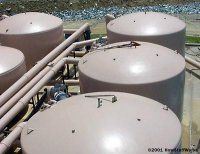
Thunder Bay is 84 feet (26 m) across at the deep end, and it is more than 400 feet (122 m) long. Overall, the pool holds about 2 million gallons (7.6 million L) of water, and the wave itself is 90,000 gallons (341,000 L). To make a wave this big and get it to make its way across the entire pool, you need some pretty heavy equipment.
The wave generator uses a 100-horsepower pump, a 200-horsepower pump and a 300-horsepower pump. Each pump has a motor at the top, which spins a long drive shaft. The drive shaft extends down through a pipe, to a propeller positioned 13 feet (4 m) underwater. When the drive shaft spins, it rotates the propeller, which drives water upward through the pipe (in the same way a spinning fan drives air forward).
At the base level of the pump, the pipe curves, runs horizontal for 6 feet (1.8 m), then curves up and rises another 10 feet (3 m) before finally opening into the water reservoir. In all, the pumps move the water 29 feet (9 m)! At their standard speed, the pumps drive about 40,000 gallons (150,000 L) of water per minute.
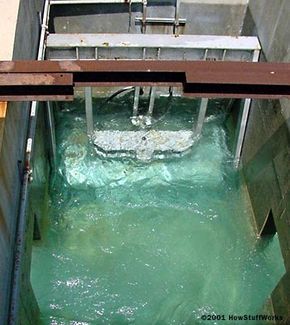
The water reservoir is broken up into eight connected chambers, each with its own release valve. The release valve has three major elements:
- The valve seat - The opening that leads down to the pool
- The valve plate - A wide piece of metal that fits snugly on top of the valve seat
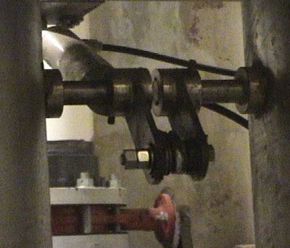
- Metal struts that pivot on a stationary steel beam attached to the reservoir walls on one end and to the valve plate on the other end
- The hydraulic-cylinder piston, which is attached to a metal beam running between the two struts
Since the metal struts pivot freely on the stationary steel beam, you can swing the valve plate back and forth. The plate is fairly heavy, so it naturally will swing over the valve seat. This plugs up the reservoir so water can't escape. (A rubber gasket around the valve seat keeps the valve from leaking too much.)
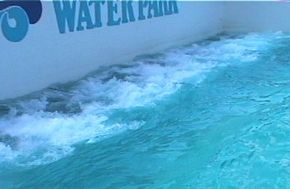
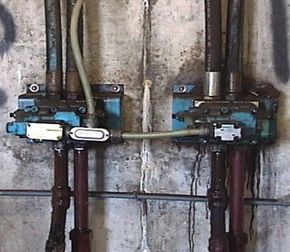
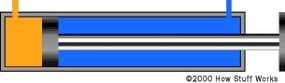
When pressurized oil is directed to the hydraulic cylinder, it moves the piston with a great deal of force. This pushes out on the metal struts. The valve plate extends outward, unplugging the water reservoir. The water drops directly underneath the reservoir, into a curved passageway leading to the pool. As it rushes into the pool, the water ramps up a sort of reef in the concrete floor. This focuses the flowing water so that it moves in a good-sized, surfable wave.
The water pumps do most of the work in building up a wave, but the hydraulic system is the crucial element that actually gets it going. In the next section, we'll look at the simple but ingenious mechanism that controls this system.