Human history is filled with tales of explorers who took a chance, put their lives on the line and plunged into the deep reaches of the unknown. Because of their efforts and ambition, it seems we now have access to even the most mysterious of places on Earth: the deepest rainforests, the darkest caverns, the highest mountains and the sky itself. Now, our incessant need to explore must be sated by yet another frontier: space.
But, unlike the days of the Wild West, when pioneers were free to set out for glory or gold with just a pack on their backs and a pair of good walking shoes, exploration of this new frontier requires quite a bit more money and has therefore been limited to elite government agencies -- until the Ansari X Prize.
Advertisement
In this article, we'll cover the origins and requirements of the "New Race to Space" for which SpaceShipOne took the $10 million prize on October 4, 2004 -- all without government funds, rocket parts from NASA or a special, cabinet-level position for private spaceflight. We'll also discuss some of the other teams and technology involved in the race and what the contest means for the future of space tourism.
Personal Ingenuity
This banning of government support (and the strings attached to such funds) speaks to the heart of the Ansari X Prize. The X Prize Foundation was established in 1995 by Dr. Peter H. Diamandis (CEO and Chairman of Zero Gravity Corporation and co-founder of the International Space University) to spur development of the space tourism industry and open the new frontier to the public. Dr. Diamandis' inspiration for the contest -- and his confidence in its success -- stemmed from the $25,000 Orteig Prize awarded to the first man to build and fly an airplane non-stop from New York to Paris in 1927. This contest, which cracked open the now $250 billion aviation industry, was won by underdog Charles Lindbergh.
So, just what is the Ansari X Prize? Simply put, it's a contest that promised a cash prize of $10 million to the first registered team to:
Build a spaceship able to carry three adults (height up to 188 centimeters [6 feet, 2 inches] and weight up to 90 kilograms [198 pounds] each).
Launch the spaceship with three soon-to-be astronauts to a height of 100 kilometers (62.5 miles), the internationally recognized altitude at which sub-orbital space begins.
Return the spaceship to Earth safely -- no broken bones on the astronaut, no severe damage to the ship, etc.
Repeat the flight within two weeks using the same ship, having replaced no more than 10 percent of the ship's parts (with the exception of fuel), thus classifying the spacecraft as a Reusable Launch Vehicle (RLV).
The feat had to be completed by January 1, 2005, so SpaceShipOne took the prize with lots of time to spare. In addition to the cash purse, the winner received a 5-foot-tall (152-cm), 200-pound (90.7-kg) bronze trophy. (See Ansari X Prize Trophy for a look at the design.)
Advertisement
No financial help could be accepted from any government -- this means no government grants, no government subsidies, no NASA ships and no NASA parts. There was no lack of private donors, however. The star-studded list of contributors include Microsoft co-founder Paul Allen (Scaled Composites' SpaceShipOne), the original space tourist and millionaire Dennis Tito, Charles Lindbergh's grandson Erik Lindbergh, former astronaut and U.S. Senator John Glenn, author Tom Clancy and actor Tom Hanks.
People from all countries of the world were able to compete for the X Prize, and more than 20 teams from seven countries were registered. Contestants had to submit a $1,000 registration fee along with a detailed description of the proposed vehicle and mission, and they had to agree to follow the rules and specifications above (for a look at the specific documents that were required, see Ansari X Prize: Register as a Team).
Impact of the Orteig Prize
As a result of hotel magnate Raymond Orteig's aviation contest and Lindbergh's successful flight, in the United States:
The number of airline passengers increased by 167,623 between 1926 and 1929.
The number of pilot's license applications increased by 300 percent in 1927.
The number of licensed aircraft increased by 400 percent.
The number of airports doubled within three years.
Only time will tell if the Ansari X Prize will have a similar effect on the burgeoning sub-orbital flight industry. Already, the Federal Aviation Administration (FAA) has created and issued two new licenses for sub-orbital space travel.
Source: http://www.xprize.org
Advertisement
Regulatory Roadblocks
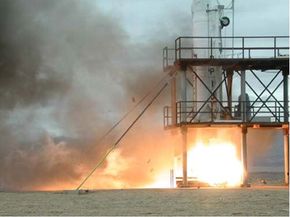
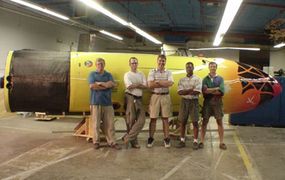
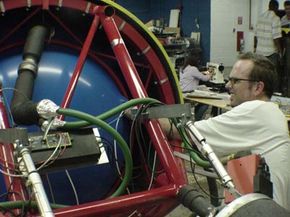
Testing the da Vinci Project rocket
Photo courtesy da Vinci Project
After registration as an official X Prize contestant and all of the challenges of planning and building a spaceship that followed, a team ready for launch faced yet another roadblock: launch licensing. Most countries require a license to fly any vehicle into the air, and launching something into space and back definitely falls under that heading. In the United States, the Federal Aviation Administration (FAA) requires an Experimental Aircraft Certificate and a Space Launch License. The application form is fairly simple, but the process that follows is not: The FAA's Applicant Checklist is divided into four phases, which include frequent meetings with FAA officials and regular inspections of the project's progress.
Another thing to keep in mind: According to the FAA, you can't just build and launch a sub-orbital rocket in your backyard. Launches are allowed only at specific government-funded and privately funded sites (see FAA: Launch Sites); however, according to X Prize rules, a team could not use a government site unless it was open to all teams (including those from other countries).
Advertisement
Only two sub-orbital, manned rocket-launch licenses have ever been awarded in the United States, both of those within the last six months. Add the time it takes to get FAA approval to the 60-day notice required by the X Prise Foundation to launch, and time was of the essence.
Therefore, many teams came quite far in their development of spacecraft but could not get ready to launch before the January 1, 2005, deadline. Their ideas and technological innovations will live on, however. In the next section, we'll a look at some of the teams that were involved in the Ansari X Prize.
The Ansari X Prize garnered teams from countries as varied as Russia, Canada, Romania, Israel, England, Argentina and the United States. Contrary to the expectation that big aerospace companies would jump to get involved, many of the teams' companies were founded after the announcement of the contest, and teams often consisted of their founders. When Scaled Composites' SpaceShipOne took the prize, more than 20 teams were registered. Most only managed to complete the design or build the spacecraft, but a few did have test flights with demonstrator rockets -- some successful, others not so successful. Here's a breakdown of the successful ones:
WINNER: Scaled Composites LLC
Mojave, California
Advertisement
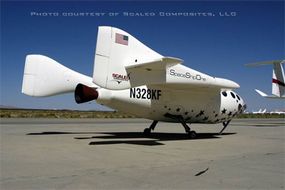
Vehicle: SpaceShipOne, a 16.4-foot (~5-meter) rocket launched mid-air from carrier aircraft White Knight
To understand the challenges the X PRIZE teams faced and the individual solutions they engineered to conquer them, you may need to brush up on some basic rocket science. (If you're up for a more extended course in rocket science, be sure to check out How Rocket Engines Work.)
When creating a space-bound rocket, you need to know about two main things:
Advertisement
Orbital Mechanics - These are the basic principals behind the behavior of any moving object that is affected by gravity, including people (within the Earth's atmosphere), the satellites orbiting the Earth that make the GPS system in your car work and even things as big as a planet or as small as a atom.
Propulsion Systems - In a word, these make the rocket go. To combat the gravity on the Earth's surface, the propulsion system of a spacecraft has to create considerable force in the opposite direction. This force is called thrust. Thrust is created by the often-explosive combustion of the propellant (or fuel), which can consist of things as everyday as gasoline or tire rubber. The more the rocket weighs, the more propellant is required; however, the more propellant is required, the more the rocket weighs, so the rocket's design must be planned carefully.
These two basic elements affect the complex Ansari X Prize spacecraft similar to the way they'd affect something as simple as a golf ball. When a golfer takes a swing, the golf club functions as the propulsion system and thrusts the golf ball high into the air, flying in the direction of the swing. Because it is hit from the side, it forms a long, wide arc before returning to the ground. If the ball could be hit from the bottom, it would go straight up -- which is pointless for golfers but great for rocket scientists.
The traditional way of propelling a rocket or a spacecraft into sub-orbit is to fire up the propulsion system directly beneath the vehicle to thrust it straight up. Upon reaching burnout (the point at which all of the fuel is used up), the rocket continues to ascend for a short time. As it slows down from lack of propellant, it begins to make an arc -- this is where it reaches its highest point (or altitude), known as apogee. It then begins to descend, completing the arc until it falls in a straight line back to the Earth's surface. To prevent the destruction of the rocket on impact, many are equipped with parachutes to slow the fall.
There are plenty of resources for the at-home rocketeer. Do-it-yourself, beginner rocket kits -- complete with engines -- can be purchased for as little as $5 to as much as $150 at hobby stores nationwide. For the serious hobbyist or budding rocket scientist, high-powered versions can be purchased that fly as high as a commercial jet -- more than 30,000 feet (9,144 meters). A word to the wise: Use of these and H-class rockets require National Association of Rocketry approval for a reason -- these launches can be dangerous. FAA approval may be required as well.
In the next section, we'll describe some of the technology used in the X Prize competition and take a detailed look at the top teams' flight plans.
Advertisement
"New Space Race" Tactics
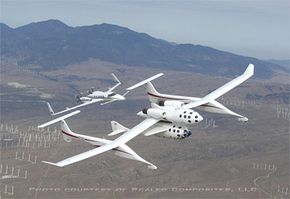
SpaceShipOne attached to the underbelly of its launch vehicle (followed by another aircraft)
Photo courtesy Scaled Composites, LLC
The spaceship designs are as varied as the origins of the teams, making use of established as well as innovative technology.
Traditional Tactics
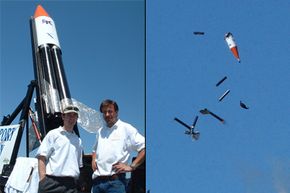
Several teams took the "oldie but goodie" tack, basing their sub-orbital rockets on technology developed as early as the 1940s. A popular design to copy was the German V-2, a World War II rocket that launched vertically from the ground into the Earth's stratosphere so as not to be detected and destroyed by enemy aircraft -- the world's first guided ballistic missile. Teams that chose this model for their spacecraft, such as Canadian Arrow, were forced to make some serious adjustments to fulfill the contest's requirements: Primarily, the rocket had to be large enough to carry three people, and the passengers couldn't explode when the rocket touched back down. To tackle this, some teams divided the rocket from the launch vehicle, turning the launch into a two-stage affair. The first stage involved lift-off from the ground, the craft propelled by the main rocket engine. During the second stage, the cabin of the spacecraft disengaged from the bottom portion, propelled by its own engines into sub-orbit. In the case of the Canadian Arrow, the two portions were equipped with parachutes to ease the landing.
Advertisement
High Ambitions
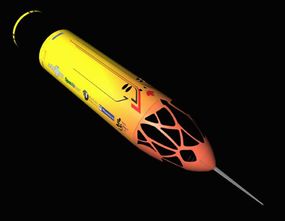
The most successful teams in the contest took a slightly different tack. Using the rationale that launching from the Earth's surface is twice as difficult as launching from high altitudes, Scaled Composites and the da Vinci Project developed spacecraft that actually launched from the sky care of a carrier plane and a gigantic helium balloon, respectively. These high-altitude launches reduce the amount of rocket fuel required (a major factor in keeping down weight and cost) because the rocket has a shorter distance to travel to get to sub-orbit, and the thin air provides less resistance than that on the Earth's surface. Scaled Composites' SpaceShipOne released from its carrier plane White Knight at about 45,000 feet (~13,700 meters), boosted itself into sub-orbit, cut its engines for a three-minute view of the Earth in weightless conditions and then fell back down to Earth, slowing its decent by creating aerodynamic drag (see How SpaceShipOne Works for detailed information of the flight).
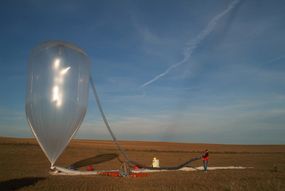
The da Vinci Project used a slightly different approach, dangling its spaceship from a reusable helium balloon until reaching 80,000 feet (~24,400 meters), at which time the engines were fired. Since propelling the rocket straight up would destroy the balloon (disqualifying the entry), the GPS-guided vessel first shot out at a 75-degree angle to clear the balloon and then changed to a 90-degree trajectory to go straight up to sub-orbit. The cabin then separated from the bottom portion and, after three minutes of weightlessness and an awe-inspiring view, plummeted back to the Earth while using parachutes on both sections to break the fall.
The da Vinci launch balloon
Photo courtesy Ansari X-Prize
Innovative Effort
Some of the more unique designs did not make it to the flight-testing stage, but certainly deserve an "E" for effort. American Discraft of Portland, Oregon, had the inspired idea to create a 100-foot-diameter (~30.5-meter) "hypersonic wave rider aerospace craft" -- a flying saucer. In theory, the ship (called the Space Tourist) would take off horizontally from a runway at 60 miles per hour (~97 kph) by creating suction along the top surface and would then thrust the air through the ship's exhaust to create propulsion and steering.
In the next section, we'll discuss future developments and what is expected to arise from the efforts of the Ansari X Prize contestants.
Sub-orbital Wings
For a look at the new set of "wings" the FAA is awarding to this new class of sub-orbital astronauts, click here.
Advertisement
Space Tourism
So what does all this rocket science mean for the average person? Well, for starters, it means that space tourism could be widely available before we even lay eyes on those flying cars we thought we'd be driving by now.
The developments and efforts of the X Prize contestants have both sped up the time-table for such an adventure and potentially driven down the cost. According to market studies cited by X Prize founder Diamandis, as many as 10,000 Americans would be willing to pay up to $100,000 for the opportunity to ride in a sub-orbital spacecraft -- the question, of course, is whether that fee is a realistic one to cover costs and profit. The X PRIZE chairman and CEO equates the near future of space tourism with the "barnstorming" of the 1920s, when people flocked to freelance pilots and paid them a fee for riding along. According to Diamandis, the X Prize contest is the first of three phases in the development of a privatized space-flight industry:
Advertisement
Research and development - Spacecraft are conceptualized, designed, created and then tested. This stage has occurred during the Ansari X Prize.
Trained participation - Passengers undergo training, understand the possible risks involved in flying in an experimental spacecraft and sign a liability waiver before the trip. Between 2,000 and 3,000 flights will have to occur before the safety of the process is approved for the general public, making the next step possible.
Government certification - The spacecraft and manufacturers undergo a rigorous FAA approval process, which could end up costing up to 100 times more than the development of the vehicle before its final certification of public safety.
In addition to space tourism, it is anticipated that Ansari X Prize vehicles will provide cheap satellite launches, faster point-to-point passenger travel and same-day international mail delivery. The sky is truly the limit.
For more information on the X Prize, private spaceflight, space tourism and related topics, check out the links on the next page.
What's Next?
According to Space.com: New $50 Million Prize for Private Orbiting Spacecraft, the next big thing in private-spaceflight competition is America's Space Prize -- and this one’s for $50 million. The race is to "build an orbital vehicle capable of carrying up to seven astronauts to an orbital outpost by the end of the decade."
And NASA's getting in on the private spaceflight action, too. The government organization, through its Centennial Challenges division, plans to offer cash awards -- anywhere from $250,000 to $30 million -- for a wide range of space-related achievements including soft lunar landings.