Admit it. You'd love to own an invisibility cloak. Utter an embarrassing faux pas at a party? Just throw on your magical garment and vanish from the snooty gaze of your fellow partygoers. Want to hear what your boss is really saying about you? Stroll right into his or her office and get the goods.
Such fantastic fashion accessories have become ridiculously standard in the world of science fiction and fantasy. Everyone, from Harry Potter and his bestie Ron Weasley to intergalactic safari hunters, has at least one invisible blouse in their wardrobe, but what about us poor saps in the real world?
Advertisement
Well, muggles, science has some good news for you: Invisibility cloaks are a reality. While the technology is far from perfect and won't provide actual invisibility like a true invisibility cloak, we'll guide you through your invisibility cloak options.
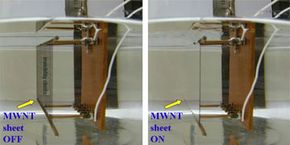
Here we see the multi-walled carbon nanotube (MWCT) switch from inactive to active, vanishing from sight in the process.
Photo courtesy Aliev A et al. 2011 Nanotechnology
First, let's try this carbon nanotube invisibility cloak on for size and experience the wonders of the mirage effect.
The Mirage Effect: Carbon Nanotubes
You're probably most familiar with mirages from tales of desert wanderers who glimpse a distant oasis, only to discover it was only a mirage — no miraculous lake of drinking water, only more hot sand.
Advertisement
The hot sand is key to the mirage effect (or photothermal deflection), as the stiff temperature difference between sand and air bends, or refracts, light rays. The refraction swings the light rays up toward the viewer’s eyes instead of bouncing them off the surface.
In the classic example of the desert mirage, this effect causes a "puddle" of sky to appear on the ground, which the logical (and thirsty) brain interprets as a pool of water. You've probably seen similar effects on hot roadway surfaces, with distant stretches of the road appearing to gleam with pooled water.
Experimentation and Potential
In 2011, researchers at the University of Texas at Dallas NanoTech Institute managed to capitalize on this effect. They used sheets of carbon nanotubes, sheets of carbon wrapped up into cylindrical tubes [source: Aliev et al.]. Each page is barely as thick as a single molecule, yet is as strong as steel because the carbon atoms in each tube are bonded incredibly tightly. These sheets are also excellent conductors of heat, making them ideal mirage-makers.
In the experiment, the researchers heated the sheets electrically, which transferred the heat to the surrounding area (a petri dish of water). This caused light to bend away from the carbon nanotube sheet, effectively cloaking anything behind it with invisibility.
Needless to say, there aren’t many places you'd want to wear a tiny, super-heated thermal camouflage jacket that has to stay immersed in water, but the experiment demonstrates the potential for such materials. In time, the research may enable not only invisibility cloaks but also other light-bending devices — all of them with a handy on/off switch.
Advertisement
The Concept of Metamaterials
Next, let's slip into an invisibility cloak made from metamaterials.
Using Metamaterials to Bend Light Waves
Metamaterials offer a more compelling vision of invisibility technology, without the need for multiple projectors and cameras. First conceptualized by Russian physicist Victor Veselago in 1967, these tiny, artificial structures are smaller than the wavelength of light (they have to be to divert them) and exhibit negative electromagnetic properties that affect how an object interacts with electromagnetic fields.
Advertisement
Refractivity and Wave Interaction
Natural materials all have a positive refractive index, and this dictates how light waves interact with them. Refractivity stems in part from chemical composition, but internal structure plays an even more important role. If we alter the structure of a material on a small enough scale, we can change the way they refract incoming waves — even forcing a switch from positive to negative refraction.
Remember, images reach us via light waves. Sounds reaches us via sound waves. If you can channel these waves around an object, you can effectively hide it from view or sound.
Imagine a small stream. If you stick a teabag full of red dye into the flowing water, its presence would be apparent downstream, thanks to the way it altered the water's hue, taste and smell. But what if you could divert the water around the teabag?
Metamaterial Fabric and Energy Waves
In 2006, Duke University's David Smith took an earlier theory posed by English theoretical physicist John Pendry and used it to create a metamaterial capable of distorting the flow of microwaves. Smith's metamaterial fabric consisted of concentric rings containing electronic microwave distorters. When activated, they steer frequency-specific microwaves around the central portion of the material.
Obviously humans don't see in the microwave spectrum, but the technology demonstrated that energy waves could be routed around an object. Imagine a cloak that can divert a third grader's straw-fired spitball, move it around the wearer and allow it to continue on the other side as if its trajectory had taken it, unopposed, straight through the person in the cloak. Now how much more of a stretch would it be to divert a rock? A bullet?
Smith's metamaterials proved the method. The recipe to invisibility lay in adapting it to different waves.
The Smallest Frontier
Metamaterials, a creation of science, don't occur naturally. In order to create the minute structures required to redirect electromagnetic waves, scientists employ nanotechnology.
Advertisement
Metamaterials: Invisible Tanks
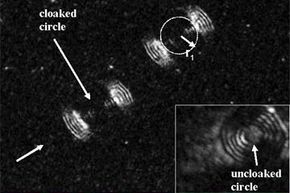
This optical image shows the University of Maryland metamaterials in action, steering light waves away from the each central circle. The arrows indicate the direction of the light waves.
Image courtesy of the University of Maryland Department of Electrical and Computer Engineering
In 2007, the University of Maryland's Igor Smolyaninov led his team even farther down the road to invisibility. Incorporating earlier theories proposed by Purdue University's Vladimir Shaleav, Smolyaninov constructed a metamaterial capable of bending visible light around an object.
A mere 10 micrometers wide, the Purdue cloak uses concentric gold rings injected with polarized cyan light. These rings steer incoming light waves away from the hidden object, effectively making it invisible. Chinese physicists at Wuhan University have taken this concept into the audible range, proposing the creation of an acoustic invisibility cloak capable of diverting sound waves around an object.
Advertisement
For the time being, metamaterial invisibility cloaks are somewhat limited. They're not only small; they're limited to two dimensions — hardly what you'd need to vanish into the scenery of a 3-D war zone.
Plus, the resulting cloak would weigh more than even a full-grown wizard could hope to lug around. As a result, the technology might be better suited to applications such as hiding stationary buildings or vehicles, such as a tank.
Advertisement
Optical Camouflage: Altered Reality
Optical camouflage technology won't make you invisible to multi-eyed Beholder monsters — or even to stray cats and squirrels.
Ready to slip into some old-school optical camouflage fashions?
This technology takes advantage of augmented-reality (AR) technology — a type of technology first pioneered in the 1960s by Ivan Sutherland and his students at Harvard University and the University of Utah.
Advertisement
Optical camouflage delivers a similar experience to Harry Potter's invisibility cloak, but using it requires a slightly complicated arrangement. First, the person who wants to be invisible (let's call him Harry) dons a garment that resembles a hooded raincoat. The garment is made of a special material that we'll examine more closely in a moment.
Next, an observer (let's call him Professor Snape) stands before Harry at a specific location. At that location, instead of seeing Harry wearing a hooded raincoat, Snape sees right through the cloak, making Harry appear to be invisible.
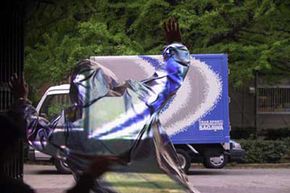
The above photograph shows you what Snape would see. And if Snape stepped to the side and viewed Harry from a slightly different location? Why, he'd simply see the boy wizard wearing a silver garment. Scowls and detentions would likely follow. Lucky for Harry, his fictional cloak affords 360-degree protection.
Augmented Reality vs. Virtual Reality
Augmented reality systems add computer-generated information to a user's sensory perceptions. Imagine, for example, that you're walking down a city street. As you gaze at sites along the way, additional information appears to enhance and enrich your normal view. Perhaps it's the day's specials at a restaurant or the showtimes at a theater or the bus schedule at the station.
What's critical to understand is that augmented reality is not the same as virtual reality. While virtual reality aims to replace the world, augmented reality merely tries to supplement it with additional, helpful content. Think of it as a heads-up display (HUD) for everyday life.
Components of Optical Camouflage
Most augmented reality systems require a user to look through a special viewing apparatus to see a real-world scene enhanced with synthesized graphics. They also call for a powerful computer. Optical camouflage requires these things as well, but it also necessitates several other components. Here's everything needed to make a person appear invisible:
a garment made from highly reflective material
a digital video camera
a computer
a projector
a special, half-silvered mirror called a combiner
Advertisement
Optical Camouflage: Invisibility Cloak Components
Optical camouflage works by taking advantage of AR technology. Learn how it works and find out what goes into the cloak.
All right, so you have your video camera, computer, projector, combiner and wondrous reflective raincoat. Just how does augmented-reality technology turn this odd shopping list into a recipe for invisibility?
Retro-reflective Material
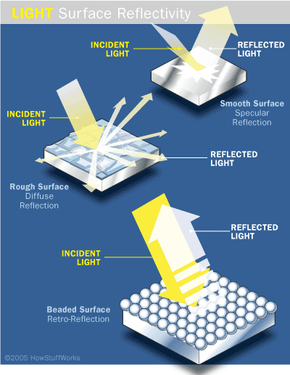
First, let's take a closer look at the raincoat: It's made from retro-reflective material. This high-tech fabric is covered with thousands and thousands of small beads. When light strikes one of these beads, the light rays bounce back exactly in the same direction from which they came.
Advertisement
To understand why this is unique, look at how light reflects off other types of surfaces. A rough surface creates a diffused reflection because the incident (incoming) light rays scatters in many different directions. A perfectly smooth surface, like that of a mirror, creates what is known as a specular reflection — a reflection in which incident light rays and reflected light rays form the exact same angle with the mirror surface.
Light Reflection and Retro-reflection
In retro-reflection, the glass beads act like prisms, bending the light rays by refraction. This causes the reflected light rays to travel back along the same path as the incident light rays. The result: An observer situated at the light source receives more of the reflected light and therefore sees a brighter reflection.
Retro-reflective materials are actually quite common. Traffic signs, road markers and bicycle reflectors all take advantage of retro-reflection to be more visible to people driving at night. The movie screens found in most modern commercial theaters also take advantage of this material because it allows for high brilliance under dark conditions.
In optical camouflage, the use of retro-reflective material is critical because it can be seen from far away and outside in bright sunlight — two requirements for the illusion of invisibility.
As you can see in this image, the experience closely resembles walking directly in front of a movie projection screen, only with a real background.
AP Photo/Shizuo Kambayashi
For the rest of the setup, the video camera needs to be positioned behind the subject to capture the background. The computer takes the captured image from the video camera, calculates the appropriate perspective and transforms the captured image into the picture that will be projected onto the retro-reflective material.
Projector and Combiner
The projector then shines the modified image on the garment, by shining a light beam through an opening controlled by a device called an iris diaphragm.
This diaphragm is made of thin, opaque plates, and turning a ring changes the diameter of the central opening. For optical camouflage to work properly, this opening must be the size of a pinhole. Why? This ensures a larger depth of field so that the screen (in this case the cloak) can be located any distance from the projector.
Finally, the overall system requires a special mirror to both reflect the projected image toward the cloak and to let light rays bouncing off the cloak return to the user's eye. This special mirror is called a beam splitter, or a combiner — a half-silvered mirror that both reflects light (the silvered half) and transmits light (the transparent half).
Integration of Computer-generated Image
If properly positioned in front of the user's eye, the combiner allows the user to perceive both the image enhanced by the computer and light from the surrounding world.
This is critical because the computer-generated image and the real-world scene must be integrated fully for the illusion of invisibility to seem realistic. The user has to look through a peephole in this mirror to see the augmented reality.
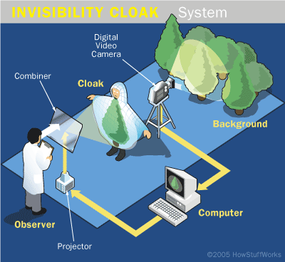
Now let's put all of these components together to see how the invisibility cloak appears to make a person transparent. This diagram shows the typical arrangement of all the various devices and pieces of equipment.
One way to make a person appear transparent
Once a person puts on the cloak made with the retro-reflective material, here's the sequence of events:
A digital video camera captures the scene behind the person wearing the cloak.
The computer processes the captured image and makes the calculations necessary to adjust the still image or video so it will look realistic when it is projected.
The projector receives the enhanced image from the computer and shines the image through a pinhole-sized opening onto the combiner.
The silvered half of the mirror, which is completely reflective, bounces the projected image toward the person wearing the cloak.
The cloak acts like a movie screen, reflecting light directly back to the source, which in this case is the mirror.
Light rays bouncing off the cloak pass through the transparent part of the mirror and fall on the user's eyes. Remember that the light rays bouncing off the cloak contain the image of the scene that exists behind the person wearing the cloak.
The person wearing the cloak appears invisible because the background scene is being displayed onto the retro-reflective material. At the same time, light rays from the rest of the world are allowed to reach the user's eye, making it seem as if an invisible person exists in an otherwise normal-looking world.
While an invisibility cloak is an interesting application of optical camouflage, it's probably not the most useful one.
The words "invisibility cloak" tends to summon images of fantastic adventure, magical espionage and otherworldly deception. The actual applications for optical camouflage, however, are far less out there. You can forget hiding your Romulan starship or hanging out in the lady wizards' dormitory, but that doesn't mean there aren't a number of viable uses for the technology.
Applications in Aviation and Driving
For instance, pilots landing a plane could use this technology to make cockpit floors transparent. This would enable them to see the runway and the landing gear simply by glancing down at the floor (which would display the view from the outside of the fuselage).
Advertisement
Similarly, drivers wouldn't have to deal with mirrors and blind spots. Instead, they could just "look through" the entire rear of the vehicle. The technology even boasts potential applications in the medical field, as surgeons could use optical camouflage to see through their hands and instruments for an unobstructed view of the underlying tissue.
Mutual Telexistence
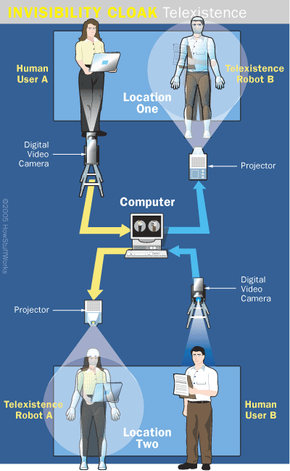
Interestingly enough, one possible application of this technology actually revolves around making objects more visible. The concept is called mutual telexistence and essentially involves projecting a remote user's appearance onto a robot coated in retro-reflective material.
Say a surgeon were operating on a patient via remote control robotic surgery. Mutual telexistence would provide the human doctors assisting the procedure with the perception that they're working with another human instead of a machine.
Pervasive Gaming
Right now, mutual telexistence is science fiction, but scientists continue to push the boundaries of the technology. For example, pervasive gaming is already becoming a reality. Pervasive gaming extends gaming experiences out into the real world, whether on city streets or in remote wilderness (i.e., Pokémon Go). Players with mobile displays move through the world while sensors capture information about their environment, including their location. This information delivers a gaming experience that changes according to where users are and what they are doing.
Sources
Adler, Robert. "Acoustic 'superlens' could mean finer ultrasound scans." New Scientist. January 2008. (Oct. 13, 2009)http://www.newscientist.com/article/dn13156-acoustic-superlens-could-mean-finer-ultrasound-scans.html
Aliev, Ali E. et al. "Mirage effect from thermally modulated transparent carbon nanotube sheets." Nanotechnology 22. 2011. (Oct. 13, 2011) http://iopscience.iop.org/0957-4484/22/43/435704/pdf/0957-4484_22_43_435704.pdf
BBC News. "Inventor plans 'invisible walls'." BBC News. June 14, 2004.http://news.bbc.co.uk/2/hi/technology/3791795.stm
Bland, Eric. "Invisibility Cloak Closer Than Ever to Reality." Discovery News. Jan. 15, 2009. (Oct. 13, 2009)http://dsc.discovery.com/news/2009/01/15/invisibility-cloak.html
Brown, Mark. "Watch: ‘Invisibility Cloak’ Uses Mirages to Make Objects Vanish." Wired. Oct. 4, 2011. (Oct. 13, 2011) http://www.wired.com/dangerroom/2011/10/invisibility-cloak-mirage/
Feiner, Steven K. "Augmented reality: A new way of seeing," Scientific American. April 2002.
Inami, Masahiko et al. "Visuo-Haptic Display Using Head-Mounted Projector."http://projects.star.t.u-tokyo.ac.jp/projects/MEDIA/xv/oc.html
Inami, Masahiko et al. "Optical Camouflage Using Retro-reflective Projection Technology," Proceedings of the Second IEEE and ACM International Symposium on Mixed and Augmented Reality (ISMAR 03).http://projects.star.t.u-tokyo.ac.jp/projects/MEDIA/xv/oc.html
"'Invisibility Cloaks' Could Break Sound Barriers." Duke Engineering. Jan. 9, 2008. (Oct. 13, 2009)http://www.pratt.duke.edu/news/?id=1193
McCarthy, Wil. "Being Invisible." Wired. November 2008. (Oct. 13, 2009)http://www.wired.com/wired/archive/11.08/pwr_invisible_pr.html
Mullins, Justin. "Working invisibility cloak created at last." Oct. 19, 2006. (Oct. 13, 2009)http://www.newscientist.com/article/dn10334-working-invisibility-cloak-created-at-last.html
Pendry, John. "Metamaterials." New Scientist. (Oct. 21,2011) http://www.newscientist.com/data/doc/article/dn19554/instant_expert_7_-_metamaterials.pdf
Smolyaninov, Igor et al. "Electromagnetic cloaking in the visible frequency range." University of Maryland Department of Electrical and Computer Engineering. Dec. 10, 2007. (Oct. 13, 2009) http://arxiv.org/ftp/arxiv/papers/0709/0709.2862.pdf
Tachi, Susumu. "Telexistence and Retro-reflective Projection Technology (RPT)," Proceedings of the 5th Virtual Reality International Conference (VRIC2003), pp. 69/1-69/9.http://projects.star.t.u-tokyo.ac.jp/projects/MEDIA/xv/oc.html
Advertisement
Cite This!
Please copy/paste the following text to properly cite this HowStuffWorks.com article: