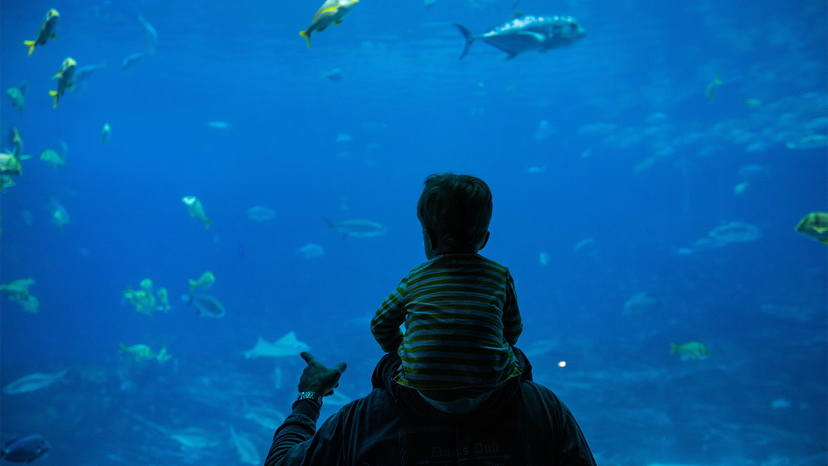
Containing 11 million gallons of water, Georgia Aquarium is the largest aquarium, not just in the U.S., but in the entire Western Hemisphere. Georgia Aquarium
Georgia Aquarium is the biggest aquarium in the Western Hemisphere, whether you measure by the number of fish (tens of thousands) or the volume of water (more than 11 million gallons or 41.6 million liters). It houses over 500 species in 100 habitats with more than 12,000 square feet (1,115 square meters) of viewing windows, and it cost $290 million to build.
Thank You!
HowStuffWorks would like to thank the staff of Georgia Aquarium for their assistance with this article.
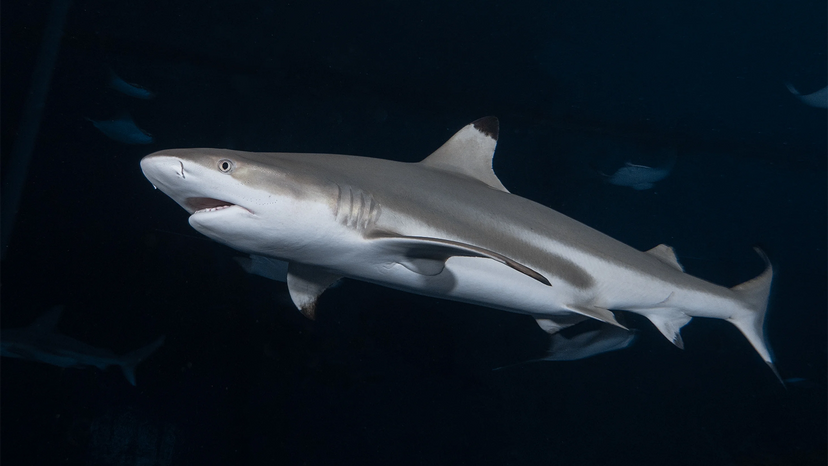
Predators like this blacktip reef shark don't typically feed on other animals in their exhibit as they are always well-fed. Georgia Aquarium
Building the Aquarium, a parking deck and exhibits for all these animals was no small task. In the process, the Aquarium used:
328 tons (297.6 metric tons) of acrylic windows, about the weight of two fully-grown blue whales
290 plumbing fixtures, 200 floor drains and 53 roof drains connected with 1.5 miles (2.4 km) of underground pipe and 5.5 miles (8.9 km) of aboveground pipe
61 miles (98.1 km) of pipe and wire
100,000 yards (91.4 km) of concrete and 2,500 auger-cast piles
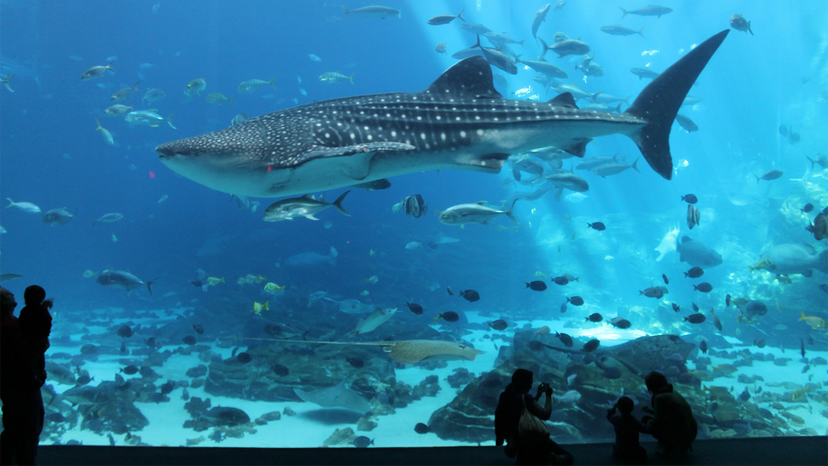
The Ocean Voyager exhibit, the largest habitat, holds over half of the Aquarium's water. It is 263 feet long by 126 feet wide by 33 feet deep (80.1 x 38.4 x 10.1 meters), and it holds 6.3 million gallons (23.9 million liters) of water. A skylight over the Ocean Voyager exhibit lets the fish get natural sunlight on clear days.
Advertisement
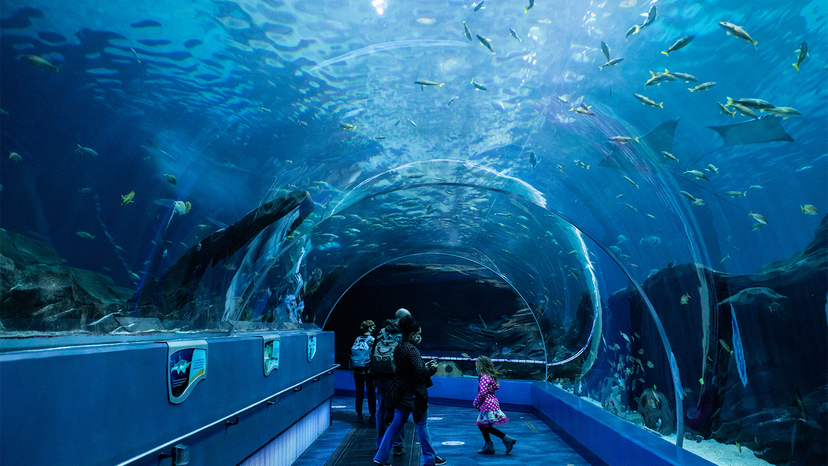
A special holding pool at one end allows staff to give fish, rays or even babies a separate area from the rest of the exhibit if needed, and veterinarians can examine larger animals inside it. A slow-moving conveyor belt takes visitors through a 100-foot (30.5-meter) acrylic tunnel under the exhibit, letting them view the fish from below.
The acrylic tunnel below the Ocean Voyager exhibit provides visitors with spectacular views.
Georgia Aquarium
Other Aquarium exhibits include the 800,000-gallon (3-million-liter) beluga whale exhibit, smaller habitats and touch pools where visitors can get hands-on experiences with aquatic animals.
Many of the exhibits use artificial light, but Ocean Voyager, the beluga whale habitat and the large coral reef all receive natural light.
To initially salinate the water for the marine exhibits, the Aquarium used 1.5 million pounds (680,389 kg) of Instant Ocean® sea salt. Keeping the water salinated requires additional salt that’s added periodically.
To prepare the Aquarium for opening in 2005, staff piped in 8 million gallons (30.3 million liters) of City of Atlanta tap water — enough to fill 160,000 bathtubs — to fill the exhibits. After treating it to remove chemicals and impurities, the staff had to turn this fresh water into salt water for marine habitats.
To do this, they added 750 2,000-pound (907 kg) sacks of Instant Ocean® sea salt, for a total of 1.5 million pounds (680,389 kg). That's the equivalent of more than 920,000 containers of table salt.
Advertisement
Acquiring Animals
Many of the Aquarium's animals came from aquaculture farms, other zoos and aquariums, confiscations, or when animals are deemed non-releasable by the federal government.
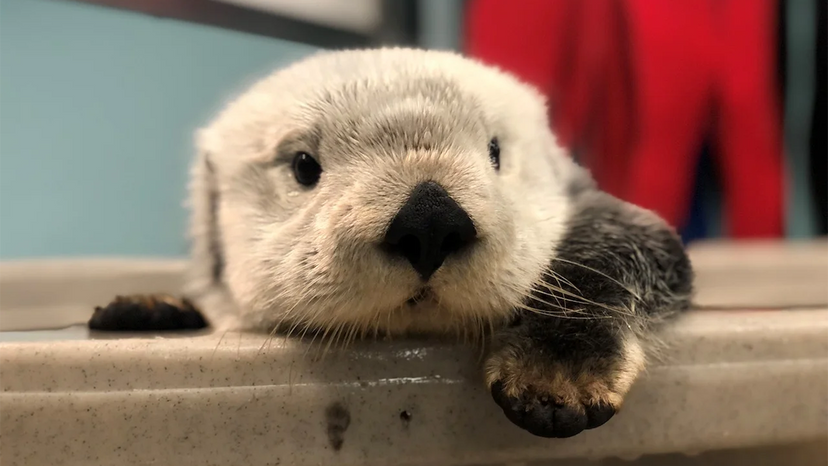
This adorable southern sea otter is a rescue.
Georgia Aquarium
When an animal is deemed non-releasable after a rescue and attempted rehabilitation, the animal cannot be returned to the ocean and they need a forever home; otherwise, they are euthanized. Georgia Aquarium has taken in many animals to be housed in their forever home! In several cases, Aquarium staff rescued animals living in unhealthy circumstances, or that would have died without their intervention.
Advertisement
In addition to beluga whales, whale sharks and animals from aquaculture facilities, other live animals brought to the Aquarium include:
A school of tarpon, silver fish that can weigh more than 300 pounds (136.1 kg) when fully grown, rescued from a tide pool
Several species of tropical fish rescued after the U.S. Fish and Wildlife Service confiscated them as an illegal shipment
Bowmouth guitarfish caught by accident by Taiwanese fishermen
All five of the Aquarium’s southern sea otters are rescues that were previously stranded off the California coast.
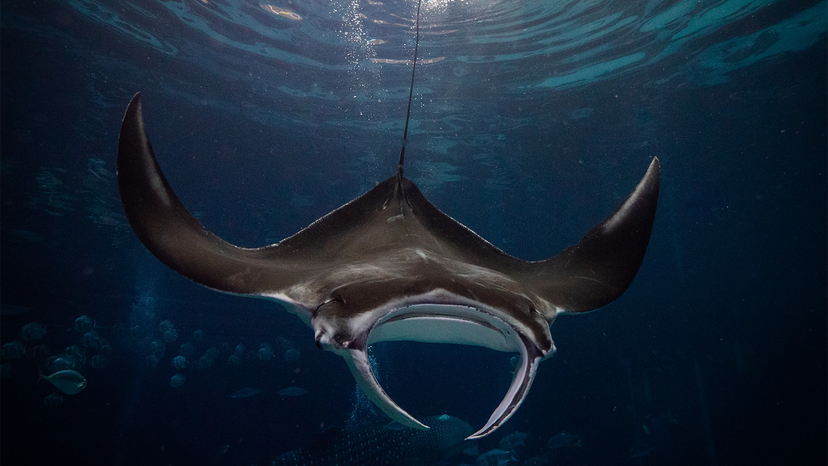
Local species, like cownose rays, freshwater fishes, and even manta rays native to Florida
Coral, grown for use in the Aquarium rather than harvested from existing reefs
Coral is also brought to the Aquarium from U.S. Fish and Wildlife Service confiscations.
Many of the California sea lions at Georgia Aquarium are rescues from the coast of California after stranding multiple times in search of food and then being deemed non-releasable.
Advertisement
Feeding the Animals
Feeding the animals at Georgia Aquarium is much more complex than just sprinkling food on the water's surface.
This manta ray gets just as excited for feeding time as all the other animals at the Aquarium.
Georgia Aquarium
The Aquarium staff prepares meals for all its animals in its commissary, a specially designed kitchen held to higher standards than restaurant kitchens. The United States Department of Agriculture conducts random inspections of the commissary to ensure safety and sanitation.
Advertisement
The commissary has a freezer that holds 20,000 pounds (9,071.9 kg) of food and a refrigerator that holds 6,000 pounds (2,721.6 kg). The Aquarium staff prepares food for the animals every day.
Animal diets, amounts of food and the number of daily feedings vary widely from species to species. Animals eat prepared food based on their native diets. Many get supplements in their food such as vitamins or medicine when necessary. For example:
Leafy sea dragons eat small shrimp called mysids.
Whale sharks eat a special, premade gel food and tiny crustaceans called krill. Whale sharks are filter-feeding fish, and they learned to eat from ladles before traveling to the Aquarium.
Beluga whales get multiple feedings of fish per day, and the largest eats about 50 pounds (22.7 kg) of fish divided among those feedings.
Sea otters eat food-grade fish and clams. The trainers who work with the otters inspect their food for scrapes and cuts where bacteria can grow.
Aquarium specialists have access to the exhibits to feed the animals, but the vast Ocean Voyager habitat presents unique challenges. It's roughly the shape of an hourglass and houses a wide variety of fishes.
Georgia Aquarium is the only aquarium outside of Asia to care for whale sharks.
Georgia Aquarium
Along with the whale sharks are sawfish, bowmouth guitarfish, grouper, manta rays, a green sea turtle and golden trevally. To feed all these fishes, the Aquarium uses a variety of feeding techniques including ladle feedings, hand feedings and a broadcast-style feeding for the smaller fishes. A special broadcast system runs through the exhibit to send food out to those animals.
Feeding the fish high-quality food, customized based on what they eat in the wild and need to thrive, helps to keep them healthy.
Advertisement
Georgia Aquarium's Correll Center for Animal Health
Georgia Aquarium's animal health team has a state-of-the-art, on-site veterinary hospital for preventative and interventional medicine for the animals at the Aquarium. It's a 5,800-square-foot (538.8-square-meter) unit with around 10 staff members, and it houses over 20 treatment systems and a fully equipped surgery suite.
The Aquarium partners with the University of Georgia and provides internships to train new aquatic animal specialists. The veterinary staff also researches animal health and behavior and shares their results with other zoos and aquariums.
Advertisement
The laboratory and health facility can run blood tests, examine slides under a microscope and culture bacteria for analysis.
The surgery suite also has a mobile, digital radiography unit that can move anywhere in the facility and can x-ray animals as small as penguins and large as whales. It has an ultrasound machine, an endoscope and machines that allow mammals, reptiles and fish to be anesthetized for surgery.
Georgia Aquarium does preventive medicine protocols for all of its larger animals, including annual exams.
Some animals may receive vaccines, although preventive medicine for Aquarium fishes generally relies on observation and quarantines for all new animals rather than vaccines.
All of the larger animals in the Aquarium learn husbandry behaviors, which makes it easier for veterinary staff to conduct examinations. All veterinary exams are voluntary for the animals through those behaviors.
For example, when a trainer instructs them to, whales will present their flippers or tail flukes for examinations or blood collection. They will also blow from their blowhole onto a plate, which staff can examine under a microscope for parasites or bacteria.
When held, penguins will present their feet for foot checks. This makes it easier for the staff and considerably reduces stress on the animals.
Advertisement
Fish Life Support
Even though Georgia Aquarium's exhibits hold 11 million gallons (41.6 million liters) of water, the facility recycles almost 99 percent of its water. A treatment and reclamation system cleans and recycles the water, losing only a little to evaporation and the protein skimmers that help remove debris.
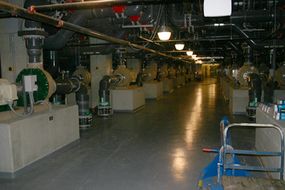
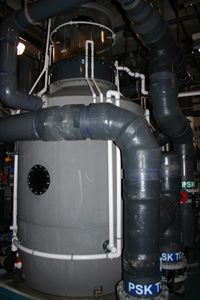
Some of the over 500 pumps that help keep the water at the Aquarium clean.
Behind the scenes, the Aquarium uses three types of filtration:
Ozone: plays the same role as chlorine in a swimming pool but is safer for fish
It takes over 500 pumps, 148 sand filters and 82 protein skimmers to filter the whole Aquarium.
Ocean Voyager alone requires 232 pumps and 74 sand filters, which clean about 65,000 gallons (246,052 liters) of water per minute. The life support staff must perform maintenance, including oil changes and filter changes, on all of these pumps and filters.
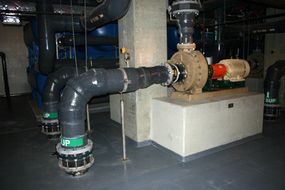
This pump drives a protein skimmer.
Georgia Aquarium
The life support staff also measures exhibit turnover time — the amount of time it takes for all the water in an exhibit to be filtered and cleaned. The staff's goal is to keep the turnover time under two hours.
Flow rates also affect the dissolved oxygen in the exhibits; the fish will suffocate if there is too little, but too much can be toxic.
All these pumps send water through a series of filters and skimmers. Even though this process is necessary, it needs to be monitored by staff at all times to ensure it’s running properly.
Advertisement
Filters and Skimmers
Sand Filters
The sand filters are similar to what you would find in a home swimming pool, but on a much larger scale. The pumps force water through the sand and the sand traps debris. The system can automatically back-wash sluggish filters, and the staff changes the sand periodically.
Protein Skimmers
The protein skimmer produces foam. Debris clings to this foam, and when the foam overflows it takes the debris with it.
Georgia Aquarium
In a protein skimmer, water from the exhibits passes through the filter, which injects air at a very high velocity. A venturi valve — a tube with a constricted area in the center — breaks the air into microbubbles.
Advertisement
These bubbles have a lot of surface area for debris to cling to. The foam this process creates overflows from an opening at the top of the filter and falls into a collection chamber, which the staff must clean periodically.
This process naturally requires a lot of pumping, which can produce dissolved gasses harmful to fish. So, the system pumps water up into holding tanks above the exhibits and allows the dissolved gasses to dissipate. Then, gravity pulls the water back into the habitats.
Heating or cooling a small amount of water before returning it to the exhibits helps keep them at the correct temperature.
Automated Systems With a Manual Touch
This system sounds complex, but a computer handles nearly all the decisions regarding clean and dirty water.
Several computers connected throughout the building make millions of decisions per second involving tank levels, temperatures and pumping flow. The computers use graphics and data to provide information and feedback to the life support staff.
Even though the system is almost 100 percent self-sustaining, the staff still takes samples from every exhibit daily, analyzes them in a lab and adds any necessary chemicals by hand.
The high-performance liquid chromatography (HPLC) system can measure antibiotic concentrations and anything abnormal in the water. The laboratory staff use it for research.
Water chemists evaluate the nitrogen cycle — the breakdown of organic material into nitrogenous wastes — and ammonia levels, pH, salinity and oxygen in water samples from every habitat daily.
An ion photography system measures, dilutes and analyzes samples, recording anything that is positively or negatively charged. The staff also uses a high-performance liquid chromatography (HPLC) system for research-based applications.
Advertisement
Education Program
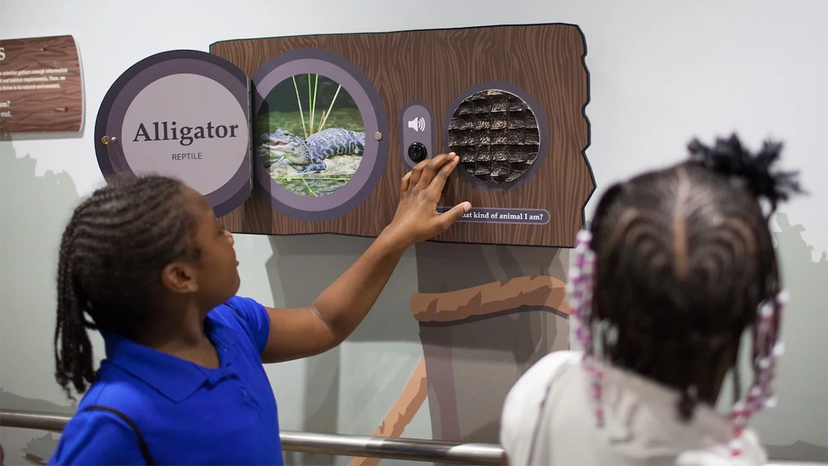
It's hard to miss the educational focus when you visit the Aquarium. Every exhibit has signs or touch screens with information about its inhabitants. The Aquarium also has education stations to offer additional information to the public.
Touch pools, staffed with employees and volunteers, allow people to touch and interact with some of the Aquarium's animals. In several areas, projectors display information about the animals along walls and floors.
Advertisement
Wall displays help students learn about alligators.
Georgia Aquarium
The Aquarium also offers behind-the-scenes tours and animal interactions where visitors can see how the Aquarium feeds and cares for all the animals.
A beluga whale in the 800,000-gallon (3-million-liter) whale habitat. Beluga whales live exclusively in arctic and subarctic waters, so the water in their exhibit is around 59 degrees Fahrenheit (15 degrees Celsius).
Advertisement
Funding and Running the Aquarium
Georgia Aquarium started with The Home Depot founder Bernie Marcus. Marcus wanted to present a gift to the city of Atlanta and the state of Georgia that would encourage education and economic growth.
In November 2001, he announced his plan to build an aquarium in downtown Atlanta. He and his wife Billi donated $250 million toward Georgia Aquarium's construction.
Advertisement
But they didn't do it alone. Marcus and the Aquarium staff visited 56 aquariums in 13 countries to research and gather ideas. They also received financial contributions from corporate sponsors. Even the land was a donation; 9 acres (3.6 hectares) came from The Coca-Cola Company.
With all this financial help, the Aquarium opened debt-free.
Groundbreaking for the Aquarium occurred in May 2003 and opened to the public on Nov. 23, 2005. Construction of the 550,000-square-foot (51,097-square-meter) facility took only 27 months.
In addition to the animal habitats, the Aquarium houses a gift shop and newly renovated cafe. It also has a 16,400-square-foot (1,523-square-meter) ballroom and food-service kitchens.
More than 500 people work at the Aquarium, and over 1,000 trained volunteers donate their time.
Everyone who visits the Aquarium must go through a security check, and guns, knives, matches and lighters are not allowed inside.
3 More of the Largest Aquariums in the United States
While Georgia Aquarium takes the number one spot for largest aquarium in the United States, it's not the only big aquarium worth seeing. Here are three more to visit.
1. Shedd Aquarium in Chicago, Illinois
Opened in 1930, Chicago's Shedd Aquarium isn't just one of the biggest aquariums in the world; it's also a National Historic Landmark. Each year, two million guests visit its exhibitions, including the 3-million-gallon (11.4-million-liter) Abbott Oceanarium, its re-creation of a Pacific Northwest ocean environment, including beluga whales, sea otters and dolphins.
Advertisement
2. The National Aquarium in Baltimore, Maryland
With a total water volume of about 2.2 million gallons (8.3 million liters), the National Aquarium in Baltimore is one of the largest aquariums in the United States. Its biggest exhibit is the 1.3-million-gallon (4.9-million-liter) Atlantic bottlenose dolphin habitat.
3. The Monterey Bay Aquarium in Monterey, California
California's Monterey Bay Aquarium houses over 81,000 animals from 771 species in 1.9 million gallons (7.2 million liters) of water. Its exhibits highlight the local marine life, with a 343,000-gallon (1.3-million-liter) kelp forest and 55,000-gallon (208,198-liter) sea otter habitat.
Its largest tank is the 1.2-million-gallon (4.5-million-liter) Open Sea exhibit, home to sea turtles and hammerhead sharks.
Advertisement
Frequently Answered Questions
Is the dolphin presentation free at Georgia Aquarium?
The dolphin presentation is included with general admission at Georgia Aquarium. Preferred seating is available for an additional fee.
Why is Georgia Aquarium famous?
Georgia Aquarium is famous because it is the largest aquarium in the Western Hemisphere and one of the largest aquariums in the world. It is also the only aquarium outside of Asia to care for whale sharks.
Cite This!
Please copy/paste the following text to properly cite this HowStuffWorks.com article: