One of the most amazing endeavors man has ever undertaken is the exploration of space. A big part of the amazement is the complexity. Space exploration is complicated because there are so many problems to solve and obstacles to overcome. You have things like:
- The vacuum of space
- Heat management problems
- The difficulty of re-entry
- Orbital mechanics
- Micrometeorites and space debris
- Cosmic and solar radiation
- The logistics of having restroom facilities in a weightless environment
But the biggest problem of all is harnessing enough energy simply to get a spaceship off the ground. That is where rocket engines come in.
Advertisement
Rocket Image Gallery
Rocket engines are, on the one hand, so simple that you can build and fly your own model rockets very inexpensively (see the links on the last page of the article for details). On the other hand, rocket engines (and their fuel systems) are so complicated that only three countries have actually ever put people in orbit. In this article, we will look at rocket engines to understand how they work, as well as to understand some of the complexity surrounding them.
When most people think about motors or engines, they think about rotation. For example, a reciprocating gasoline engine in a car produces rotational energy to drive the wheels. An electric motor produces rotational energy to drive a fan or spin a disk. A steam engine is used to do the same thing, as is a steam turbine and most gas turbines.
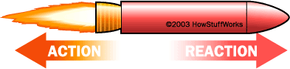
Rocket engines are fundamentally different. Rocket engines are reaction engines. The basic principle driving a rocket engine is the famous Newtonian principle that "to every action there is an equal and opposite reaction." A rocket engine is throwing mass in one direction and benefiting from the reaction that occurs in the other direction as a result.
This concept of "throwing mass and benefiting from the reaction" can be hard to grasp at first, because that does not seem to be what is happening. Rocket engines seem to be about flames and noise and pressure, not "throwing things." Let's look at a few examples to get a better picture of reality:
- If you have ever shot a shotgun, especially a big 12-gauge shotgun, then you know that it has a lot of "kick." That is, when you shoot the gun it "kicks" your shoulder back with a great deal of force. That kick is a reaction. A shotgun is shooting about an ounce of metal in one direction at about 700 miles per hour, and your shoulder gets hit with the reaction. If you were wearing roller skates or standing on a skateboard when you shot the gun, then the gun would be acting like a rocket engine and you would react by rolling in the opposite direction.
- If you have ever seen a big fire hose spraying water, you may have noticed that it takes a lot of strength to hold the hose (sometimes you will see two or three firefighters holding the hose). The hose is acting like a rocket engine. The hose is throwing water in one direction, and the firefighters are using their strength and weight to counteract the reaction. If they were to let go of the hose, it would thrash around with tremendous force. If the firefighters were all standing on skateboards, the hose would propel them backward at great speed!
- When you blow up a balloon and let it go so that it flies all over the room before running out of air, you have created a rocket engine. In this case, what is being thrown is the air molecules inside the balloon. Many people believe that air molecules don't weigh anything, but they do (see the page on helium to get a better picture of the weight of air). When you throw them out the nozzle of a balloon, the rest of the balloon reacts in the opposite direction.
Next, we'll look at another scenario that explains action and reaction: the space baseball.
Advertisement