Volcanoes are some of nature's most awe-inspiring displays, with everything from exploding mountaintops to rivers of lava. Learn how all the different types of volcanoes work. See more volcano pictures.
Whenever there is a major volcanic eruption in the world, you'll see a slew of newspaper articles and nightly news stories covering the catastrophe, all stressing a familiar set of words -- violent, raging, awesome. When faced with a spewing volcano, people today share many of the same feelings volcano-observers have had throughout human history: We are in awe of the destructive power of nature, and we are unsettled by the thought that a peaceful mountain can suddenly become an unstoppable destructive force!
While scientists have cleared up much of the mystery surrounding volcanoes, our knowledge has not made volcanoes any less amazing. In this article, we'll take a look at the powerful, violent forces that create eruptions, and see how these eruptions build volcanic structures like islands.
Advertisement
When people think of volcanoes, the first image that comes to mind is probably a tall, conical mountain with orange lava spewing out the top. There are certainly many volcanoes of this type. But the term volcano actually describes a much wider range of geological phenomena.
Generally speaking, a volcano is any place on a planet where some material from the inside of the planet makes its way through to the planet's surface. One way is "material spewing from the top of a mountain", but there are other forms as well. Check out the next page to find out more about magma (that "material spewing") and plate tectonics!
The first question this raises is: what exactly is this "material from the inside"? On our planet, it's magma, fluid molten rock. This material is partially liquid, partially solid and partially gaseous. To understand where it comes from, we need to consider the structure of planet Earth.
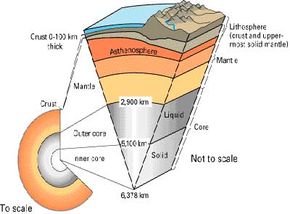
The earth is composed of many layers, roughly divided into three mega-layers: the core, the mantle and the outer crust:
Advertisement
We all live on the rigid outer crust, which is 3 to 6 miles (5 to 10 km) thick under the oceans and 20 to 44 miles (32 to 70)thick under the land. This may seem fairly thick to us, but compared to the rest of the planet, it's very thin -- like the outer skin on an apple.
Directly under the outer crust is the mantle, the largest layer of the earth. The mantle is extremely hot, but for the most part, it stays in solid form because the pressure deep inside the planet is so great that the material can't melt. In certain circumstances, however, the mantle material does melt, forming magma that makes its way through the outer crust.
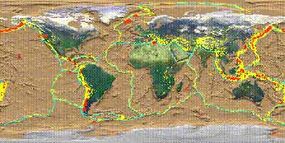
The blue lines mark plate boundaries, the red triangles mark active volcanoes and the yellow dots show recent earthquakes.
Graphic courtesy NASA
In the 1960s, scientists developed a revolutionary theory called plate tectonics. Plate tectonics holds that the lithosphere, a layer of rigid material composed of the outer crust and the very top of the mantle, is divided into seven large plates and several more smaller plates. These plates drift very slowly over the mantle below, which is lubricated by a soft layer called the asthenosphere. The activity at the boundary between some of these plates is the primary catalyst for magma production.
Where the different plates meet, they typically interact in one of four ways:
If the two plates are moving away from each other, an ocean ridge or continental ridge forms, depending on whether the plates meet under the ocean or on land. As the two plates separate, the mantle rock from the asthenosphere layer below flows up into the void between the plates. Because the pressure is not as great at this level, the mantle rock will melt, forming magma. As the magma flows out, it cools, hardening to form new crust. This fills in the gap created by the plates diverging. This sort of magma production is called spreading center volcanism.
At the point where two plates collide, one plate may be pushed under the other plate, so that it sinks into the mantle. This process, called subduction, typically forms a trench, a very deep ditch, usually in the ocean floor. As the rigid lithosphere pushes down into the hot, high-pressure mantle, it heats up. Many scientists believe that the sinking lithosphere layer can't melt at this depth, but that the heat and pressure forces the water (the surface water and water from hydrated minerals) out of the plate and into the mantle layer above. The increased water content lowers the melting point of the mantle rock in this wedge, causing it to melt into magma. This sort of magma production is called subduction zone volcanism.
If the plates collide and neither plate can subduct under the other, the crust material will just "crumple," pushing up mountains. This process does not produce volcanoes. This kind of boundary can develop later into a subduction zone.
Some plates move against each other rather than push or pull apart. These transform plate boundaries rarely produce volcanic activity.
Advertisement
Volcano Formation
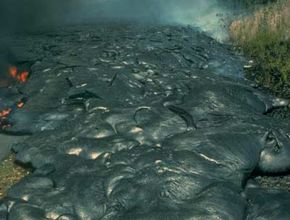
Flowing lava on Kilauea Volcano in Hawaii
Photo courtesy USGS
Magma can also push up under the middle of a lithosphere plate, though this is much less common than magma production around plate boundaries. This interplate volcanic activity is caused by unusually hot mantle material forming in the lower mantle and pushing up into the upper mantle. The mantle material, which forms a plume shape that is from 500 to 1000 km wide, wells up to create a hot spot under a particular point on the earth. Because of the unusual heat of this mantle material, it melts, forming magma just under the earth's crust. The hot spot itself is stationary; but as a continental plate moves over the spot, the magma will create a string of volcanoes, which die out once they move past the hot spot. The Hawaii volcanoes were created by such a hot spot, which appears to be at least 70 million years old.
So what happens to the magma formed by these processes? We saw that the magma produced at ocean ridges just hardens to form new crust material, and so doesn't produce spewing land volcanoes. There are a few continental ridge areas, where the magma does spew out onto land; but most land volcanoes are produced by subduction zone volcanism and hot spot volcanism.
Advertisement
When the solid rock changes form to a more liquid rock material, it becomes less dense than the surrounding solid rock. Because of this difference in density, the magma pushes upward with great force (for the same reason the helium in a balloon pushes up through the denser surrounding air and oil pushes upward through denser surrounding water). As it pushes up, its intense heat melts some more rock, adding to the magma mixture.
The magma keeps moving through the crust unless its upward pressure is exceeded by the downward pressure of the surrounding solid rock. At this point, the magma collects in magma chambers below the surface of the earth. If the magma pressure rises to a high enough level, or a crack opens up in the crust, the molten rock will spew out at the earth's surface.
If this happens, the flowing magma (now called lava) forms a volcano. The structure of the volcano, and the intensity of the volcanic eruption, is dependent on a number of factors, primarily the composition of the magma. In the next section, we'll look at some different magma types and see how they erupt.
Advertisement
Magma Eruptions
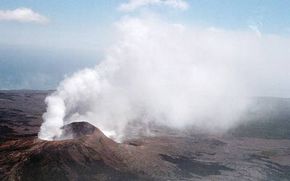
Gas vents from Kilauea Volcano in Hawaii
Photo courtesy USGS
Volcanoes vary a great deal in their destructive power. Some volcanoes explode violently, destroying everything in a mile radius within minutes, while other volcanoes seep out lava so slowly that you can safely walk all around them. The severity of the eruption depends mostly on the composition of the magma.
The first question to address is: why does the magma erupt at all? The erupting force generally comes from internal gas pressure. The material that forms magma contains a lot of dissolved gases -- gases that have been suspended in the magma solution. The gases are kept in this dissolved state as long as the confining pressure of the surrounding rock is greater than the vapor pressure of the gas. When this balance shifts and vapor pressure becomes greater than the confining pressure, the dissolved gas is allowed to expand, and forms small gas bubbles, called vesicles, in the magma. This happens if one of two things occurs:
Advertisement
The confining pressure decreases, due to decompression from the magma rising from a higher pressure point to a lower pressure point.
The vapor pressure increases because the magma cools, initiating a crystallization process that enriches the gas content of the magma.
In either case, what you get is magma filled with tiny gas bubbles, which have a much lower density than the surrounding magma, and so push out to escape. This is the same thing that happens when you open a bottle of soda, particularly after shaking it up. When you decompress the soda (by opening the bottle), the tiny gas bubbles push out and escape. If you shake the bottle up first, the bubbles are all mixed up in the soda so they push a lot of the soda out with them. This is true for volcanoes as well. As the bubbles escape, they push the magma out, causing a spewing eruption.
The nature of this eruption depends mainly on the gas content and the viscosity of the magma material. Viscosity is just the ability to resist flow -- essentially, it is the opposite of fluidity. If the magma has a high viscosity, meaning it resists flow very well, the gas bubbles will have a hard time escaping from the magma, and so will push more material up, causing a bigger eruption. If the magma has a lower viscosity, the gas bubbles will be able to escape from the magma more easily, so the lava won't erupt as violently.
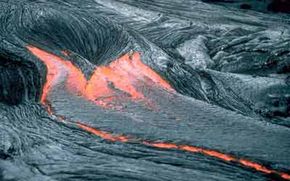
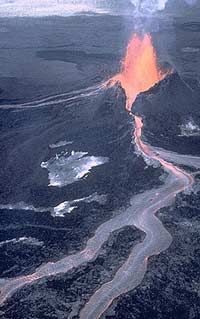
An effusive lava flow from Pu`u `O`o Cone on Kilauea Volcano in Hawaii.
Photo courtesy USGS
Of course, this is balanced with gas content -- if the magma contains more gas bubbles, it will erupt more violently, and if it contains less gas, it will erupt more calmly. Both factors are determined by the composition of the magma. Generally, viscosity is determined by the proportion of silicon in the magma, because of the metal's reaction to oxygen, an element found in most magmas. Gas content varies depending on what sort of material melted to form the magma.
As a general rule, the most explosive eruptions come from magmas that have high gas levels and high viscosity, while the most subdued eruptions come from magmas with low gas levels and low viscosity. Volcanic eruptions don't often fall into easy categories, however. Most eruptions occur in several stages, with varying degrees of destructiveness.
If the viscosity and the gas pressure are low enough, lava will flow slowly onto the earth's surface when the volcano erupts, with minimal explosion. While these effusive lava flows can reap considerable damage on wildlife and manmade structures, they are not particularly dangerous to people because they move so slowly -- you have plenty of time to get out of the way.
If there is a good deal of pressure, however, a volcano will begin its eruption with an explosive launch of material into the air. Typically, this eruption column is composed of hot gas, ash and pyroclastic rocks -- volcanic material in solid form. There are many sorts of explosive eruptions, varying significantly in size, shape and duration.
Advertisement
Types of Eruptions
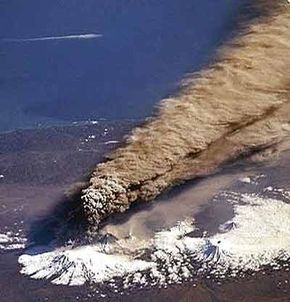
A tall Plinian plume erupts from Klyuchevskaya Volcano in Russia.
Photo courtesy NASA
Within these two broad eruption categories, there are several typical eruption varieties. The most common eruption types are:
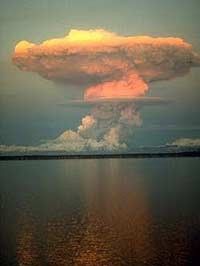
Plinian Eruptions: These awesome eruptions can inflict serious damage on nearby areas -- the eruption that buried Pompeii and Herculaneam was a Plinian eruption. They are initiated by magma with very high viscosity and gas content. The powerful upward thrust of the expanding gases propels pyroclastic material as high as 30 miles (48 km) in the air, at hundreds of feet per second. The eruption, which can last hours or even days, produces a towering, sustained eruption plume. This dumps a huge amount of tephra, fallen volcanic material, on surrounding areas (usually more to one side, depending on how the wind blows). Additionally, a Plinian eruption can produce extremely fast moving lava flows that destroy everything in their path.
Advertisement
Hawaiian Eruptions: Generally, these eruptions are not very destructive or explosive. They don't thrust much pyroclastic material into the air, producing instead a relatively sluggish flow of low-viscosity, low-gas-content lava. This flow can take a couple of different forms. The most impressive display is the fire fountain, a fountain of bright orange lava pouring hundreds of feet in the air, for a few minutes or sometimes several hours. The more typical eruption style is a steady lava flow from a central vent, which can produce wide lava lakes, ponds of lava forming in craters or other depressions. Lava flows and spatter from fire fountains can certainly destroy surrounding vegetation or trees, but the flow is usually slow enough that people have plenty of time to make it to safety. Hawaiian eruptions are so named because they are common to Hawaii's volcanoes.
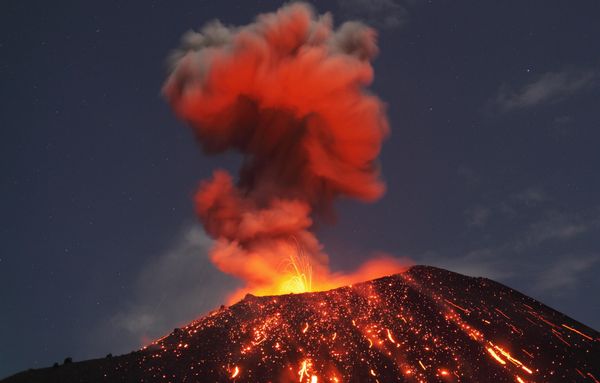
Strombolian Eruptions: These eruptions are fairly impressive but not particularly dangerous. They thrust small amounts of lava 50 to a few hundred feet (15 to 90 meters) in the air, in very short bursts. The lava has a fairly high viscosity, so gas pressure has to build to a high level before it will thrust the material upward. These regular explosions can produce impressive booming sounds, but the eruptions are relatively small. Strombolian eruptions generally don't produce lava flows, but some lava flow may follow the eruption. These eruptions produce a small amount of ashy tephra.
Advertisement
Other Types of Eruptions
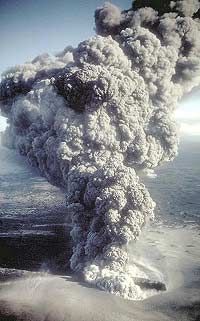
A hydrovolcanic eruption fromUkinrek Volcano, off the coastof Alaska.
Photo courtesy USGS
Vulcanian Eruptions: Like Strombolian eruptions, these eruptions are characterized by many short explosions. Vulcanian eruptive columns are typically larger than Strombolian columns, however; and they are mostly made up of ashy pyroclastic material. The explosions are initiated by high-viscosity, high-gas-content magma in which small amounts of gas pressure build up and thrust material into the air. In addition to ashy tephra, Vulcanian eruptions will also launch football-sized pyroclastic bombs into the air. Vulcanian eruptions generally aren't associated with lava flow.
Hydrovolcanic Eruptions: When volcanic eruptions occur near oceans, saturated clouds or other wet areas, the interaction of water and magma can create a unique sort of eruptive column. Basically, the hot magma heats the water so that it becomes steam. This rapid change of state causes an explosive type of expansion in the water, which breaks apart the pyroclastic material, creating a fine ash. Hydrovolcanic eruptions vary considerably. Some are characterized by short bursts, while others build sustained eruptive columns. Volcanic eruptions can also melt large amounts of snow, causing mudslides and major flooding.
Advertisement
Fissure Eruptions: Not all eruptions start with an explosion caused by gas pressure. Fissure eruptions occur when magma flows up through cracks in the ground and leaks out onto the surface. These often occur where plate movement has caused large fractures in the earth's crust, and may also spring up around the base of a volcano with a central vent. Fissure eruptions are characterized by a curtain of fire, a curtain of lava spewing out to a small height above the ground. Fissure eruptions can produce very heavy flows, though the lava is generally slow moving.
These different eruption types build different sorts of volcanoes around them. In the next section, we'll look at the most common types of volcanoes and see how they're formed.
Most land volcanoes have the same basic structure, but volcano shape and size varies considerably. There are several elements that these different volcano types have in common are:
a summit crater - the mouth of the volcano, where the lava exists
a magma chamber - where the lava wells up underground
a central vent - leads from the magma chamber to the summit crater.
The biggest variation in volcano structure is the edifice, the structure surrounding the central vent. The edifice is built up by the volcanic material spewed out when the volcano erupts. Consequently, its composition, shape and structure are all determined by the nature of the volcanic material and the nature of the eruption. The three main volcano shapes are:
Advertisement
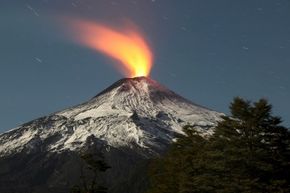
Stratovolcanoes: These are the most familiar type of volcanoes, and generally have the most destructive history of eruptions. They are characterized by a fairly symmetrical mountain edifice, which curves steeply near the relatively small summit crater at the top. They are usually built by Plinian eruptions that launch a great deal of pyroclastic material. As the lava, ash and other material spews out, it rapidly builds the edifice around the vent. Stratovolcanoes tend to have highly infrequent eruptions -- hundreds of years apart -- and typically form in subduction zones.
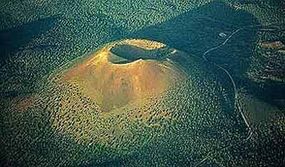
Sunset Crater, a scoria cone volcano in Arizona
Photo courtesy USGS
Scoria cone volcanoes: These relatively small cones are the most common volcano type. They are characterized by steep slopes on both sides of the edifice, which lead up to a very wide summit crater. This edifice is composed of ashy tephra, usually spewed out by Strombolian eruptions. Unlike stratovolcanoes, many Scoria cone volcanoes have only one eruption event.
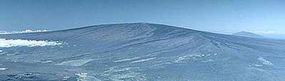
Mauna Loa, a shield volcano in Hawaii.
Photo courtesy USGS
Shield volcanoes: These wide, relatively short volcanoes occur when low-viscosity lava flows out with minimal explosiveness, such as in Hawaiian eruptions. The lava disperses out over a wide surface area -- sometimes hundreds of kilometers -- building up a shield-shaped dome. Near the summit, the edifice gets a little steeper, giving the volcano a slightly raised center. Many shield volcanoes erupt with great frequency (every few years or so).
Advertisement
Eruption Frequency
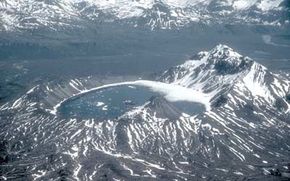
The caldera at Kaguyak Volcano, in Alaska, is about 1.5 miles (2.5 km) in diameter.
Photo courtesy USGS
Volcanic activity can also produce other interesting structures, such as calderas and lava domes. Calderas, large crater-shaped basins, form when eruptions drain a magma chamber and the volcano edifice collapses into the empty space. These often fill up with water, creating round lakes, such as Crater Lake in Oregon. Lava domes form when most of the gas vesicles escape during an initial eruption, and the remaining viscous lava lacks the necessary pressure to spew out and so it flows out very slowly at the summit crater. This creates a domed plug at the top of the volcano, which may continue to grow over time.
There are a startling number of volcanoes on earth -- more than 500 "active" volcanoes in the world, about as many "dormant" volcanoes, and many volcanoes that have been deemed "extinct." As it turns out, these determinations are largely based on subjective interpretation or somewhat arbitrary standards. The traditional criteria for this determination was the date of the last eruption. If the last eruption fell within historic times -- the period people have been recording history -- the volcano was deemed active. If the last eruption occurred before historic times but within 10,000 years, the volcano was considered "dormant" because it likely had the potential to erupt again. Volcanoes that had not erupted in more than 10,000 years were considered extinct, because it seemed unlikely they would erupt again.
Advertisement
A 1990 eruption of Redoubt Volcano in Alaska.
Photo courtesy USGS
This is certainly an inexact standard. For one thing, "historic times" is fairly vague, and varies from culture to culture. Additionally, different volcano types have widely varying eruption frequencies. Scientists generally use a more sensible criteria these days, though it's based mostly on subjective assessment. If the volcano is erupting or demonstrating activity in the form of earthquakes or gaseous emissions, it is considered active. If the volcano is not showing any signs of activity, but has erupted within the last 10,000 years and has the potential to erupt again, it is considered dormant. If it has not erupted in 10,000 years or has clearly exhausted any magma supply, the volcano is considered extinct.
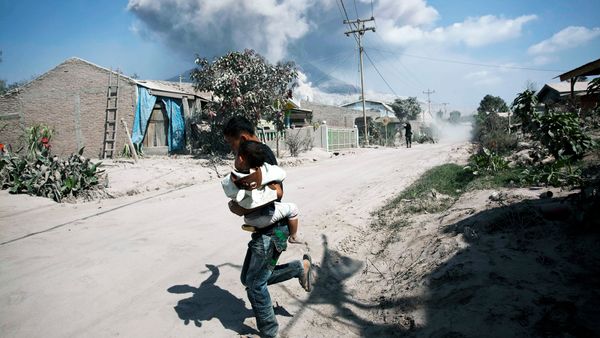
Of the 500 or so active volcanoes, around 10 are erupting on any given day. For the most part, these eruptions are small and well-contained, so they don't threaten life and limb. From time to time, however, we get a major eruption that either takes lives or, more often, devours property. And while not as catastrophic as life-threatening eruptions, these destructive events can certainly take a heavy financial toll on the victims.
There have been, in recorded history, dozens of extremely catastrophic volcanic eruptions -- one may even have wiped out an entire civilization. In fact, in just the last 200 years there have been 19 eruptions that have killed more than 1,000 people. Volcanic activity has certainly played a significant and destructive role in our history, and will continue to do so in the future.
This is only half the story, however. As destructive as it is, volcanic activity is one of the most important, constructive geological processes on Earth. After all, as we saw when we looked at plate tectonics, volcanoes are constantly rebuilding the ocean floor. As with most natural forces, volcanoes have a dual nature. They can wreak horrible devastation, but they are also a crucial element of the earth's ongoing regeneration. They are certainly one of the most amazing, awe-inspiring phenomena on the planet.