Biomimicry, as an innovating process, generally comes from one of two directions. Sometimes, the innovator sees a process in nature and connects it to an existing technology or problem. Other times, the innovator studies an existing design problem and turns to nature for help. This is where biomimicry serves as a bridge between biology and engineering.
The first step of solving a problem through biomimicry is to translate what you need out of a design into biological terms. For instance, what if you wanted to design a fire extinguisher with a longer range? Where in nature have organisms evolved to deal with a similar problem? Bombardier beetles might not deal with quenching a flaming stovetop, but they have evolved to squirt a heated, explosive stream of venom at predators.
Once discovered, the next challenge is to take the lesson from nature and apply it back to your design. In the case of the bombardier beetle, researchers studied the insect's use of a high-pressure "combustion chamber" in its abdomen. Designers have begun applying this discovery to existing spray technology.
You can find biomimicry in a number of different fields. Whatever the design challenge, there's a good chance a species on Earth has tackled a similar problem already. Consider these examples:
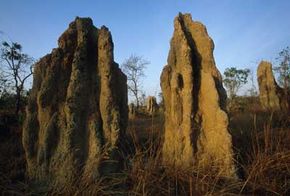
Example of Biomimicry — Cool Air and Energy-Efficient Structures
Human need: Builders want a cheaper means of cooling large buildings.
Nature's example: Certain African termite mounds must maintain a constant temperature of 87 degrees Celsius (189 degrees Fahrenheit) in order for the fungus crop to survive. To achieve this, they construct air vents that constantly move air throughout the mound, cooling or heating it to the same temperature as the mound itself.
Biomimetic solution: Architects and engineers are building several large office complexes that mimic the termite approach to temperature control.
Example of Biomimicry — Anti-Collision Insects
Human need: Auto manufacturers want to develop an anti-collision system.
Nature's example: Locusts avoid running into each other in swarms by using highly evolved eyes that allow these insects to see in several directions simultaneously.
Biomimetic solution: Automobile designers mimicked the locusts' vision when developing sensors that detect movement directly surrounding a car and warn drivers of impending crashes.
Example of Biomimicry — Lotus-Flower Inspired Paint
Human need: Chemical companies want a self-cleaning coat of paint.
Nature's example: Lotus plants must keep the surfaces of their leaves clean, despite living in muddy ponds and swamps. The leaves' tiny ridges and bumps keep water molecules and other particles from spreading across the surface. As a result, the water beads and slides away, carrying particles of dirt with it.
Biomimetic solution: Developers have applied this lotus effect to paint. When the paint dries, tiny bumps remain on the surface that help water droplets remove dirt.
Example of Biomimicry — Preserving Vaccines With Dehydration
Human need: Health workers want a way to store vaccines without refrigeration.
Nature's example: The African resurrection plant completely dries out during yearly droughts and then revives itself when the rains returns. The plants contain a polyphenol that protects against cell membrane damage during dehydration.
Biomimetic solution: Researchers are seeking a way to use these sugars to preserve living vaccines through dehydration.
All over the world, researchers are looking to nature for answers to their various design challenges. By studying how evolution overcomes challenges, biomimicry may one day help us solve problems ranging from soap scum to global sustainability issues.
This article was updated in conjunction with AI technology, then fact-checked and edited by a HowStuffWorks editor.