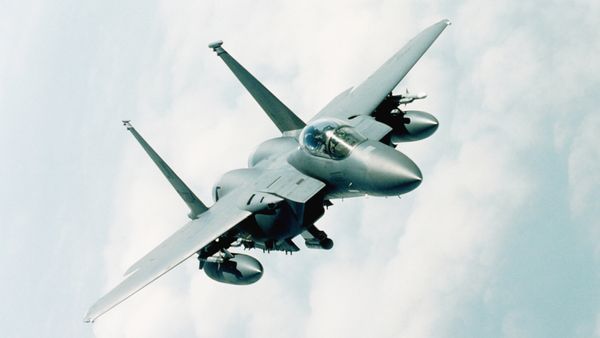
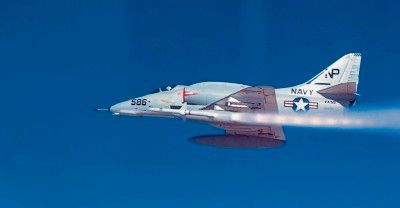
An F-18 Hornet is something like a power drill. If you have the right attachments, a power drill can act as an electric screwdriver, a sander, a drill of various sizes and many other tools. The basic idea behind the F-18 is to have a plane the military can reconfigure for different types of missions. By adjusting it and outfitting it with different components, you can specialize the aircraft for the task at hand.
As you might imagine, this adaptability makes the F-18 an invaluable addition to the U.S. arsenal. It makes it much easier for the Navy and Marine Corps to accomplish air superiority -- dominance in the air to the point that the enemy cannot mount a significant air attack.
Advertisement
In this article, we'll check out these remarkable machines, from cockpit to body to weaponry.
Take the Quiz
Think you're an aviation expert? Read about the world's best pilots on the American Heroes Channel:
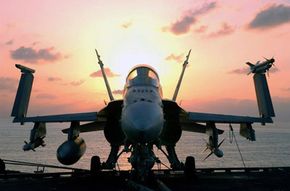
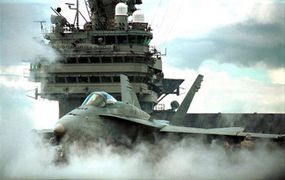
An F/A-18 sits on the flight deck of an aircraft carrier in the Persian Gulf.
Photo courtesy U.S. Department of Defense
The F-18 is designed to function as two different types of aircraft. It is both:
A fighter jet, a plane designed to battle enemy aircraft. Fighters need to be very fast, relatively lightweight and highly maneuverable, so they can keep up with any enemy aircraft and evade counter-attack. They carry air-to-air weapons, like heat-seeking sidewinder missiles.
An attack jet, a plane designed to take out ground targets. Attack jets fly in low and destroy individual targets, such as tanks, rather than the larger area targets a bomber might take out from a high elevation. Attack jets tend to be bulkier than fighter jets, because of the various bombs they need to carry.
The F-18 is the first plane in the U.S. arsenal designed specifically to fill both of these roles.
Advertisement
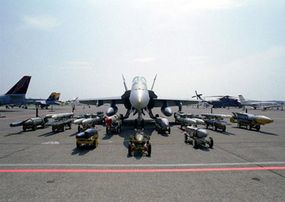
The central innovation that makes this possible is a collection of stations -- storage areas on the belly and wings of the plane that can carry everything from extra fuel tanks to a tactical nuclear bomb. By loading these stations with different components -- for example, air-to-ground GPS-guided bombs as opposed to air-to-air heat-seeking missiles -- the F-18 in effect becomes different planes.
The other major secret to the F-18's adaptability is its high performance standards. As we'll see in the next section, its impressive engineering makes it a much better all-around player than most other aircraft.
F/A-18 Variations
The F/A-18 was introduced in 1983. There are several variations available:
F/A-18A - A reliable single seat strike fighter.
F/A-18B - The two seat version of the 'A' allowing for a weapons systems officer.
F/A-18C - This version is specialized for night strikes.
F/A-18D - The two seat night striker
F/A-18E - The Super Hornet: The ultimate fighter/bomber
F/A-18F - The Super Hornet: The two seat fighter/bomber
Advertisement
Under the Hood
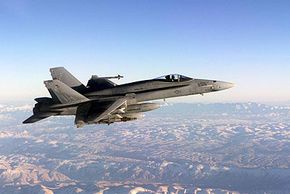
The F/A-18 can reach a speed of Mach 1.7 and fly up to 36,089 feet.
Photo courtesy U.S. Department of Defense
Hornets at heart are like any other jet plane. They use powerful turbine engines to create thrust and two broad wings to create lift. Rear fins stabilize the plane while rudders allow it to turn. The pilot uses an air brake to slow the plane down.
Specifically, the Hornet sports two F414-GE-400 afterburning turbofan engines capable of 22,000 pounds (9,977 kg) of static thrust each. The F/A-18 can reach a speed of Mach 1.7 (563 meters per second) and fly as high as 36,089 feet (11,000 meters).
Advertisement
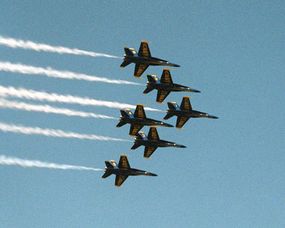
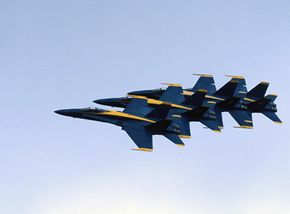
The Blue Angels streak by at an air show.
Photo courtesy U.S. Department of Defense
The engine afterburners provide powerful thrust quickly to help the F/A-18 attack and escape quickly. The afterburner injects fuel into jet exhaust, igniting it. The resulting combustion adds a considerable boost to the speed of the jet.
Advertisement
Inside the Cockpit
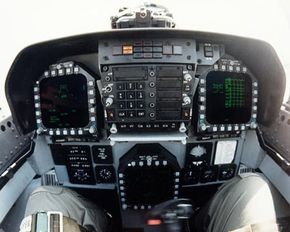
The Hornets computers are designed to be very user-friendly. They assist aviators by handling a lot of the F/A-18’s needs freeing up the pilot to concentrate on his mission.
Photo courtesy U.S. Department of Defense
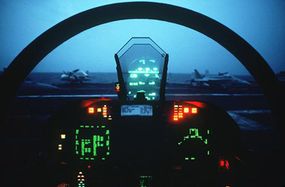
The cockpit of the F/A-18 is loaded with advanced gadgetry. This equipment, together with the avionics software, provides the pilot with everything he needs to stay on top of things in even the hairiest situation. The interface for these features is laid out intuitively, allowing for the easiest operation possible. Some of these features include:
Special cockpit lighting for use with night vision
Digital color moving map
Independent multipurpose color display
The NAVFLIR or "Navigation Forward Looking Infrared" is a set of sensors that give the pilot a complete grasp of everything that is going on around him in the midst of a mission.
Advertisement
A SAR or synthetic aperture ground mapping radar uses a Doppler beam to provide the pilot with a real-time rendered map of what's going on below him. The pilot uses this system to stay aware of threats on the ground -- even if they are obscured by smoke or bad weather. This system also improves accuracy on bombing runs. In the event that he has to do some speedy maneuvering to avoid enemy fire, the pilot can make quick adjustments to his position on approach relative to the target.
When it was developed in 1976, the F/A-18 hornet became the first "digital" combat fighter.
Photo courtesy U.S. Department of Defense
The Hughes ATFLIR or Advanced Targeting Forward-Looking Infra-Red pod is used for navigation and targeting. Hornets use a laser target designator or ranger to deliver laser-guided bombs. The ATFLIR works seamlessly with all of the F/A-18's weapons systems to make target acquisition and destruction as easy as possible.
The Raster heads-up display puts all of these elements, as well as many other specific-to-flight conditions, together in one easy place for the pilot to see.
The F-18 cockpit puts all the control of this powerful war machine at the pilot’s finger tips.
Photo courtesy U.S. Department of Defense
The F/A-18 is the first aircraft to incorporate a digital MUX bus architecture for the entire flight system. This architecture allows the computer controlling the aircraft to transfer data between systems quickly and more efficiently. As a result the F/A-18 can support the most advanced avionics software suite currently available.
This software, known as the digital control-by-wire flight control system, acts as a digital co-pilot in the Hornet. The advantages of this system are excellent computer-assisted handling qualities and maneuverability. This makes it easier for the pilot to concentrate on operating the weapons system during a mission.
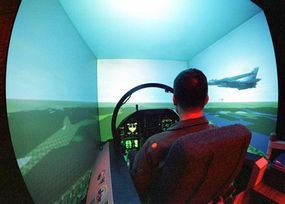
A Naval Aviator trains on an F/A-18 Flight Simulator. The F/A-18 is known for being relatively easy to learn to fly.
Photo courtesy U.S. Department of Defense
The Hornet is famous among fighter pilots for its ability to remain evasive while still acquiring targets. It is also known for being relatively easy to learn to fly. This is all thanks to its advanced electronics. As an added bonus, upgrading a Hornet computer system is easy and inexpensive.
Advertisement
Weapons
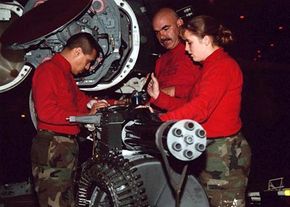
Technicians work on an M61 Vulcan Cannon.
Photo courtesy U.S. Department of Defense
One of the most powerful features of the F/A-18 is that it can carry many different types of ordnance into battle. This guide explains the weaponry possibilities.
For more information, click on each piece of ordnance.
In addition to all of this ordnance, the Hornet can defend itself with the powerful M61A2 Vulcan -- a 20 mm, 6-barrel rotary cannon.
Mounted inside the nose of the craft, the M61A2 is a hydraulically driven, electrically fired, rotary action cannon. Operators can select between two rates of fire: 4000 or 6000 rounds per minute. The Vulcan has an air cooling system that prevents the barrel from melting as it spews out hot lead. The gun fires 20mm linkless M-50 or PGU series electrically-primed rounds and is used to fire on enemy aircraft and ground targets.
A Hornet waits to be loaded with ordnance.
Photo courtesy U.S. Department of Defense
Advertisement
The Super Hornet
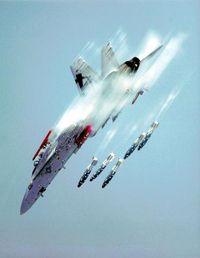
A Super Hornet attacks.
Photo courtesy U.S. Department of Defense
The Hornet comes in six models designated by letters A through F. The most formidable of these models is the newest design: the F/A-18E/F Super Hornet. Model E takes a single pilot while the F has a second seat for a weapons system officer. The Super Hornet is a multi-mission strike fighter like the regular Hornet, but it comes equipped with some pretty impressive upgrades (with half as many parts):
4.2 feet (1.3 meters) longer than earlier Hornets
25 percent larger wing area
33 percent more internal fuel
35 percent higher thrust supplied by F414-GE-400 Engines
41 percent greater mission range
50 percent more endurance
Two additional weapon stations for carrying additional ordnance
Increased flexibility to mix air-to-air and/or air-to-ground ordnance
Complete complement of "smart" weapons such as Joint Direct Attack Munition (JDAM) and Joint Stand-off Weaponry (JSOW)
Increased load capacity: 17,750 pounds (8,032 kg) of external load
Two additional wing tip stations
Four inboard wing stations for carrying extra fuel tanks or air-to-ground weapons
Two nacelle fuselage stations for carrying sensor pods
All-weather, air-to-air radar and a control system for accurate delivery of conventional or guided weapons
One centerline station for carrying extra fuel or air-to-ground weapons
Cockpit upgrades: a touch-sensitive, up-front control display; a larger, liquid crystal multipurpose color display; and a new engine fuel display
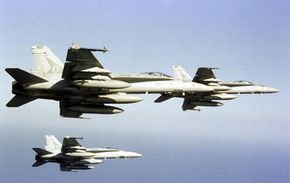
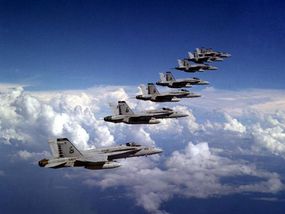
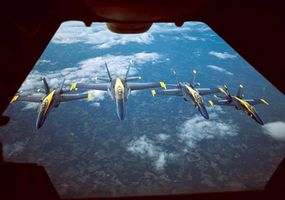
Super Hornets in formation
Photo courtesy U.S. Department of Defense
Advertisement
Hornet Origins
A Hornet pilot waits for take off.
Photo courtesy U.S. Department of Defense
In the late 1970's, Congress gave the Navy permission to develop a new kind of combat fighter that incorporated the latest technology available. To keep the budget in check, Congress set the limitation that the new craft had to be based on the design of either the F-16 or F-17.
The problem was that those craft were designed to take off from airstrips. A combat fighter designed for the Navy needs to be able to be deployed from aircraft carriers. To meet the challenge, several competing defense contractors had to team up to create this new craft.
Advertisement
In 1976 one design beat out all others and was officially designated the F/A-18. By 1983 the F/A-18 had been fully integrated into the Navy's air power.
Boeing, McDonnell Douglas Aerospace and Northrop Grumman worked together to create the Hornet's airframe (the body frame of the plane including the flight control surfaces, fuselage, wings and so on). General Electric (the company responsible for everything from light bulbs to dishwashers) designed the engines. Communications contractor Hughes provided the radar equipment.
International Workhorse
The Hornet is the air strike workhorse for seven other countries besides the United States:
Australia
Canada
Finland
Kuwait
Malaysia
Spain
Switzerland
Advertisement
Hornets in Action
The Blue Angels
Photo courtesy U.S. Department of Defense
Hornets had been in service for almost eight years by the time Operation Desert Storm began. On Jan 17, 1991 (local time), the air war started in Iraq, and the Hornets were given a trial by fire.
Two F/A-18s, each outfitted with four 2,000-pound bombs, left their air base on a conventional bombing run to take out enemy air defenses. Shortly into the mission they were intercepted and attacked by two Iraqi MiG fighter jets. Despite enemy interference, the two Hornets shot down the two MiG jets and then proceeded to bomb their target, completing the mission.
Advertisement
The Hornets performance in Desert Storm broke all previously held records for a tactical aircraft in combat.
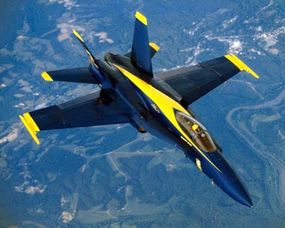
Today, there are 37 tactical squadrons of F/A-18 Hornets in operation all over the world. The U.S. Navy's Blue Angels Flight Demonstration Squadron features the F/A-18 as its showpiece.
The flexible design of the Hornet makes it one of the most upgradable aircraft in the military. It has specifically been designed with the room, cooling and weight capacity to accommodate future upgrades and equipment.
Photo courtesy U.S. Department of Defense
By 2010 the Navy intends to retire the EA-6B Prowler with the F/A-18G Growler. The 'G' is a new variation on the Super Hornet modified for use in escort and jamming. The Growler will add punch to the traditional escort/jammer design by being able to defend itself better than any other plane previously used for this type of mission. The F/A-18G will fly radar-jamming missions alongside unmanned air vehicles such as the Predator or Global Hawk.
Photo courtesy U.S. Department of Defense
With its impeccable service record, reliability, flexibility and combat effectiveness it is safe to say that the F/A-18 will be in service for years to come.
For more information about the F/A-18 and related topics, check out the links on the next page.