Landmine Basics

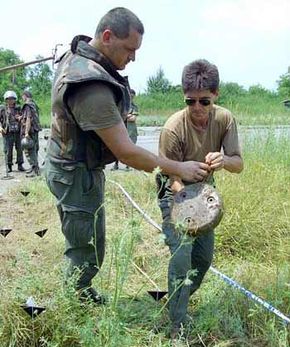
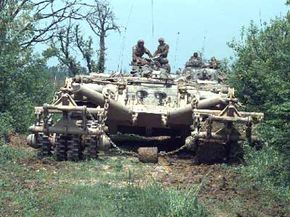
Landmines are easy-to-make, cheap and effective weapons that can be deployed easily over large areas to prevent enemy movements. Mines are typically placed in the ground by hand, but there are also mechanical minelayers that can plow the earth and drop and bury mines at specific intervals.


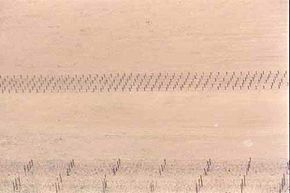
Photo courtesy United Nations
Landmines create the dotted lines through this desert scene.

Mines are often laid in groups, called mine fields, and are designed to prevent the enemy from passing through a certain area, or sometimes to force an enemy through a particular area. An army also will use landmines to slow an enemy until reinforcements can arrive. While more than 350 varieties of mines exist, they can be broken into two categories:

  • Anti-personnel (AP) mines
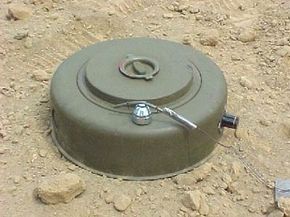
  • Anti-tank (AT) mines

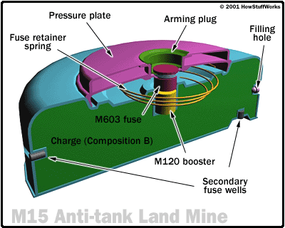
The basic function of both of these types of landmines is the same, but there are a couple of key differences between them. Anti-tank mines are typically larger and contain several times more explosive material than anti-personnel mines. There is enough explosive in an anti-tank mine to destroy a tank or truck, as well as kill people in or around the vehicle. Additionally, more pressure is usually required for an anti-tank mine to detonate. Most of these mines are found on roads, bridges and large clearances where tanks may travel.

Landmine Terms
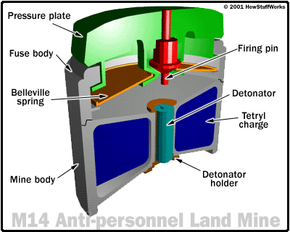
  • Belleville spring - A piece of curved steel shaped like a doughnut, used to cushion heavy loads
  • Black powder - A gunpowder used as an explosive, typically made of potassium nitrate or sodium nitrate, charcoal and sulfur
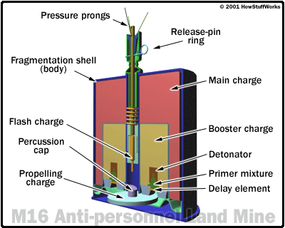
  • Delay element - A chemical compound that burns for a set time before igniting a fuse or explosive
  • Detonator - A small amount of explosive used to ignite larger amounts of explosive
  • Firing pin - The metal pin that is forced down into the detonator when the mine is activated
  • Fuse - A combustible material used to ignite an explosive charge
  • Igniter - A metal rod (in bounding mines) that protrudes from the ground, triggering the mine when it's stepped on; also called the striker
  • Magnetic mine - A mine equipped with magnets, triggered by large metal objects entering its immediate area
  • Main charge - The large of amount of explosive in the mine that causes it to explode
  • Percussion cap - A chemical compound detonated by striking or applying pressure to it
  • Pressure plate - The metal disc on top of the mine that depresses and triggers the mine when stepped on
  • Projectiles - Metal balls or glass fragments placed in the mine to cause greater injuries to victims (The mine's metal casing can also become projectiles after the mine explodes.)
  • Propelling charge - A small amount of explosive placed at the bottom of a bounding mine to propel it into the air
  • Safety pin/clip - A pin placed in the mine to prevent it from being activated while not in use

In the next two sections, you will get a closer look at a few landmines and the parts that make them work.