
Making Colors
Visible light is light that the human eye can perceive. When you look at the sun's visible light, it appears to be colorless, which we call white. Although we can see this light, white isn't considered part of the visible spectrum. That's because white light isn't the light of a single color but instead many colors.
When sunlight passes through a glass of water to land on a wall, we see a rainbow on the wall. This wouldn't happen unless white light were a mixture of all of the colors of the visible spectrum. Isaac Newton was the first person to demonstrate this. Newton passed sunlight through a glass prism to separate the colors into a rainbow spectrum. He then passed sunlight through a second glass prism and combined the two rainbows. The combination produced white light. His simple experiment proved conclusively that white light is a mixture of colors.
Advertisement
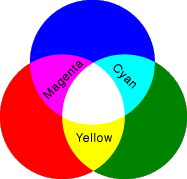
You can do a similar experiment with three flashlights and three different colors of cellophane -- red, green and blue (commonly referred to as RGB). Cover one flashlight with one to two layers of red cellophane and fasten the cellophane with a rubber band (don't use too many layers or you'll block the light from the flashlight). Cover another flashlight with blue cellophane and a third flashlight with green cellophane. Go into a darkened room, turn the flashlights on and shine them against a wall so that the beams overlap, as shown in the figure. Where red and blue light overlap, you will see magenta. Where red and green light overlap, you will see yellow. Where green and blue light overlap, you will see cyan. You will notice that white light can be made by various combinations, such as yellow with blue, magenta with green, cyan with red, and by mixing all of the colors together.
By adding various combinations of these so-called additive colors -- red, green and blue light -- you can make all the colors of the visible spectrum. This is how computer monitors (RGB monitors) generate colors.