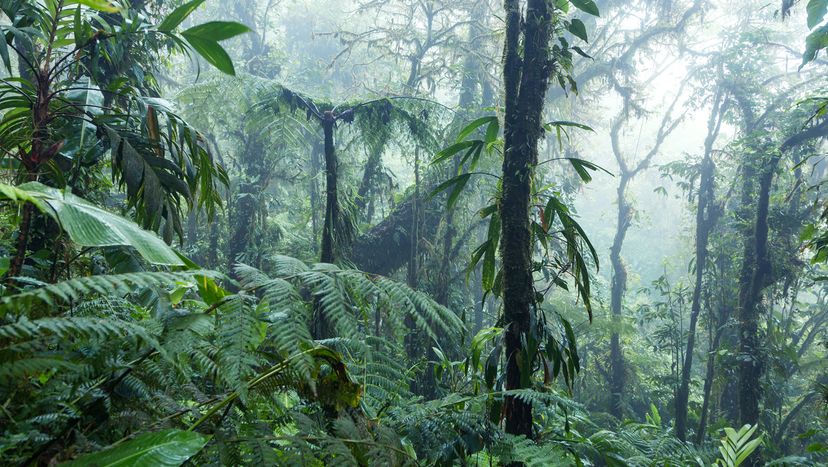
Monteverde, a cloud forest in Costa Rica, exemplifies the typical qualities of a rainforest: receives high rainfall, dominated by tall trees and located near the equator. Matteo Colombo / Getty Images
Tropical rainforests are the most diverse ecosystems on Earth, and also the oldest. Today, tropical rainforests cover only 6 percent of the Earth's ground surface, but they are home to over half of the planet's plant and animal species.
In this article, we'll travel into the tropical rainforest to see what makes it such a bountiful environment for plants and animals and the thousands of species we have yet to discover. We'll also see why the rainforests are in danger and look at some of the ways this affects us.
A rainforest is an environment that receives high rainfall and is dominated by tall trees. A wide range of ecosystems around the world fall into this category, of course, including the old-growth temperate forests of the Pacific Northwest.
But most of the time when people talk about rainforests, they mean the tropical rainforests located near the equator.
Advertisement
Weather and Seasons
These forests, concentrated in Africa, Australia, Asia and Central and South America, receive between 160 and 400 inches (406.4 to 1,016 cm) of rain per year. Unlike the rainforests farther to the north and south, tropical rainforests don't really have a "dry season."
In fact, they don't have distinct seasons at all. The total annual rainfall is spread pretty evenly throughout the year, and the temperature rarely dips below 60 degrees Fahrenheit (16 degrees Celsius).
This steady climate is due to the position of rainforests on the globe. Because of the orientation of the Earth's axis, the Northern and Southern hemispheres each spend part of the year tilted away from the sun.
Since rainforests are at the middle of the globe, located near the equator, they are not especially affected by this change. They receive nearly the same amount of sunlight, and therefore heat, all year. Consequently, the weather in these regions remains fairly constant.
Layers of Greenery
The consistently wet, warm weather and ample sunlight give plant life everything it needs to thrive. Trees have the resources to grow to tremendous heights, and they live for hundreds, even thousands, of years. These giants, which reach 60 to 150 ft (18 to 46 m) in the air, form the basic structure of the rainforest.
Their top branches spread wide in order to capture maximum sunlight. This creates a thick canopy level at the top of the forest, with thinner greenery levels underneath. Some large trees, called emergents, grow so tall (up to 250 ft / 76 m) that they even tower over the canopy layer.
As you go lower, down into the rainforest, you find less and less greenery. The forest floor is made up of moss, fungi, and decaying plant matter that has fallen from the upper layers.
The reason for this decrease in greenery is very simple: The overabundance of plants gathering sunlight at the top of the forest blocks most sunlight from reaching the bottom of the forest.
The lowest levels of the rainforest are extremely dark, making it difficult for robust plants to thrive. As little as 1 percent of the light shining onto the forest reaches the lowest levels.
This makes for a fascinating biological community in which plant life strives to reach 100 ft (30.5 m) into the air, and most food for animals comes from above.
Advertisement
The Forest for the Trees
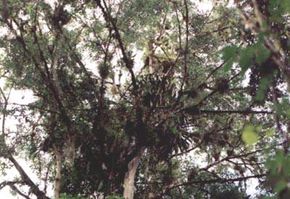
This tree has become covered in epiphytes. Note the vines and thick root balls that have formed in the branches.
Photo courtesy Todd Fearer
The ample sunlight and extremely wet climate of many tropical areas encourages the growth of towering trees with wide canopies. This thick top layer of the rainforest dictates the lives of all other plants in the forest.
New tree seedlings rarely survive to make it to the top unless some older trees die, creating a "hole" in the canopy. When this happens, all of the seedlings on the ground level compete intensely to reach the sunlight. Most other plants survive by taking advantage of the trees that form the canopy layer.
Advertisement
Many plant species reach the top of the forest by climbing the tall trees. It is much easier to ascend this way, because the plant doesn't have to form its own supporting structure.
Lianas — long, woody plants that can grow more than 8 inches (20 cm) across — will often climb tall trees all the way up to the canopy layer. At the top of the forest, these climbers may spread from tree to tree, making the canopy ceiling even thicker.
Some plant species, called epiphytes, grow directly on the surface of the giant trees. These plants, which include a variety of orchids and ferns, make up much of the understory, the layer of the rainforest right below the canopy.
Epiphytes are close enough to the top to receive adequate light, and the runoff from the canopy layer provides all the water and nutrients they need, which is important since they don't have access to the nutrients in the ground.
Forest Food
Roughly 80 percent of the food we eat originally came from tropical rainforests. Without rainforests, we wouldn't have the seeds that produce coffee and chocolate. Other rainforest foods include tomatoes, potatoes, rice, bananas, black pepper, pineapples and corn.
There are over 3,000 fruits found in rainforests. People in the Western world make use of about 200 of them, but the Indigenous tribes of the rainforest make use of over 2,000. Rainforest tribes also have a knowledge of rainforest medicine that far exceeds the Western world's.
One major problem with deforestation is the devastating effect it has on these tribes. As these cultures are lost, so is their extensive knowledge of the vast resources of the rainforest, whose wild plants are vital to our well being.
Advertisement
Stranglers and Buttresses
Photo courtesy Todd Fearer
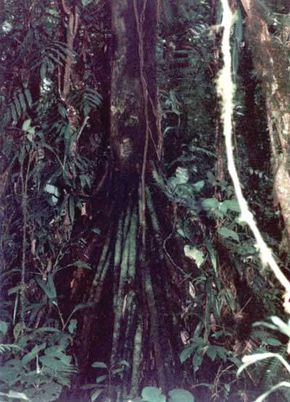
Many tropical trees have stilt roots to counter the shallow, loose soil of the tropics. Instead of the roots splitting off the trunk underground, stilt roots split several feet above ground, making the tree more stable, and allowing it to utilize the soil more efficiently.
Stranglers
Some epiphytes eventually develop into stranglers. They grow long, thick roots that extend down the tree trunk into the ground. As they continue to grow, the roots form a sort of web structure all around the tree.
Advertisement
At the same time, the strangler plant's branches extend upward, spreading out into the canopy. Eventually, the strangler may block so much light from above, and absorb such a high percentage of nutrients from the ground below, that the host tree dies.
When the host decomposes, the strangler's lattice of roots remains, giving the plant the structure it needs to reach from the forest floor to the canopy.
Buttresses
Competition over nutrients is almost as intense as competition for light. The excessive rainfall rapidly dissolves nutrients in the soil, making it relatively infertile except at the top layers.
For this reason, rainforest tree roots grow outward to cover a wider area, rather than downward to lower levels. This makes rainforest trees somewhat unstable, since they don't have very strong anchors in the ground.
Some trees compensate for this by growing natural buttresses. These buttresses are basically tree trunks that extend out from the side of the tree and down to the ground, giving the tree additional support.
Bacteria
Rainforest trees are dependent on bacteria that are continually producing nutrients in the ground. Rainforest bacteria and trees have a very close, symbiotic relationship. The trees provide the bacteria with food, in the form of fallen leaves and other material, and the bacteria break this material down into the nutrients that the trees need to survive.
Even with this amazing symbiotic cycle, nutrients are scarce. Some plant species gather additional nutrients by capturing bugs or catching plant material that falls from the canopy above.
One of the most remarkable things about rainforest plant life is its diversity. The temperate rainforests of the Pacific Northwest are mainly composed of a dozen or so tree species. A tropical rainforest, on the other hand, might have 300 distinct tree species.
This plant life is spread out over wide areas — in a square acre, an entire species might be represented by only a few individual plants.
Advertisement
All Creatures, Great and Small
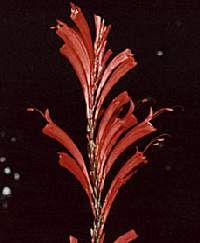
This flower has adapted to be pollinated by hummingbirds. The long, curved, tubular bloom is the perfect size and shape for the hummingbird's bill. The inside of the blossom holds nectar for the hummingbirds to drink. While drinking, the bird's head bumps against the flower's anther (stem protruding out of the blossom that holds the pollen), causing the hummingbird to transfer the pollen from the anther to the stigma and fertilize the flower.
Photo courtesy Todd Fearer
Rainforests are home to the majority of animal species in the world. And a great number of species who now live in other environments originally inhabited the rainforests. Researchers estimate that in a large rainforest area, there may be more than 10 million different animal species.
Most of these species have adapted for life in the upper levels of the rainforest, where food is most plentiful.
Advertisement
Insects
Insects, which can easily climb or fly from tree to tree, make up the largest group (ants are the most abundant animal in the rainforest). Insect species have a highly symbiotic relationship with the plant life in a rainforest.
The insects move from plant to plant, enjoying the wealth of food provided there. As they travel, the insects may pick up the plants' seeds, dropping them some distance away. This helps to disperse the population of the plant species over a larger area — underneath the canopy, the wind is not strong enough to carry seeds a significant distance, so plants depend entirely on animals for seed dispersal.
Less-harmful insects may also help a plant by fighting off more destructive insect species.
Birds
The numerous birds of the rainforest also play a major part in seed dispersal. When they eat fruit from a plant, the seeds pass through their digestive system. By the time they excrete the seeds, the birds may have flown many miles away from the fruit-bearing tree.
Most people are familiar with the colorful parrots of the tropical rainforests, but this is only one part of the total bird population. Rainforest bird species come in all shapes and sizes, from tiny hummingbirds to large toucans. Over 1/4 of all bird species in the world today live in tropical rainforests.
Reptiles and Mammals
There are also a large number of reptiles and mammals in the rainforest. Many of these species have remarkable adaptations for life in the trees.
Some animals have very thin webs of skin that let them glide from branch to branch. Many mammals, including a wide variety of monkeys, have developed prehensile tails. Essentially, the tail works like an extra hand to grasp hold of tree branches.
Obviously, this adaptation makes life much easier for animals who spend their lives in the trees. For example, a monkey might grab onto a branch with its tail so it can reach down to grab a piece of fruit that would otherwise be inaccessible.
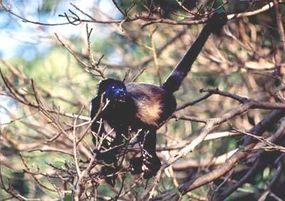
This Howler monkey can grab ahold of branches with its prehensile tail.
Photo courtesy Todd Fearer
Since the weather is so hot and humid during the day, most rainforest mammals are active only at night, dusk or dawn. The many rainforest bat species are especially well adapted for this lifestyle. Using their sonar, bats navigate easily through the mass of trees in the rainforest, feeding on insects and fruit.
While most rainforest species spend their lives in the trees, there is also a lot of life on the forest floor. Great apes, such as gorillas and orangutans, wild pigs, big cats and even elephants can all be found in rainforests.
Humans
There are a number of people who live in the rainforests, as well. These Indigenous tribes — which, up until recently, numbered in the thousands — are being forced out of the rainforests at an alarming rate because of deforestation.
Advertisement
Deforestation
In the past hundred years, humans have begun destroying rainforests at an alarming rate. Today, roughly 48 acres of rainforest are destroyed every minute. People cut down the rainforests in pursuit of three major resources:
In the current economy, people obviously have a need for all of these resources. But almost all experts agree that, over time, we will suffer much more from the destruction of the rainforests than we will benefit. There are several factors involved in this scientific assessment:
Advertisement
To begin with, the land in rainforest regions is not particularly suited for crops and livestock. Once the forest is cleared, it is even less so — without any decomposing plant life, the soil is so infertile that it is nearly useless for growing anything. Generally, when people clear-cut a forest, they can only use the land for a year or two before the nutrients from the original plants are depleted, leaving a huge, barren tract of land.
Cutting large sections of rainforest may be a good source of lumber right now, but in the long run it actually diminishes the world's lumber supply. Experts say that we should preserve most of the rainforests and harvest them only on a small scale. This way, we maintain a self-replenishing supply of lumber for the future.
Rainforests are often called the world's pharmacy, because their diverse plant and animal populations make up a vast collection of potential medicines (not to mention food sources). More than 25 percent of the medicines we use today come from plants originating in rainforests, and these plants make up only a tiny fraction of the total collection of rainforest species. Fewer than 1 percent of rainforest plants have been examined for their medicinal properties. It is entirely possible that our best shot at curing cancer, AIDS and many other debilitating diseases lies somewhere in the world's diminishing rainforests.
The world's rainforest are an extremely valuable natural resource, to be sure, but not for their lumber or their land. They are the main cradle of life on Earth, and they hold millions of unique life forms that we have yet to discover.
Destroying the rainforests is comparable to destroying an unknown planet — we have no idea what we're losing. If deforestation continues at its current rate, the world's tropical rainforests will be wiped out within 100 years.
The World's Lungs?
In the past, scientists often referred to tropical rainforests as the "lungs of the world" because of the large amount of oxygen they produce.
More recent evidence shows that rainforests don't have much of an effect on the world's oxygen supply. The decomposition of dead plant matter consumes roughly the same amount of oxygen that the living plants produce.
But rainforests do play a key role in the global ecosystem. Some experts are now calling them the "air conditioners to the world," because their dark depths absorb heat from the sun. Without the forest cover, these regions would reflect more heat into the atmosphere, warming the rest of the world.
Losing the rainforests may also have a profound effect on global wind and rainfall patterns, potentially causing droughts throughout the United States and other areas.
The act of deforestation itself affects the environment as a whole. Burning rainforest trees in Brazil releases 1.65 tons (1.5 metric tons) of carbon dioxide (a leading cause of global warming) each year.
Thank You
Special thanks to Todd Fearer for providing the photos for this article.
Advertisement
Frequently Answered Questions
What are the rainforests?
The rainforests are the Earth's oldest and most biodiverse ecosystems. They are home to an incredible variety of plants and animals, many of which are found nowhere else on the planet.