Astronaut Image Gallery

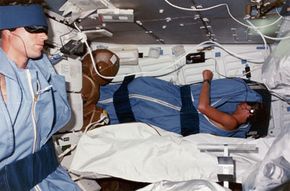
Pilot Michael L. Coats (left) and mission specialist Steven A. Hawley (right) fall asleep listening to music on the lower deck of the shuttle Discovery. What's it like for an astronaut to sleep in space? See more astronaut pictures.

Space Frontiers/Getty Images

What is it like to sleep in space?

When we settle into our beds at night, we usually experience a pleasant sense of unburdening. After a long day of walking, sitting and standing, letting gravity do the work and sinking into a soft mattress can be a relief. But thousands of miles above the Earth, where astronauts live and work in zero gravity aboard the International Space Station (ISS), going to sleep in space presents a much different situation.

Astronaut Image Gallery

Since November 2000, the ISS has never been empty, with at most three astronauts living onboard. (After its completion, as many as six astronauts will stay there.) They stay up there for many months at a time, and their daily routine is widely varied. For instance, on May 19, 2008, the crew woke up at 6:00 a.m., and at 6:40 had a lengthy breakfast. At 9:30 the astronauts had a short telephone interview with the editor of Russian magazine "Cosmos," which was quickly followed by nearly three hours of exercise. After a lunch of prepared space food, the crew completed several tasks in between more exercise and another phone conference. By 8:00 p.m. they'd managed to finish dinner and squeeze in a private talk with their families.

After a busy day of exercising, spacewalking and research, the least an astronaut could ask for is a good night's sleep. But even the idea of "night" changes onboard a space shuttle, when an orbiter zooms around the Earth several times a day. And with the effects of microgravity and weightlessness, even the quality of sleep in space is different from that on Earth.

What's it like for astronauts to sleep in space? Do they just float around without anything to hold them down, or are they attached to something? Is it difficult to sleep in space, or do the effects of low gravity actually make it easier? To learn how astronauts get their Z's in zero gravity, read the next page.

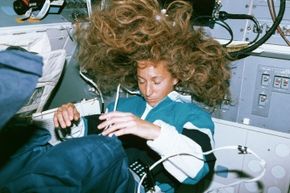
Astronaut Sally Ride, the first American woman in space, is shown zipped up in her sleep restraint during flight aboard the Space Shuttle Challenger II.

Time Life Pictures/NASA/Getty Images

How Astronauts Sleep in Space

Spacecraft like the International Space Station have pressurized cabins and are filled with the same kind of air we breathe on Earth, so the atmosphere onboard is made to feel as close to sea level as possible. But microgravity causes astronauts to experience the effects of weightlessness, so setting up a mattress on the floor isn't quite a part of the plan -- not only would the astronaut float away after dozing off, but the mattress would also drift off, creating the potential for midair collisions.

This means that astronauts can sleep practically anywhere in a spacecraft, as long as they tether themselves to something: the floor, the walls or the ceiling. While some astronauts, such as Canada's first astronaut Marc Garneau, prefer to sleep "free floating," which simply consists of curling up and going to sleep, most others use sleeping bags to mimic the way we sleep on Earth. A free floater would bounce around and flail his or her limbs around, so a sleeping bag keeps everything nice, cozy and normal.

Astronauts sleeping during space shuttle missions normally strap themselves into seats or attach sleeping bags to the walls, and they'll avoid the cockpit since light from the sun can cause the area to heat up significantly and make slumber uncomfortable. ISS astronauts, on the other hand, have personal sleeping compartments in the Russian Zvezda Service Module, the current living quarters for the crew. Tiny closets are set into the 43 foot (13.1 meter) long module, where astronauts hang a sleeping bag and keep a pillow, light source, air vent and any personal belongings like books or family photos with them. Pillows, of course, need to be strapped to astronauts' heads during sleep so they don't float away.

There are only two compartments on the Zvezda, so when three astronauts are onboard, someone has to stake out a personal space elsewhere throughout the ISS. For example, Susan Helms slept on the opposite side of the ISS in the U.S. Destiny Laboratory Module during her stay.

Adjusting to sleep in space takes a long time for astronauts. After thousands of years of evolution on Earth, our bodies and brains are used to circadian rhythms, the 24-hour cycle of waking and sleeping. To learn how astronauts adapt to sleeping in space and read about some of the difficulties they can experience, see the next page.

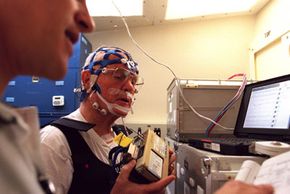
John Glenn tries on a harness meant to monitor body functions while sleeping in space.

Shelly Katz/Getty Images

The Difficulties of Sleeping in Space

The strange atmosphere of space can cause some problems for astronauts, and you can tell this by looking at the pills they take during their time spent in space -- almost half of the medication prescribed to astronauts is sleep aids and hypnotic medicines [source: Canadian Space Agency]. Most difficulties stem from the fact that living onboard a space station, despite the familiar atmosphere, can be very disorienting, even to astronauts who undergo months or even years of training.

For one, the International Space Station usually sees the sun "rise" once every 90 minutes -- that's about 16 sunsets every day. To counteract this, ISS administrators set astronauts' schedules on a 24-hour, Earth-based timetable to keep their activity as grounded as possible. The clocks onboard the ISS are set to Greenwich Mean Time (GMT), about halfway between Houston, Tex., and Moscow. To keep astronauts on that schedule, Mission Control sends wake-up calls to shuttle missions. They typically play music, which is either requested by an astronaut or an astronaut's family member. Astronauts on the ISS, on the other hand, wake up with the help of an alarm.

To avoid any distracting light and heat from the sun, astronauts will cover up any windows they're near. The personal sleeping compartments in the Zvezda module all have windows, so blocking out the sun is important. Astronauts can also choose to wear black sleep masks, the same kind that some people wear on Earth when they want to shut out distracting light. On top of excessive light, strange noises are a big part of the ISS. Because fans, air filters and other noisy equipment provide life support to the astronauts, the ISS is often filled with constant whirring noises. In fact, astronauts often compare the insides of the spacecraft to a giant vacuum. Astronauts sometimes sleep with earplugs to dampen the sound, but after a while they simply get used to it, much in the same way a person can adjust to living near a busy railroad track.

Despite taking sleeping pills, astronauts still get less sleep than they do on Earth. Although their schedules reflect an 8 to 8.5-hour period of sleep, they usually report receiving only 6 hours a night. On the plus side, some studies actually suggest that astronauts receive a better quality slumber -- the effects of microgravity can reduce sleep-disordered breathing like sleep apnea because air travels easier through upper airway passages in space.

It's also possible for astronauts to snore in space, and NASA has even recorded crewmembers doing so, but the effects of zero gravity also appear to reduce snoring [source: American Journal of Respiratory and Critical Care Medicine].

For lots more information on living in space, see the next page.

Lots More Information

Related HowStuffWorks Articles

More Great Links

Sources

  • Dinges, David. "Sleep in space: breathe easy -- sleep less?" American Journal of Respiratory and Critical Care Medicine. Philadelphia, Penn.: University of Pennsylvania, School of Medicine. Vol. 164, Num. 3, p. 337-338. August 2001. http://ajrccm.atsjournals.org/cgi/content/full/164/3/337
  • Halvorson, John. "Zvezda, the new crew quarters for the International Space Station will rank right up there with the penthouse at the Ritz." Space.com. July 5, 2000. http://www.space.com/news/spacestation/zvezda_life_000705.html
  • Petty, John. "Space sleep." National Aeronautics and Space Administration. Aug. 11, 2003. http://spaceflight.nasa.gov/living/spacesleep/index.html
  • "Astronauts: daily life." European Space Agency. July 19, 2004. http://www.esa.int/esaHS/ESAH1V0VMOC_astronauts_0.html
  • "Sleeping in space." Canadian Space Agency. Aug. 18, 2006. http://www.space.gc.ca/asc/eng/astronauts/living_sleeping.asp
  • "Zvezda Service Module." National Aeronautics and Space Administration. http://www.nasa.gov/mission_pages/station/structure/elements/sm.html