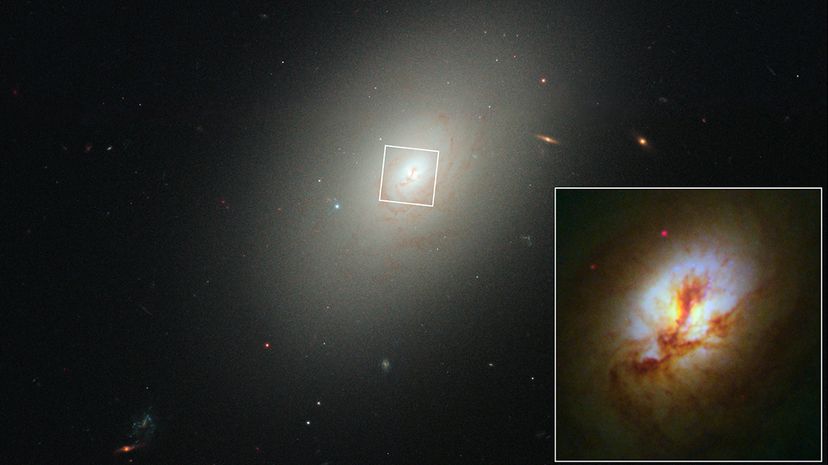
This image, taken with NASA's Hubble Space Telescope, shows fresh star birth in the ancient elliptical galaxy NGC 4150, located about 44 million light-years away from Earth. NASA and The Hubble Heritage Team
Astronomers have estimated that there are around 200 billion galaxies in the observable universe. But when we see other types of galaxies portrayed in science-fiction films, they tend to have the same basic shape as ours. This would be an example of our human-centered biases. Although many of them do resemble the Milky Way, others come in wildly different shapes and forms.
You've probably seen illustrations of our home galaxy hanging on the walls in countless science classrooms. But we bet you didn't know that those posters are proportionately thicker than a key component of the galaxy itself.
Advertisement
That's right. Like a fried egg, the Milky Way consists of a central bulge surrounded by a flat, thin disc. And when we say "thin," we mean mind-bogglingly thin. As physicist and Forbes correspondent Jillian Scudder points out, the "disc" of the Milky Way galaxy is around 100,000 light-years long but only about 0.6 light-years tall. This means that, proportionally, it's 30 times thinner than a typical sheet of printer paper.
But we're getting ahead of ourselves. Before we learn more about what makes the Milky Way unique, let's take a step back and talk about what all galaxies have in common.
Galaxies are complex systems held together by gravity. They're made up of gases, stellar dust and millions — sometimes even billions — of stars, which are accompanied by their own planets and asteroid belts.
Out of the more than 200 billion galaxies, many have a spiral shape (like the Milky Way). There are a few other galaxy types, including irregular galaxies, elliptical galaxies and lenticular galaxies. Dwarf galaxies, which are smaller and have fewer stars than spiral and elliptical galaxies, come in a variety of shapes and sizes.
Advertisement
How Galaxies Get Their Shapes
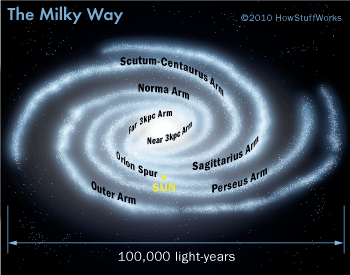
Every galaxy has a unique story to tell. The history of each one is evident in its shape. Scientists divide galaxies up into a handful of appearance-based categories. The Milky Way is what's known as a spiral galaxy, meaning that it looks like a broad, flattened disc with a slight bulge protruding outward at its center.
That arrangement is the product of rotation speed, time and gravity. To learn more, we talked to astrophysicist Raja GuhaThakurta, Ph.D., a professor at the University of California Santa Cruz and an authority on the study of how galaxies evolve. It's a field that invites a lot of debate.
Advertisement
"The physics of how these things form is not completely known or settled," GuhaThakurta says. Nonetheless, it's widely thought that most spiral galaxies begin their lives as spinning clouds of gas and dust. The speed at which they rotate matters a great deal. According to GuhaThakurta, massive, rapidly rotating clouds are more likely to become spiral galaxies.
Gravity attempts to pull these spinning, amorphous bodies into flattened planes. Over time, the clouds contract because of gravity and loss of energy due to friction. And due to a principle called the conservation of angular momentum, when a spinning object contracts, it rotates more rapidly.
You can see this in action at your local skating rink. Experienced ice skaters know to increase their twirl speed by drawing their arms inward.
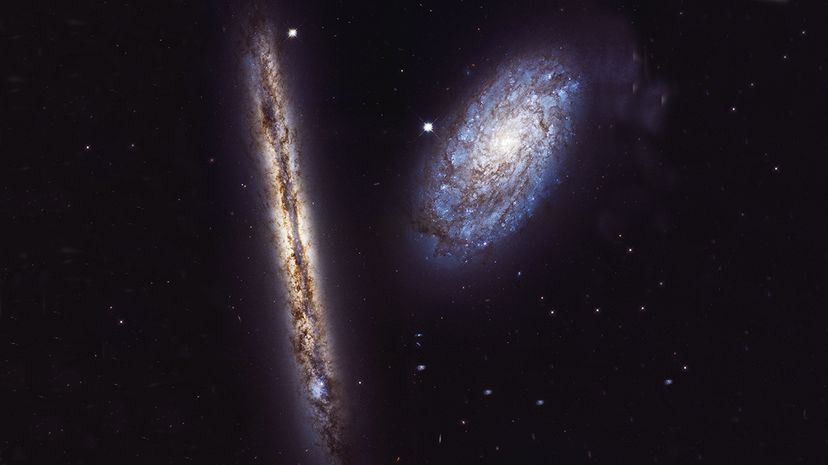
Galaxy NGC 4302n (left) and galaxy NGC 4298 (right) are examples of spiral galaxies like our Milky Way. They appear different in the image taken by Hubble Space Telescope on April 24, 1990 because they are angled at different positions on the sky.
NASA and The Hubble Heritage Team
So, much like a spinning blob of pizza dough, spiral galaxies form when shapeless gas/dust clouds flatten out at high speed. The same physical forces also affect the look of the pointed "arms" that can be seen around the rims of such galaxies.
"The types of spiral arms are almost certainly related to the rotation rate," GuhaThakurta says. Rapidly rotating systems tend to have a ring of small, tight arms. In contrast, those that move more slowly have longer, loosely wrapped ones.
To understand why, GuhaThakurta recommends trying a little home experiment: "Imagine stirring your coffee. Put a dollop of cream somewhere other than the center. You'll notice that the cream will form a spiral pattern," he says. Then, stir the brew with a spoon. If you do so rapidly, the pattern's arms will get smaller and tighter.
Advertisement
The Mystery of the Bulge
Okay, time for a quick recap. Thus far, we've talked about how spiral galaxies develop and how rotation shapes their arms. But what's the deal with those bulges we mentioned earlier? At the center of spiral galaxies, you'll find a cluster of very old stars revolving around a central point. This is the bulge.
While the stars out in the disc move around in an orderly, horizontal plane, the stars that comprise the bulge act like bees erratically swarming around a hive. Astronomers are still trying to figure out how these bulges form. Some speculate that they develop before the rest of a spiral galaxy does, while others think the reverse is true.
Advertisement
Now imagine a galaxy that's all bulge. This thing would be disc-free and either look like a giant, rounded sphere or a massive American football. Inside, its stars would orbit the galaxy's central point in all directions. Congratulations, you've just pictured an elliptical galaxy.
It's important to note that some galaxies are neither spirals nor ellipticals. So-called irregular galaxies lack bulges and can come in a wide variety of shapes.
Advertisement
Colliding Galaxies
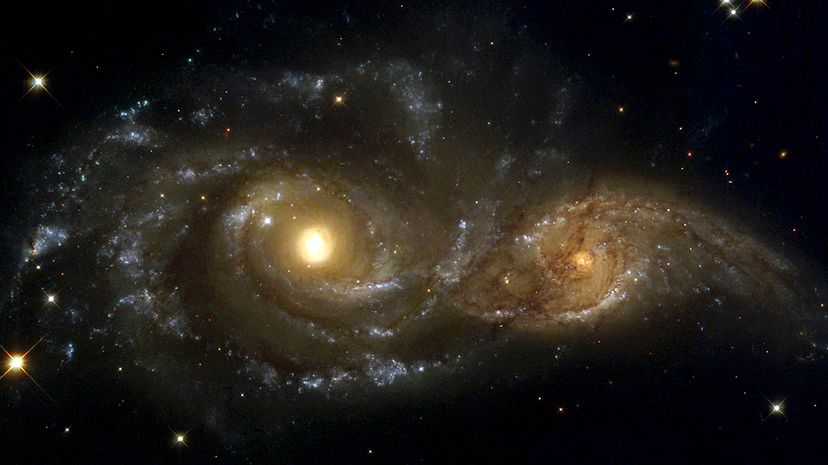
A near galactic-collision between NGC 2207 (left) and IC 2163 (right) spiral galaxies captured by the Hubble Space Telescope in 2007. Scientists predict the Milky Way will collide with our neighbor galaxy Andromeda in about 3 billion years from now. NASA and The Hubble Heritage Team
Scientists have observed some galactic mergers that are currently in progress. Maybe they'll look like nice, well-rounded ellipticals someday, but at the moment, these developing unions appear disorganized and distorted.
There are also a few documented examples of big spiral galaxies cannibalizing smaller ones that have gotten too close, with the victim getting slowly devoured bit by bit. Experts project that our very own Milky Way will eventually collide with the nearby Andromeda galaxy, a process that'll reconstitute these two spiral galaxies into one elliptical galaxy.
Advertisement
The process should begin about 3 billion years from now and finish in an additional 4 billion years from then. Obviously, it's not something any of us will live to see. But regardless, scientists have already come up with a name for this future elliptical galaxy: They call it "Milkomeda." Everyone loves a good portmanteau.
Spiral Galaxies
A spiral galaxy, like our own galaxy, has a central bulge and arms that spiral outward. Stars, gas and dust make up these arms and create a distinctive appearance resembling a pinwheel. Since spiral galaxies come in different sizes and forms, some have more tightly wound spiral arms and others have more loosely extended ones.
Most galaxies are spiral galaxies, and within this category, barred spiral galaxies are the most recurrent subtype. A barred spiral galaxy features a central bar-shaped structure composed of stars, gas and dust and extending out from the galactic nucleus. Scientists hypothesize that the bar signals that a galaxy is fully mature.
Advertisement
Elliptical Galaxies
An elliptical galaxy — which has a smooth, ellipsoidal or spherical shape — does not have well-defined features, such as arms or disks. Composed of older stars, they typically contain relatively little interstellar gas and dust. Researchers believe an elliptical galaxy could be a result of colliding galaxies.
Giant elliptical galaxies, a subtype of elliptical galaxy, are among the largest and brightest galaxies and are often at the center of a galaxy cluster — a collection of galaxies held together by their mutual gravitational attraction.
Advertisement
Lenticular Galaxies
A mix of spiral and elliptical galaxies, lenticular galaxies have a central bulge, older stars, and a flat, disk-like structure. They do not have well-defined spiral arms. Some theories posit that these galaxies do not have arms because they have since faded. Another theory says that lenticular galaxies formed from the merging of spiral galaxies.
Advertisement
Irregular Galaxies
As the name suggests, an irregular galaxy does not have a well-defined, symmetrical shape or structure. The shape could have resulted because of galaxies colliding or the gravitational pull of another galaxy. They do not have a specific pattern of stars, gas and dust. They can have a mix of old and young stars.
This article was updated in conjunction with AI technology, then fact-checked and edited by a HowStuffWorks editor.
Advertisement
Now That's Interesting
The word "galaxy" derives from the Greek word "gala," which means "milk" — as in "milky way." Ours has a luminous band of stars that's clearly visible in the night's sky. To ancient astronomers, this looked like a swath of spilled milk.
Cite This!
Please copy/paste the following text to properly cite this HowStuffWorks.com article: