
Brightness, Luminosity and Radius
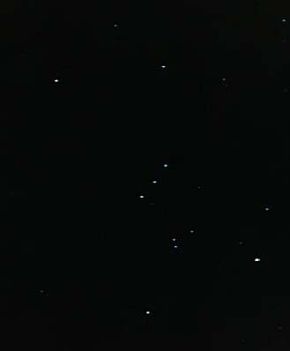
When you look at the night sky, you can see that some stars are brighter than others as shown in this image of Orion.
Two factors determine the brightness of a star:
Advertisement
- luminosity - how much energy it puts out in a given time
- distance - how far it is from us
A searchlight puts out more light than a penlight. That is, the searchlight is more luminous. If that searchlight is 5 miles (8 kilometers) away from you, however, it will not be as bright because light intensity decreases with distance squared. A searchlight 5 miles from you may look as bright as a penlight 6 inches (15 centimeters) away from you. The same is true for stars.
Astronomers (professional or amateur) can measure a star's brightness (the amount of light it puts out) by using a photometer or charge-coupled device (CCD) on the end of a telescope. If they know the star's brightness and the distance to the star, they can calculate the star's luminosity:
[luminosity = brightness x 12.57 x (distance)2].
Luminosity is also related to a star's size. The larger a star is, the more energy it puts out and the more luminous it is. You can see this on the charcoal grill, too. Three glowing red charcoal briquettes put out more energy than one glowing red charcoal briquette at the same temperature. Likewise, if two stars are the same temperature but different sizes, then the large star will be more luminous than the small one. See the sidebar for a formula to that shows how a star's luminosity is related to its size (radius) and its temperature.