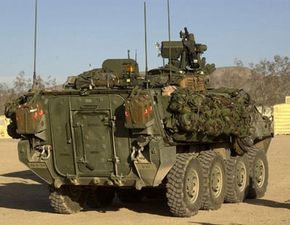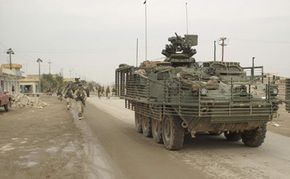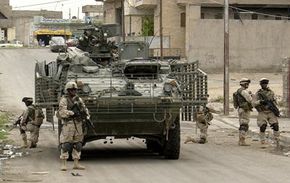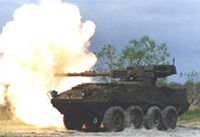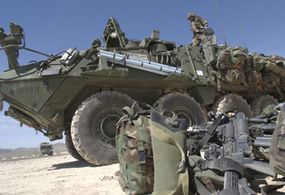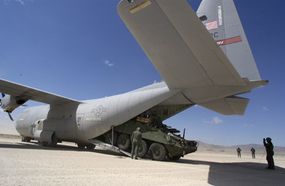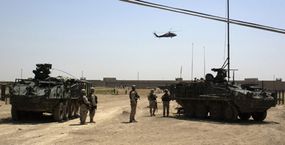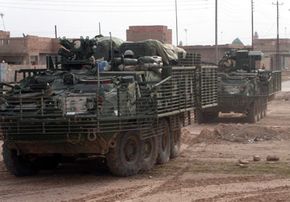
The 120-mm cannon of an M1 tank would be a useful weapon for the U.S. Army to have on just about any combat mission. Unfortunately, at a weight of around 60 tons, it takes a great deal of planning and coordination to get an M1 where it needs to go in the world. An M1 is too large to fit on the Air Force's C-130 transport planes, thus the Stryker vehicle.
What's more, a vehicle with more firepower and armor usually requires a more complicated support system. This means more specially trained soldiers to operate it, more technicians to maintain it, more parts, and more and larger shells. Thus, the most powerful equipment is often the hardest to move quickly to the battle zone. There are places the mighty M1 can't reach in time to be effective.
Advertisement
The Army's new Stryker project is an attempt to find a workable balance between power and mobility. It's a vehicle system that's built to be as deadly as a tank, as swift as a Humvee and yet mobile enough to be deployed anywhere in the world within 96 hours. In this article, HowStuffWorks explores the thinking behind the Stryker vehicle platform, how it's designed to function in combat and how it fits into the U.S. Army's plans for the future.
One Stryker, Many Strykers
The Stryker was developed by a consortium of companies led by General Dynamics Land Systems and General Motors Defense. From the ground up, it represents a complete redesign of an earlier General Dynamics project, the LAV or light-armored vehicle.
Rather than one vehicle, the Stryker project will produce a family of similar but specialized vehicles, all of which share parts, technologies and a basic structure. This array of vehicles will eventually cover all of the mission objectives the Army faces. The consortium is developing the following different Stryker configurations:
- ICV - Infantry Carrier Vehicle
- MGS - Mobile Gun System
- RV - Reconnaissance Vehicle
- MC - Mortar Carrier
- CV - Commander's Vehicle
- FSV - Fire Support Vehicle
- ESV - Engineer Squad Vehicle
- MEV - Medical Evacuation Vehicle
- ATGM - Anti-tank Guided Missile Vehicle
- NBCRV - NBC Reconnaissance Vehicle
Because the Stryker variants are so closely related, all of the vehicles can share repair parts including tires, armor and navigation systems. They require fewer specialized technicians and parts, so they require less space on a transport plane than comparable vehicles.
In theory, one type of Stryker could even be transformed into another in a relatively short period of time. This makes the Army far more adaptable and provides military planners with a full range of choices even late in the decision cycle. It ensures that the evolving needs of a particular battle can be met quickly and efficiently.
Advertisement